
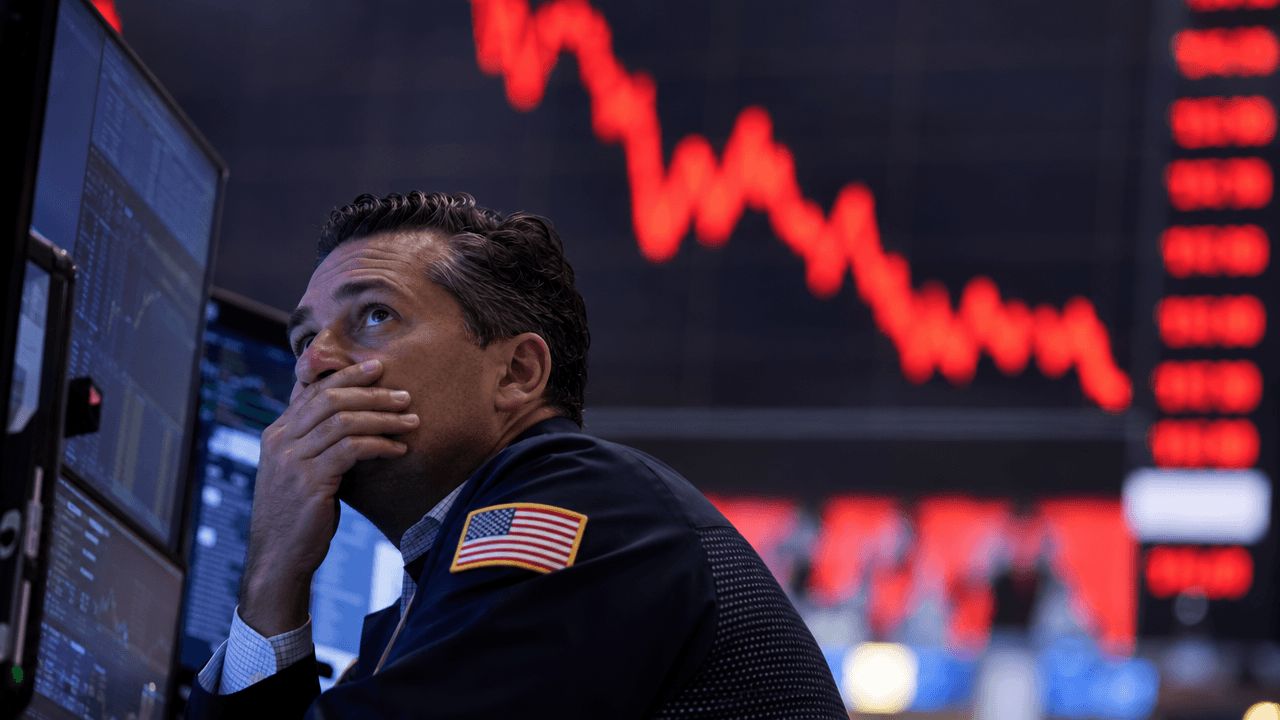
U.S. index futures weakened sharply as investors moved into risk-off mode, signaling another potentially volatile session for Wall Street. Dow futures fell roughly 840 points, Nasdaq 100 futures dropped about 150 points, and S&P 500 futures declined around 70 points in the reported session. [1] The move followed steep losses across the major averages and highlighted growing concerns about stretched valuations, interest rates, and the durability of the technology-led rally.
The futures decline is not simply a measure of overnight sentiment. It reflects a rapid repricing of risk, as traders reassess how much they are willing to pay for future earnings in an environment where borrowing costs remain important and market leadership has become increasingly concentrated in large technology companies.
What The Futures Move Signals
Stock index futures provide an indication of where markets may open, although they are not a guaranteed forecast. A sharp decline across the Dow, S&P 500, and Nasdaq 100 suggests that selling pressure is broad rather than limited to one sector.
The Dow’s 840-point decline is especially notable because the index contains many established industrial, financial, and consumer companies. At the same time, the Nasdaq 100’s drop shows that technology and growth stocks remain central to the risk-off move. The S&P 500 sits between these two exposures, combining large technology companies with a wide range of industries.
Recent cash-market losses reinforced the negative tone. The Dow had already fallen more than 800 points in the prior session, while the S&P 500 reached its lowest closing level since late July. [4] When futures weaken after a substantial decline, investors may be expressing concern that the original sell-off has further room to run rather than viewing it as a short-lived pullback.
Why Technology Stocks Are Under Pressure
Technology companies have benefited from strong enthusiasm surrounding artificial intelligence, cloud computing, semiconductors, and digital infrastructure. However, high expectations create a demanding investment environment. Companies must deliver exceptional revenue and earnings growth to justify elevated valuations.
Semiconductor stocks have been a major source of recent pressure as investors reduced exposure ahead of Nvidia’s closely watched earnings report. [4] Nvidia has become one of the market’s most important companies because its results influence expectations for the entire artificial intelligence supply chain.
The market’s reaction to technology earnings often depends less on whether a company beats estimates and more on whether its guidance is strong enough to support current prices. Investors may also focus on capital spending, order visibility, profit margins, and the pace at which AI investments generate measurable returns.
This creates a fragile setup. If earnings are strong but fail to exceed already-high expectations, traders may still sell. Conversely, a clear improvement in guidance could help stabilize technology shares and restore confidence in broader indexes.
Interest Rates And Valuation Risk
Interest rates are another major factor behind the risk-off tone. Higher bond yields can make future corporate profits less valuable in today’s dollars, which tends to affect growth companies most severely. Many technology businesses are valued on the expectation of earnings far into the future, making them especially sensitive to changes in rates.
Investors are therefore watching inflation data, employment reports, central-bank communication, and Treasury-market movements closely. Even when no new policy decision is announced, a shift in expectations about future rate cuts or increases can quickly alter equity valuations.
Valuation risk does not mean that every expensive company is destined to fall. It means that the margin for error is smaller. A disappointing forecast, slowing demand, or higher operating costs can have an outsized impact when a stock is priced for rapid growth.
For traders, the key lesson is that a strong long-term story does not eliminate short-term risk. Price, expectations, and market positioning still matter.
How Traders Can Respond
The first priority during a sharp futures decline is risk management. Traders should avoid treating a dramatic move as an automatic buying opportunity. Instead, they can assess whether selling is occurring on expanding volume, whether key support levels are holding, and whether market breadth is improving or deteriorating.
It is also useful to distinguish between index risk and individual-stock risk. A trader may have a bullish view on technology over several years while still reducing short-term exposure when volatility increases. Position sizing, stop-loss planning, and defined-risk strategies can help prevent one session from causing disproportionate damage.
Simulated trading provides a practical way to test these decisions without risking capital. Traders can compare how a momentum strategy, a mean-reversion approach, or a defensive allocation performs during a fast sell-off. They can also practice waiting for confirmation instead of entering immediately after a large price decline.
A simple checklist can improve decision-making:
1. Identify whether the decline is broad or concentrated. 2. Review upcoming earnings, economic data, and central-bank events. 3. Measure exposure to highly correlated technology positions. 4. Define the maximum acceptable loss before entering a trade. 5. Wait for price action to confirm whether support is holding.
The Bigger Market Lesson
Sharp weakness in U.S. index futures shows how quickly sentiment can change when valuations are elevated and expectations are crowded. The immediate focus will remain on corporate earnings, technology guidance, interest-rate expectations, and whether buyers return after the initial pressure.
A risk-off session does not automatically signal the beginning of a prolonged bear market. It does, however, remind traders that markets move in both directions and that popular themes can experience abrupt repricing. The most durable response is not to predict every move, but to build a process that accounts for uncertainty.
For SimFi traders, this environment is an opportunity to study discipline under pressure. Managing exposure, respecting volatility, and separating a company’s long-term potential from its current price can turn a difficult market session into a valuable lesson in risk-aware trading.