
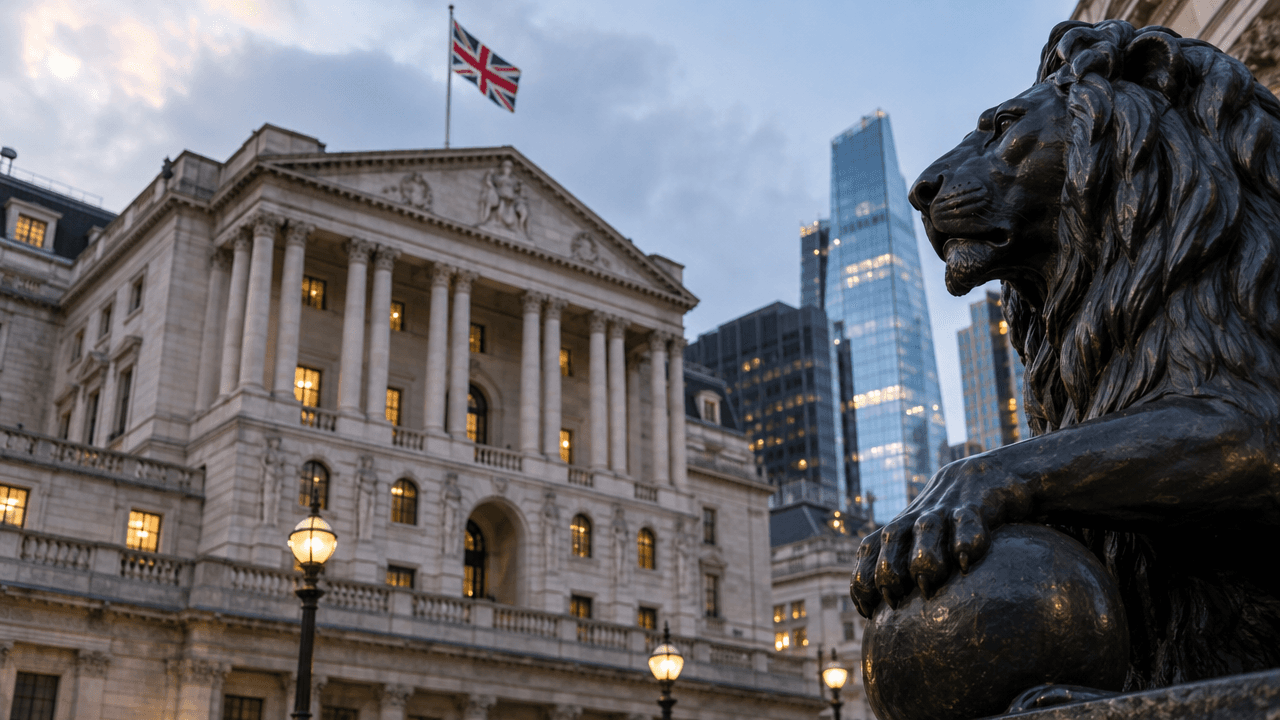
The Bank of England’s decision to hold Bank Rate at 3.75% keeps the UK firmly in a “higher for longer” regime, as policymakers balance still‑elevated inflation against increasingly fragile growth.[3][8][10][12] The move was widely anticipated by markets, but the nuances around inflation risks, quantitative tightening, and the Committee’s vote split are driving shifts in GBP pairs and gilt yields.[6][7][14] For traders, the message is less about surprise and more about how to position around a prolonged plateau in rates and a two‑sided macro risk profile.[10][12]
POLICY DECISION: HOLDING AT 3.75%
By leaving Bank Rate unchanged at 3.75%, the Bank of England confirms that its primary strategy is to maintain restrictive policy until inflation is decisively back at target.[3][4][12] Recent meetings have seen a 6–3 vote split, with a minority still arguing for a 25‑basis‑point hike to 4%, underscoring that hawkish voices remain active even as the majority favours patience.[6][15] Economist surveys had unanimously expected a hold at this meeting and, in many cases, project no changes for the rest of 2026, reinforcing market confidence in a steady rate path.[8][11][12] For traders, a known policy rate reduces event risk around meetings but increases the importance of tracking forward guidance, vote splits, and any signalling around future QT and balance sheet plans.[7][15]
Inflation Risks Remain Elevated
Headline UK inflation has eased from its post‑pandemic peaks, but it remains above the Bank’s 2% target and is expected to re‑accelerate modestly into late 2026.[5][10][12] CPI rose to around 2.9% in July, and several forecasts see headline inflation ending the year near 3.1%, with core inflation still around 2.6%.[5][12] Higher wholesale energy prices, particularly natural gas, are a key driver of upside risk, with UK households especially sensitive to energy bills and the lingering impact of past price shocks.[10][12] Longer‑term inflation expectations remain elevated, reflecting the fact that inflation has not sustainably returned to 2% since the 2022 war‑related shock, which keeps the Bank cautious about declaring victory too soon.[10][12] For markets, this inflation backdrop justifies the current restrictive stance and sustains the premium in UK yields versus economies perceived to be closer to completing their disinflation process.[7][10][12]
Growth Headwinds And Market Sentiment
While inflation remains above target, the growth outlook has softened, complicating the policy trade‑off.[5][10] The Bank’s central forecast points to a moderation in headline GDP growth through year‑end, with renewed headwinds from higher energy costs, global conflict, and weaker external demand.[5][10] Analysts highlight a weakening labour market and sluggish domestic demand, suggesting that the real economy is feeling the weight of past rate hikes and tighter financial conditions.[10][12] KPMG and other institutions expect the Bank to stay cautious, delaying further rate cuts until 2027 as it weighs the risk of reigniting inflation against the drag on activity and employment.[10][12] This “slow and steady” stance tends to dampen risk appetite in UK and European assets on the margin, as investors reassess earnings, credit spreads, and equity valuations under a longer‑lasting restrictive regime.[7][10][12]
GBP/USD AND FX MARKET REACTION
In FX markets, GBP/USD has been trading around key technical levels, with price action tightly linked to interest rate expectations and US dollar dynamics.[6][13][14] After earlier support near 1.3390, the pair has struggled to decisively break above the 1.3400 area, while downside focus has coalesced around 1.3350 and, further below, 1.3300.[6][13] Prior episodes following BoE holds saw GBP/USD slide toward two‑month lows, with a break below 1.3200 exposing the psychological 1.3000 handle as a deeper bearish target.[14] Gilt yields and the UK curve are feeding into this FX picture: stable policy rates but lingering inflation risk keep real yields relatively elevated, offering some support to sterling while capping upside as growth concerns build.[7][10][12] For traders, this creates a tactical environment where range‑trading strategies, carry considerations, and data‑driven breakouts around inflation prints and labour‑market releases can be more effective than simply betting on a one‑way trend.[6][13][14]
Implications For Simulated Trading Strategies
For SimFi traders on platforms like E8 Markets, a steady Bank Rate at 3.75% offers a clear macro anchor to build scenarios around, even as inflation and growth data inject volatility. With policy likely on hold through at least mid‑2027 in many forecasts, rate‑sensitive instruments such as gilts, GBP crosses, and UK equity indices become fertile ground for mean‑reversion and relative‑value strategies rather than purely directional rate bets.[8][10][12] One practical approach is to construct simulated portfolios that contrast UK assets with those from economies at different points in the cycle—such as regions closer to cutting or, conversely, still hiking—to test how cross‑market spreads respond to evolving inflation narratives.[10][12] Another is to incorporate macro triggers into risk management rules, for example adjusting position size or leverage in response to key data releases like CPI, wage growth, or energy‑price shocks, which have proven to be pivotal for the BoE’s reaction function.[5][10][12] Because simulated environments remove capital constraints, traders can also experiment with hedging structures—pairing GBP/USD positions with gilt futures or UK equity exposures—to understand how policy stability but macro uncertainty affects multi‑asset correlation and drawdown risk.
Key Takeaways For Traders
First, the BoE’s hold at 3.75% reinforces a higher‑for‑longer rate environment, so strategy design should assume that policy will stay restrictive rather than pivot quickly to cuts.[3][8][10][12] Second, inflation remains the dominant risk: forecasts near 3% with upside skew from energy mean that any surprises in price data can reprice the curve and GBP swiftly.[5][10][12] Third, growth is slowing but not collapsing, creating a subtle mix where the Bank can justify patience; this increases the importance of tracking labour‑market trends and corporate earnings to anticipate when growth concerns might finally force a shift.[5][10] Finally, FX and rates markets are more likely to deliver tradable ranges, technical breaks, and spread opportunities than dramatic policy‑driven repricings, making disciplined scenario planning and risk controls essential in both live and simulated environments.[6][13][14]
Conclusion
The Bank of England’s decision to hold rates at 3.75% encapsulates the current macro tension: inflation is still too high to relax, but growth is too fragile to tighten further.[3][5][10][12] For markets, this is not a shock but a confirmation that the UK is settling into an extended period of restrictive policy, with QT calibrated carefully and rate cuts pushed further into the future.[7][10][12] For traders, especially in simulation, the opportunity lies in treating this stability in the policy rate as a framework rather than a forecast: build playbooks for both upside and downside inflation surprises, test reactions across FX, rates, and equities, and refine risk management before the next inflection point arrives.[6][10][12] In a higher‑for‑longer world, those who understand how central bank caution flows through to prices, volatility, and correlations will be best placed to turn macro uncertainty into structured, repeatable trading strategies.