
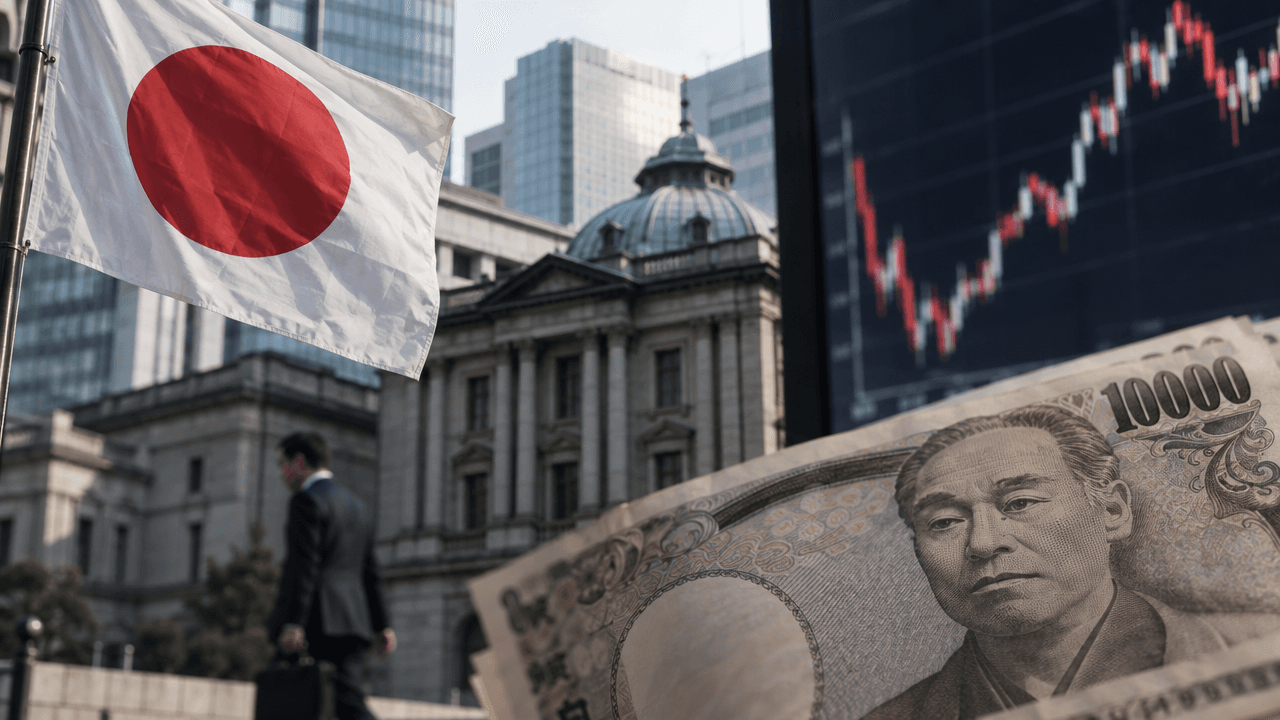
Wage growth in Japan has finally moved from aspiration to reality, and that shift is keeping the Bank of Japan squarely in the market’s spotlight.[8][9][11][13][14] Yet even as the data strengthens the case for further tightening, traders are dialing back expectations for an immediate rate move, leaving USD/JPY hovering near multi-decade highs and volatility elevated around BOJ meetings.[3][6][10] For market participants—and SimFi traders—this mix of improving fundamentals and uncertain timing is exactly what fuels opportunity.
Wage Momentum Underpins The Hawkish Argument
Japan’s real wages rose 1.5% year over year in August, marking the eighth consecutive month of gains and signaling that pay is now growing faster than inflation.[8][9][13][14] While this was slower than July’s revised 2% increase, the trend shows that households are steadily recovering purchasing power after years of stagnation.[8][9][11][14] Nominal wage growth has been running close to 4%, with base pay staying firm and overtime picking up, adding further support to the income backdrop.[2][7][15]
This wage performance is precisely what BOJ officials have been waiting for to validate a shift away from ultra-loose policy.[5][15] With wage growth above 3% for several months and real pay now rising, the central bank can argue that its goal of sustained 2% underlying inflation anchored by stronger incomes is coming into view.[11][15] In other words, the data supports a hawkish debate not because growth is spectacular, but because it is finally consistent.
Boj Policy: Tightening Cycle, Uncertain Pace
The BOJ has already started to normalize rates, lifting its policy rate to around 1.25% in September after years near zero.[2][5][7][12] Tokyo core inflation accelerated in September at its fastest pace in about ten months, reinforcing the case that price pressures are durable enough to justify further hikes.[2][7][11] Taken together, rising real wages and firmer inflation give policymakers more headroom to tighten without choking off demand.[8][11][13]
Still, the key question for markets is not whether the BOJ will hike again, but when and how quickly.[3][6] Overnight index swaps currently price only about a 12% probability of an October rate increase, down sharply from roughly 40% early last week.[1][3][6][10] When the December meeting is added, implied odds of a hike surge to around 90%, suggesting traders view back-to-back moves this year as likely, just not imminent.[3][6][10]
Governor Kazuo Ueda has reinforced the idea of a gradual path, stressing that the BOJ will evaluate the likelihood and risks around its baseline economic and price outlook before deciding on further rate rises.[3][5][6] Some analysts interpret the recent decisions and guidance as a pattern of moves spaced roughly every three months, pointing toward December rather than October for the next step.[12] That measured approach keeps the hawkish narrative alive while tempering near-term market expectations.
YEN, USD/JPY, AND VOLATILITY IN A “WAIT-AND-SEE” MARKET
Cooling expectations for a near-term BOJ hike have weighed on the yen, with USD/JPY trading near 158.35 in early Asian dealing.[3][6][10] As traders shifted their anticipated rate move from October to December, the currency lost some of the support it had gained from earlier hawkish speculation.[1][3][6][10] The result is a pair that remains elevated, reflecting both Japan’s still-low real rates and the strength of the U.S. dollar backdrop.
This tug-of-war shows up in volatility around BOJ-related headlines. When odds for an imminent hike spike toward 40%, the yen tends to firm, and short yen carry trades look more vulnerable.[1][3][6] As probabilities retreat back near 10–15%, those same trades often regain favor, and USD/JPY stabilizes or grinds higher.[3][6][10] For traders, the key is less about the exact level and more about how quickly expectations shift as new wage and inflation data arrive.
From a macro perspective, the current configuration—solid wage gains, rising inflation, but cautious tightening—creates a classic “late-cycle normalization” environment.[8][11][15] Currency and rate markets can remain range-bound for stretches, punctuated by sharp moves when the market’s timing assumptions are challenged by data or BOJ communication.
What Simulated Traders Should Watch
For SimFi participants, the BOJ story is a rich test bed for building and stress-testing trading strategies in a controlled environment. The first focus should be on the link between wage releases and rate expectations: a stronger-than-expected wage print that pushes real gains higher will usually lift implied odds of earlier hikes, even if the headline rate move remains months away.[8][9][11] Conversely, any sign that real wage momentum is fading could cool the hawkish narrative and support carry trades that lean against the yen.[13][14]
Second, monitor implied probabilities around each BOJ meeting, particularly when they swing sharply from one week to the next.[1][3][6][10] In a simulated setting, traders can model scenarios where markets overshoot in pricing a rapid sequence of hikes, then mean-revert as communication clarifies a slower path. That exercise helps develop discipline around trading expectations rather than the central bank’s long-term trajectory.
Third, pay close attention to USD/JPY behavior around key data days and BOJ speeches. When markets lean heavily toward a specific outcome—like an October hike—the risk-reward often favors contrarian positions if the probability is not fully justified by underlying data.[3][6][10] SimFi platforms allow traders to test how different positioning, stop placements, and time horizons perform when the BOJ surprises or underwhelms relative to those odds.
Finally, integrate cross-asset signals. Equity sectors sensitive to domestic demand and bank margins, as well as Japan government bond yields, will respond differently to wage-driven hawkishness than the currency alone.[5][7][11] Practicing multi-asset analysis in simulation improves readiness for real-world environments where central bank shifts ripple through credit spreads, equities, and FX at different speeds.
Conclusion
Japan’s wage recovery has turned what used to be a one-way story of ultra-easy policy into a genuinely two-sided debate about the pace and extent of BOJ tightening.[8][9][11][13][14] Real wages are rising, inflation is firming, and the policy rate has already moved off the floor, all of which support a continued hawkish bias.[2][5][7][11][12] Yet markets have clearly pulled back from pricing an immediate rate hike, favoring a slower, data-dependent path that concentrates expectations on December.[1][3][6][10]
For traders, this combination of improving fundamentals and volatile expectations is fertile ground. It rewards those who track wage and inflation trends closely, understand how they translate into rate probabilities, and position for shifts in narrative rather than chasing every headline. In a SimFi environment, the BOJ story is not just news; it is a live laboratory for learning how central bank cycles, labor market dynamics, and currency volatility intersect—and how to trade that intersection with discipline and insight.