
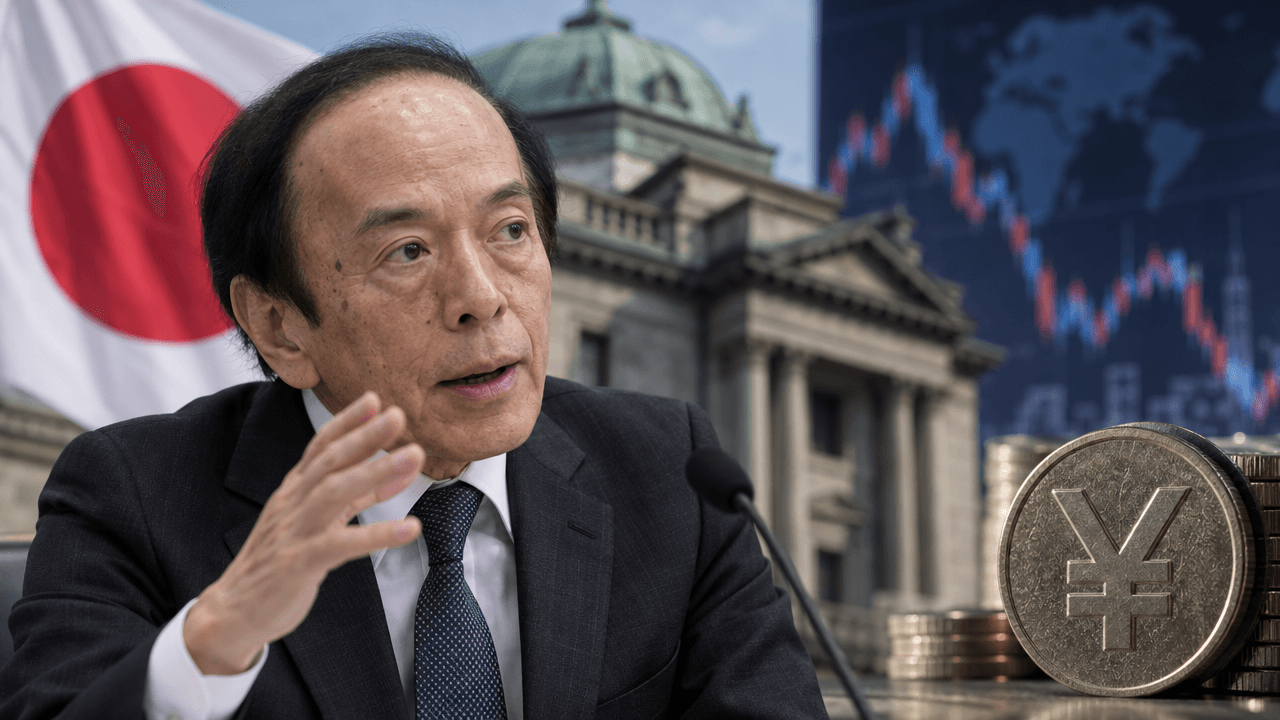
Japan’s central bank is sending a clear message to financial markets: the era of ultra-low interest rates is not over, but it is moving steadily further into the past. Bank of Japan Governor Kazuo Ueda said the BOJ will continue raising interest rates as underlying inflation approaches the bank’s 2% target, reinforcing expectations that additional policy tightening could arrive in the months ahead. [1]
The comments immediately strengthened the yen-rate outlook and injected fresh volatility into global foreign-exchange markets. For traders, the key question is no longer whether the BOJ can eventually normalize monetary policy. It is how quickly it will do so, and how markets will react when Japan’s interest-rate cycle begins to look more similar to those of other major economies.
WHAT GOVERNOR UEDA’S MESSAGE MEANS
Ueda’s remarks were significant because they linked future rate increases directly to the progress of underlying inflation. The BOJ has spent years trying to create a durable cycle of rising wages, stronger household demand, and stable price growth. Inflation approaching 2% gives policymakers more room to reduce monetary accommodation without immediately threatening economic stability.
Ueda said underlying inflation is now quite close to the central bank’s target and emphasized that the BOJ would not tolerate inflation accelerating too far beyond it. He also indicated that the issue would be considered at the bank’s next policy meeting. [1]
This does not guarantee an immediate rate increase. Instead, it confirms that the BOJ views further hikes as part of its policy direction. The timing will depend on incoming data, including wages, consumer spending, inflation expectations, currency movements, and financial conditions.
The distinction between direction and timing is important. Markets can price a tightening cycle even when the next meeting produces no change. That is why a central bank can support its currency and influence bond yields simply by communicating that rates are likely to rise later.
Why Inflation Is Central To The Outlook
Japan’s recent inflation story differs from the short-lived price shocks that affected many economies after the pandemic. The BOJ is looking for evidence that price increases are becoming embedded in domestic economic behavior rather than being driven only by imported energy, food, or currency costs.
Underlying inflation is therefore closely watched because it attempts to separate persistent price pressure from temporary factors. The BOJ’s own analysis has suggested that underlying consumer-price inflation could become broadly consistent with the 2% target between the second half of fiscal 2026 and fiscal 2027. [13]
Wage growth is another essential piece of the puzzle. If companies continue raising wages and consumers spend more, businesses may gain the confidence to pass higher labor costs through to prices. That process could create a more sustainable inflation cycle and make additional rate hikes easier to justify.
However, the BOJ must avoid tightening too aggressively. Japan’s economy remains sensitive to higher borrowing costs, especially in the housing, corporate, and government sectors. Policymakers will need to determine whether inflation is supported by healthy domestic demand or is instead being pushed higher by temporary supply pressures.
The Yen And Foreign-exchange Markets
The yen has been highly sensitive to changes in the interest-rate gap between Japan and other major economies. For years, Japan’s low rates encouraged investors to borrow yen and purchase higher-yielding assets elsewhere, a strategy commonly associated with the carry trade.
When expectations for BOJ rate increases rise, that trade becomes less attractive. Higher Japanese yields can encourage investors to keep more capital in yen-denominated assets, while traders who borrowed yen may begin reducing those positions. Both forces can support the currency.
The response is not always straightforward. Exchange rates also reflect expectations for U.S. and European interest rates, global risk appetite, energy prices, and political developments. A hawkish BOJ message may strengthen the yen, but the move can be limited if overseas yields remain high or investors continue favoring riskier assets.
Still, the policy signal adds an important potential source of yen support. Recent market expectations have pointed to a relatively low probability of an October hike but a much higher likelihood of another increase by December. [7] That gap illustrates how traders are separating the immediate decision from the broader tightening trend.
What Traders Should Watch Next
The next major focus will be the BOJ’s policy meeting and its quarterly economic outlook. Investors will look for any formal change in the bank’s assessment of underlying inflation, wage trends, and the economy’s ability to withstand higher rates.
Japanese wage data and household spending will also be important. Strong wage gains combined with resilient consumption would make a future rate increase more credible. By contrast, weak domestic demand could encourage the BOJ to move gradually, even if inflation remains close to target.
Currency traders should also monitor USD/JPY around key support and resistance levels rather than assuming that every hawkish headline will produce a sustained yen rally. Market positioning can create sharp reversals, particularly when many investors already expect tighter policy.
For SimFi traders, this is an opportunity to practice scenario-based analysis. One scenario involves a delayed hike but increasingly hawkish guidance, which could produce gradual yen appreciation. Another involves stronger inflation and wages, leading markets to price a faster tightening cycle. A third involves disappointing growth, pushing traders to unwind rate-hike expectations.
The Bigger Market Lesson
The BOJ’s message marks an important shift in the global monetary-policy landscape. Japan is no longer simply the low-rate exception that investors can ignore. Its policy decisions can affect bond markets, carry trades, equity valuations, and currency volatility worldwide.
The most practical takeaway is that forward guidance matters as much as the rate decision itself. Ueda’s comments suggest that further increases remain firmly on the table, but the path will be data-dependent. Traders who monitor inflation quality, wages, consumption, and market positioning will be better prepared than those who focus only on the headline policy rate.
Japan’s normalization process is likely to remain gradual, uneven, and highly consequential. As underlying inflation approaches the BOJ’s target, every new data release may influence expectations about the next move—and create fresh opportunities and risks across global markets.