
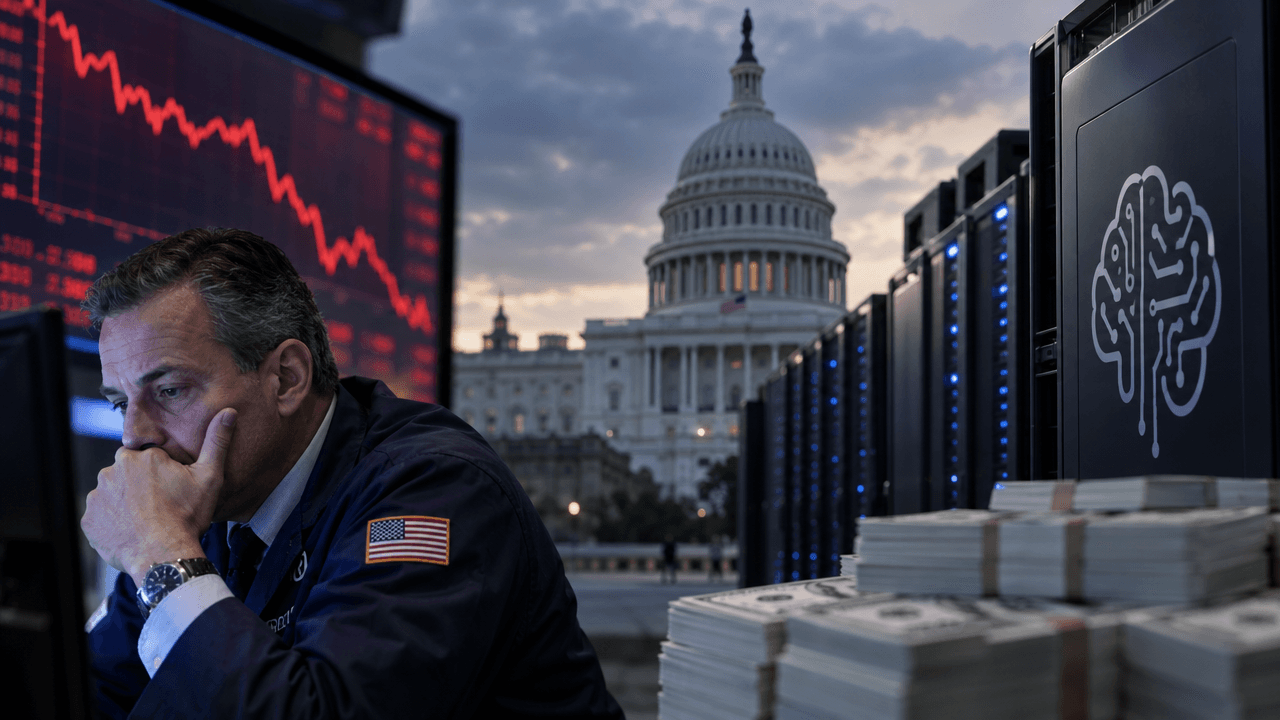
Wall Street’s post-election relief rally has reversed into a severe sell-off, exposing how quickly political developments can reshape expectations for corporate investment, regulation, and economic growth. On Thursday, November 5, the Dow Jones Industrial Average fell 1,833 points, or 3.4%, while the S&P 500 dropped 4.4%. The Nasdaq Composite suffered the sharpest decline, tumbling 5.5% and entering correction territory after falling more than 10% from its October peak. [8][9]
The immediate trigger was a sweeping Democratic victory in the U.S. midterm elections and the resulting prospect of tighter oversight of artificial intelligence, data centers, energy consumption, and technology incentives. Investors were not simply reacting to a change in political control. They were reassessing whether the enormous spending plans supporting the AI boom can continue at the same pace.
What Drove The Sell-off
The market’s first reaction to the election results was comparatively positive. Investors initially interpreted the outcome as a possible source of political clarity. That optimism faded as attention turned to the implications for AI infrastructure.
Data centers require substantial electricity, water, land, and grid capacity. Their construction has already generated opposition in several communities, particularly where residents are concerned about utility costs, environmental effects, and pressure on local infrastructure. A new political balance in Washington could strengthen calls for permitting restrictions, additional reporting requirements, utility-rate changes, or temporary moratoriums.
For technology companies, the concern is that these measures could delay construction and raise the cost of expanding computing capacity. AI businesses and cloud providers have committed billions of dollars to new facilities, chips, power contracts, and networking equipment. If projects are postponed, the impact could spread across semiconductor manufacturers, data-center operators, power suppliers, construction firms, and other companies tied to the AI investment cycle.
Reports indicated that the Nasdaq lost about 1,422 points on Thursday, closing at 24,315. The S&P 500 fell roughly 335 points to 7,354, while the Dow finished at 51,523. [8][9]
Why Ai Stocks Were Hit Hardest
The sell-off was especially intense in technology and semiconductor shares because their valuations depend heavily on expectations of future growth. Investors have been willing to pay high prices for companies positioned to benefit from AI adoption. Those valuations require continued revenue growth, aggressive capital spending, and confidence that demand for computing power will remain strong.
The election did not prove that AI demand has disappeared. Instead, it raised doubts about the speed and profitability of the infrastructure buildout. If data-center approvals become slower or more expensive, companies may reduce capital expenditure, delay orders, or redirect projects to friendlier jurisdictions.
That distinction matters. A slowdown in construction would not necessarily mean a collapse in AI usage. Businesses may continue adopting AI tools even if the physical infrastructure supporting them is built more gradually. Some analysts have argued that spending will continue but shift toward states and municipalities with more favorable policies. [5]
However, markets price expectations rather than current conditions. When investors believe that future spending will be lower than previously assumed, high-growth stocks can decline sharply even if their underlying businesses remain profitable.
A Broader Market Warning
The magnitude of the decline suggests that the election shock collided with concerns that were already present. Investors had been questioning whether hyperscalers and AI companies could justify the scale of their planned capital expenditures. They were also watching financing costs, energy availability, project delays, and signs that the industry’s spending boom might be approaching a more mature phase.
The Nasdaq-100 had already entered correction territory as concerns about the pace of data-center investment increased. The election therefore acted as a catalyst rather than an isolated cause. It connected existing valuation and spending concerns to a concrete political risk.
For the broader market, the episode is a reminder that concentration can amplify volatility. A relatively small group of mega-cap technology companies has played an outsized role in driving major indexes higher. When those shares fall together, index declines can become much larger than the weakness in the average listed company.
Investors should also distinguish between a market correction and a change in long-term economic direction. A one-day decline of this size is alarming, but it does not by itself establish a bear market. The next stage will depend on earnings, corporate guidance, interest rates, regulation, and whether companies maintain or reduce their infrastructure budgets.
What Traders Should Watch Next
The most important evidence will come from corporate capital-spending announcements. Investors should monitor whether major cloud providers revise data-center plans, reduce projected spending, or report delays in securing power and permits.
Policy details will matter just as much as election headlines. A proposal for stricter standards is different from an enforceable nationwide moratorium. Markets will be particularly sensitive to legislation affecting tax incentives, permitting timelines, energy access, and antitrust enforcement.
Traders should also watch market breadth and sector rotation. If capital moves from speculative AI infrastructure shares into profitable companies, defensive sectors, or clean-energy businesses, that could indicate repositioning rather than indiscriminate panic. If selling spreads across banks, industrials, consumer companies, and small-cap stocks, it would suggest broader concerns about economic growth and financial conditions.
Practical risk management is essential during politically driven volatility. Traders can reduce oversized positions, define stop-loss levels before entering a trade, avoid using excessive leverage, and separate short-term price action from long-term investment assumptions. Simulated trading environments can also help traders test these decisions without risking real capital.
The Bigger Lesson
The Wall Street sell-off demonstrates that political events can rapidly change the assumptions embedded in asset prices. AI remains a powerful technological and economic theme, but its expansion depends on physical infrastructure, public acceptance, energy policy, financing, and regulation.
The election shock does not settle whether the AI boom is ending. It does show that investors are no longer treating endless infrastructure spending as guaranteed. Companies will need to prove that their investments can generate durable returns, while policymakers will have to balance innovation with local costs and resource constraints.
For traders, the central lesson is straightforward: follow the cash flows behind the headline. Election results may trigger the move, but capital spending, earnings, regulation, and demand will determine whether the sell-off becomes a temporary correction or the beginning of a deeper repricing.