
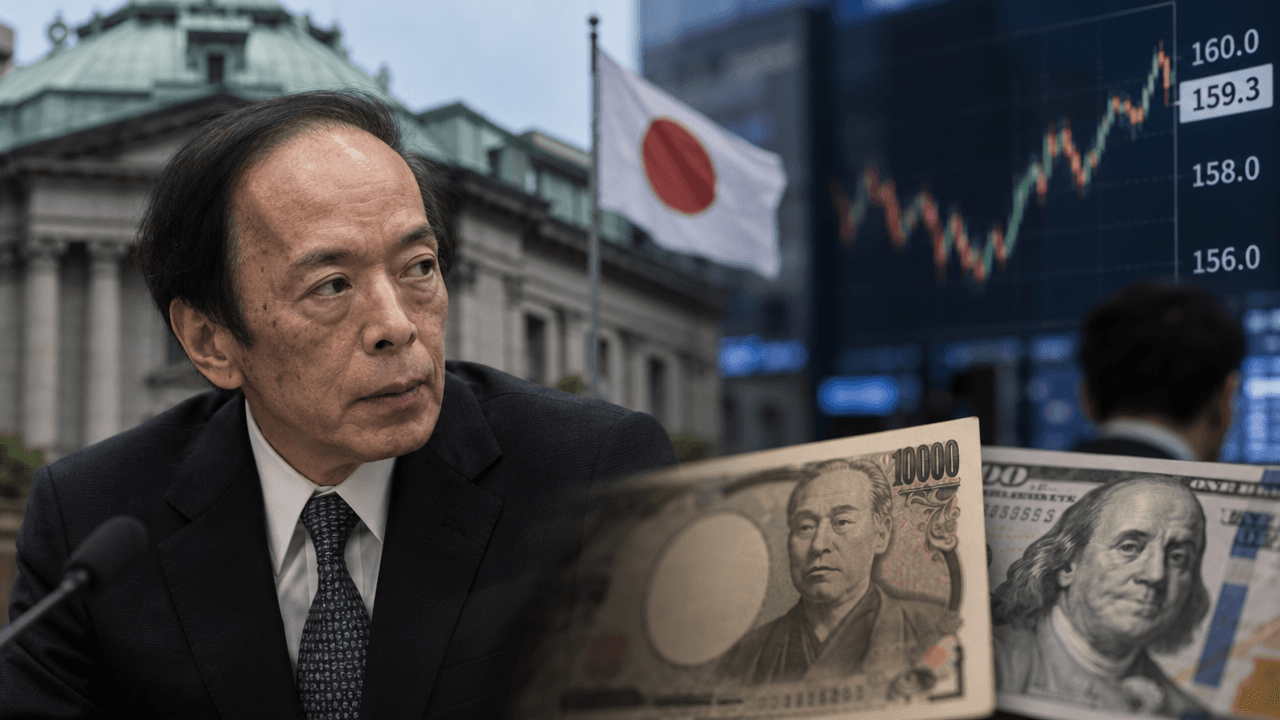
The Bank of Japan is sending a clear message: its long era of ultra-loose monetary policy is not necessarily over. Governor Kazuo Ueda reiterated that further interest-rate increases may be appropriate if economic and price conditions continue to develop as expected. Yet the yen has remained vulnerable, trading near 159.3 per dollar and close to the psychologically important 160 level. [1]
The contrast highlights a central challenge for Japanese policymakers. A more hawkish Bank of Japan can support the yen, but its influence may be overwhelmed by the stronger dollar, higher U.S. yields, and uncertainty surrounding the timing of the next rate increase. For currency traders, the result is a market shaped by two competing forces: expectations of policy tightening and rising intervention risk.
Boj Signals That Tightening Is Still On The Table
Ueda’s latest comments reinforce the view that the Bank of Japan is gradually moving toward higher interest rates. He emphasized that the central bank should continue adjusting its policy rate in response to developments in the economy, prices, and financial conditions. He also stressed the importance of keeping inflation anchored near the BOJ’s 2% target. [2]
This language matters because the Bank of Japan has historically been cautious about removing monetary support. Japan spent years dealing with weak inflation, slow growth, and deflationary pressures. More recently, however, inflation and wage developments have given policymakers greater confidence that the economy may be able to tolerate less accommodative policy.
Ueda did not provide a firm timetable for the next increase. That leaves a December rate hike as a possibility rather than a certainty. Markets will therefore focus on incoming inflation data, wage negotiations, household spending, economic growth, and the tone of upcoming BOJ communications.
Why The Yen Has Not Recovered
Normally, expectations of higher domestic interest rates would be positive for a currency. Higher rates can make yen-denominated assets more attractive and reduce the incentive for investors to borrow yen to purchase higher-yielding assets elsewhere.
The current environment is more complicated. The dollar remains supported by expectations that U.S. interest rates could stay elevated, while U.S. economic data and Federal Reserve commentary have reinforced the appeal of dollar assets. That interest-rate gap continues to work against the yen.
As a result, the yen has held around 159.3 per dollar despite Ueda’s tightening signal. The currency has recently moved only modestly as traders balance the potential benefit of a BOJ rate hike against the continuing strength of the U.S. dollar. [4]
This is an important lesson for traders: a central bank can sound hawkish without immediately generating a sustained currency rally. Markets respond not only to the direction of policy but also to the size, timing, and credibility of expected changes relative to other major economies.
Intervention Risk Changes The Trading Landscape
The yen’s proximity to 160 per dollar has placed Japanese currency intervention back in focus. Officials have repeatedly warned that excessive or disorderly moves could prompt action, and recent market commentary has identified a rapid or sustained break above 160 as a particularly important risk threshold. [6]
Intervention could involve Japan’s Ministry of Finance selling foreign currency reserves and buying yen. Such action can produce a sudden and sharp move in USD/JPY, especially if traders are holding large short-yen positions. It can also trigger wider volatility across other yen crosses, including euro-yen and pound-yen.
However, intervention risk does not guarantee a lasting yen recovery. If the underlying interest-rate gap remains wide, official purchases may slow the yen’s decline without reversing its broader trend. Traders should distinguish between a temporary intervention-driven move and a durable improvement in Japan’s monetary fundamentals.
For SimFi traders, this creates a market-management challenge. A position that appears technically attractive near 160 could be exposed to an abrupt gap or fast reversal. Position sizing, stop placement, and awareness of trading-session liquidity become especially important when official action is possible.
What Traders Should Watch Next
The first priority is the language used by BOJ officials. A clear signal that policymakers are preparing to raise rates soon could support the yen, particularly if it is accompanied by stronger inflation or wage data. Conversely, cautious remarks about weak growth could push markets to delay expectations for tightening.
The second priority is the U.S.-Japan yield differential. If U.S. yields rise while Japanese yields remain relatively stable, USD/JPY may continue to face upward pressure even when the BOJ discusses future rate increases. A decline in U.S. yields could provide the yen with more meaningful support.
The third factor is price behavior around 159 and 160. USD/JPY has recently struggled to establish a sustained move below the 159 area, while the 160 level remains closely watched. A decisive move through either boundary, supported by volume and fundamental news, could signal a shift in short-term momentum. [3]
Traders should also monitor official comments from Japan’s finance authorities, not just the BOJ. Intervention decisions are typically led by the Ministry of Finance, meaning the most important warning may come from a government currency official rather than a central bank policymaker.
A Market Driven By Policy And Politics
The Bank of Japan’s message is gradually becoming more constructive for the yen, but policy tightening alone may not be enough to overcome the dollar’s strength. Until the rate gap narrows or U.S. demand for dollars weakens, the yen may remain under pressure.
At the same time, trading near 160 means the market cannot ignore the possibility of official action. The combination of a vulnerable currency, hawkish BOJ guidance, and intervention threats is likely to keep USD/JPY volatile.
The practical takeaway is simple: traders should avoid treating Ueda’s comments as an automatic buy signal for the yen or viewing 160 as an ordinary technical level. The next major move will depend on the interaction between BOJ expectations, U.S. interest rates, Japanese economic data, and government intervention. In this environment, disciplined risk management may matter as much as the direction of the forecast.