
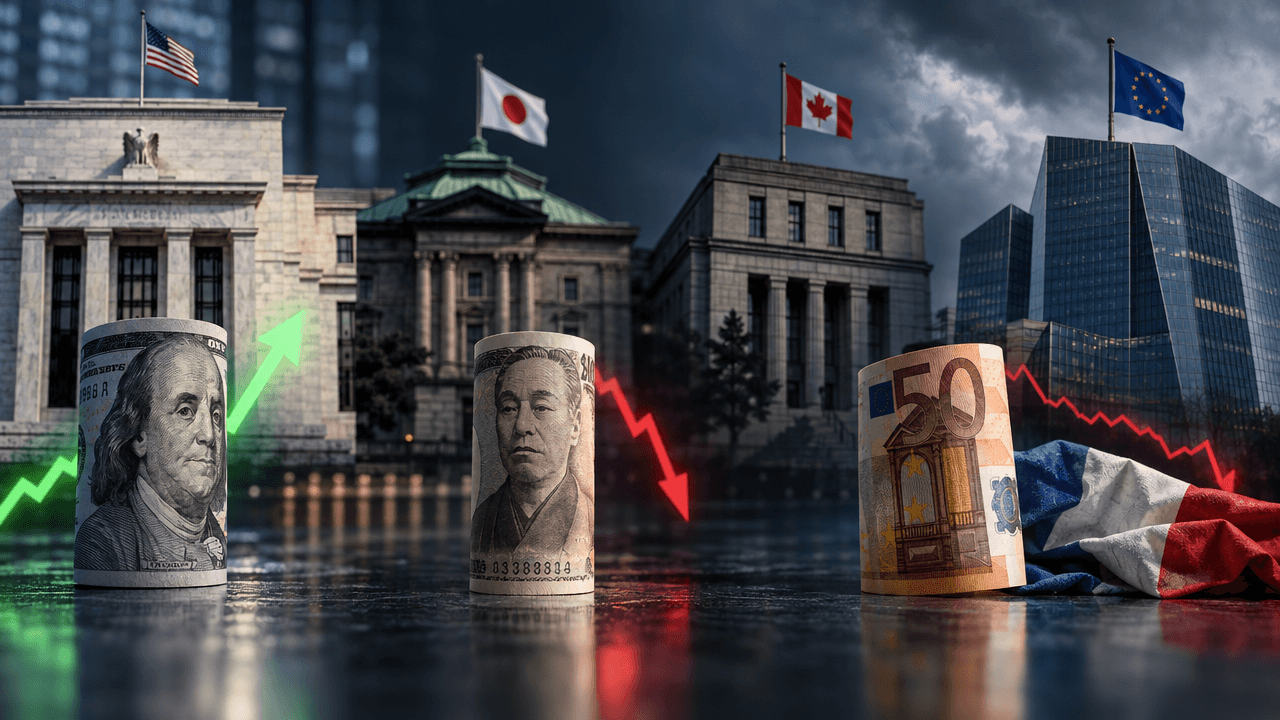
Currency markets are entering a high-stakes week in which central-bank decisions, rather than traditional economic data, are likely to determine the next major move. Traders are positioning for policy announcements from the Federal Reserve, Bank of Canada, European Central Bank and Bank of Japan, creating the potential for sharp swings in the dollar, yen and euro.
The U.S. dollar is holding near a one-week high, while the yen has weakened toward 157.75 per dollar. Meanwhile, the euro remains under pressure as investors reassess the region’s economic outlook and grow increasingly concerned about France’s fiscal position. This combination highlights a core principle of forex trading: currencies respond not only to interest-rate decisions, but also to the expectations, language and risk signals surrounding them.
Why Central Banks Move Currencies
Interest rates influence the relative attractiveness of holding one currency instead of another. When a central bank raises rates, investors may seek higher returns in that country’s assets, increasing demand for its currency. When rates fall, or when policymakers signal future easing, the currency can lose support.
However, forex markets usually react to the difference between expectations and reality. If traders have already priced in a rate increase, the currency may barely move when the increase arrives. A larger reaction often occurs when the decision surprises markets or when policymakers change their guidance about future meetings.
This week, the Federal Reserve is widely expected to leave rates unchanged after its September increase. The key question is whether policymakers signal that another increase could be appropriate later in the year. A resilient U.S. economy and persistent inflation pressures could support the dollar, particularly if the Fed maintains a more hawkish tone than other central banks. [4][8]
The practical takeaway is that traders should look beyond the headline decision. The accompanying statement, press conference and updated economic projections may matter more than the rate itself.
THE DOLLAR’S ADVANTAGE
The dollar’s current strength reflects more than expectations surrounding the Federal Reserve. It is also benefiting from relative economic resilience and its status as a global safe-haven currency. During periods of political, fiscal or market uncertainty, investors often increase exposure to U.S. dollars and dollar-denominated assets.
That dynamic is especially important while concerns about France are weighing on the euro. France’s budget deficit, political uncertainty and rising government borrowing costs have pushed the spread between French and German bond yields above 170 basis points, a level that has revived memories of previous euro-area debt stress. The euro has fallen almost 5% against the dollar since the start of the year. [1]
For forex traders, this creates two connected forces: possible support for the dollar and additional selling pressure on the euro. Yet dollar strength is not guaranteed. If the Federal Reserve sounds less concerned about inflation, or if U.S. economic data deteriorate, traders could quickly reduce bullish dollar positions.
The Yen And The Bank Of Japan
The yen’s slide toward 157.75 per dollar reflects the continuing tension between Japan’s monetary policy and market expectations. A weaker yen can support Japanese exporters, but excessive depreciation increases the cost of imported energy, food and raw materials. That makes the Bank of Japan’s communication particularly important.
Markets are watching for clues about the timing of future rate increases and the central bank’s tolerance for yen weakness. Even if the Bank of Japan leaves rates unchanged, a warning about currency depreciation or a stronger commitment to policy normalization could cause a rapid rebound in the yen.
At the same time, traders should be careful when selling the yen near psychologically important levels. Currency intervention concerns can increase when moves become disorderly. The risk is not simply that the Bank of Japan changes rates; it is that official comments or market action interrupts an otherwise established trend.
THE EURO’S FISCAL TEST
The European Central Bank faces a difficult balancing act. The euro-area economy remains uncertain, while fiscal concerns in France have increased market sensitivity to government bond movements. France’s 10-year borrowing cost rose above 5% this week for the first time since 2002, adding pressure to an already fragile political and budgetary environment. [1]
The ECB is widely expected to hold its deposit rate at 2.50%. Investors will therefore focus on whether policymakers acknowledge financial stress, discuss inflation risks or leave the door open to future rate changes. A reassuring message could stabilize the euro, but a cautious or divided tone may reinforce selling pressure.
ECB policy cannot solve France’s budget problems on its own. Investors will also monitor parliamentary negotiations, deficit-reduction proposals and the spread between French and German debt yields. This is a reminder that fiscal policy can influence currencies as powerfully as monetary policy.
A Practical Trading Framework
Traders can prepare for central-bank events by following four steps.
First, identify the consensus expectation. Knowing whether markets anticipate a hold, hike or cut provides a baseline for measuring surprise.
Second, map the likely scenarios. Consider what might happen if the decision is hawkish, neutral or dovish. This prevents emotional reactions after the announcement.
Third, monitor related markets. Bond yields, interest-rate futures and equity volatility often reveal whether traders believe a currency move is sustainable.
Finally, manage event risk. Spreads can widen, liquidity can decline and price movements can become erratic during announcements. Smaller positions, wider risk allowances and predefined exit levels may be more appropriate than aggressive trades.
Central-bank weeks reward preparation rather than prediction. The strongest opportunities often emerge when policy guidance changes market expectations, not when traders simply guess the rate decision.
Conclusion
Central-bank decisions dominate forex trading because they reshape interest-rate expectations, capital flows and confidence in national economies. This week’s dollar strength, yen weakness and euro vulnerability show how monetary policy and fiscal concerns can interact across markets.
For SimFi traders, the lesson is clear: study the consensus, track the policy language and respect event volatility. A disciplined process is more valuable than reacting to the first price spike. When central banks speak, successful trading depends on understanding not only what they do, but what markets believe they will do next.