
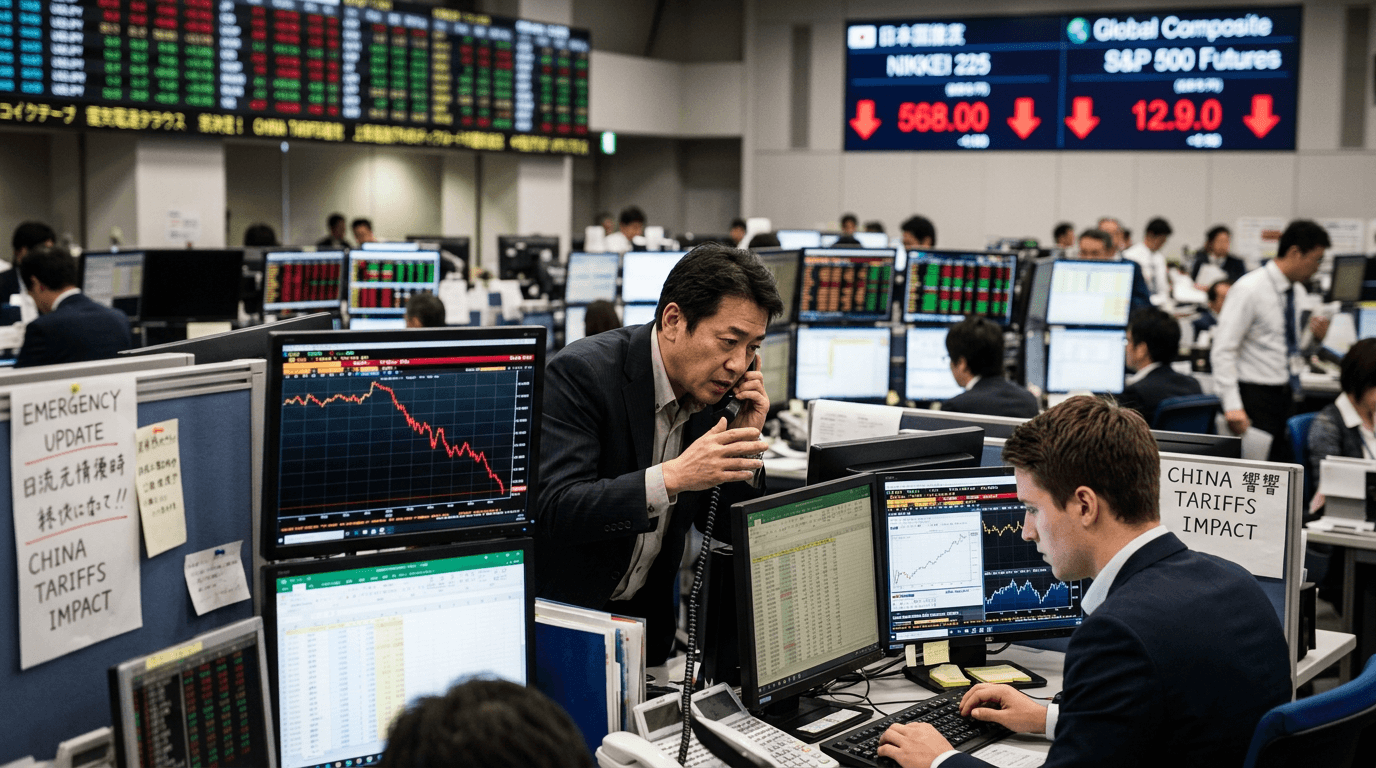
China’s decision to slap steep retaliatory tariffs of up to 125% on US-origin goods has jolted global markets, triggering classic risk-off flows in foreign exchange and weighing on equity index futures. As traders reassess growth prospects and supply chain stability, safe-haven currencies like the Japanese yen and Swiss franc are catching a strong bid while risk-sensitive FX pairs and stock benchmarks come under pressure.[3][4]
GLOBAL ESCALATION: WHAT CHINA’S 125% TARIFFS SIGNAL
The latest move marks a sharp escalation in the ongoing US–China trade conflict. After Washington raised tariffs on Chinese imports to 145% under a country-specific regime, Beijing responded by lifting its retaliatory tariffs on US goods to as high as 125%.[3][4] These rates apply on top of existing duties, significantly increasing the cost of bilateral trade and amplifying uncertainty for multinationals with deep exposure to both economies.[3]
Earlier phases of the dispute had already seen targeted tariffs on US agricultural, energy, and industrial products, as well as Chinese export restrictions on critical minerals and sanctions on selected US firms.[1][3] The step-up to triple‑digit tariff rates signals that both sides are willing to tolerate higher economic costs in pursuit of strategic goals, rather than treating tariffs as temporary bargaining chips alone.
Economists estimate that the cumulative tariff measures could shave around 0.2% off global merchandise trade, a meaningful drag in an already fragile environment.[4] For markets, that headline number matters less than the message: trade policy is again a live, unanchored macro risk, not a background noise.
Why Risk-off Flows Favor Jpy And Chf
When geopolitical or policy shocks threaten global growth, investors typically move into “risk-off” mode. That means rotating out of higher-yielding, growth-sensitive assets and into instruments perceived as safer stores of value. In FX, two currencies consistently sit at the center of that shift: the Japanese yen (JPY) and the Swiss franc (CHF).
There are several reasons these currencies tend to benefit:
1) Japan and Switzerland run strong external balance sheet positions, often being net creditors to the rest of the world, which reassures investors in times of stress.
2) Both currencies are frequently used as funding currencies in carry trades. When risk appetite collapses, investors unwind those positions, buying back JPY and CHF and pushing them higher.
3) Both countries are perceived as politically stable and relatively insulated from direct trade-war fallout compared with export-heavy emerging markets.
The result is that pairs like USD/JPY, EUR/JPY, and USD/CHF can move sharply lower as investors rush to cut risk, even if domestic Japanese or Swiss fundamentals have not changed materially. For discretionary FX traders and systematic models alike, recognizing these “risk-off reflexes” is critical when major trade headlines hit.
Pressure On Risk-sensitive Currencies And Equity Indices
On the other side of the ledger are currencies and assets tied closely to global growth and trade volumes. When tariffs jump to 125% on one of the world’s most important bilateral trade relationships, markets instinctively reprice:
- Commodity-linked currencies such as the Australian dollar and New Zealand dollar often come under pressure, given their reliance on global demand and Asia‑centric trade flows.
- Asian and emerging-market FX with strong trade ties to China and the US can sell off as investors anticipate weaker export orders and potential capital outflows.
- The offshore Chinese yuan (CNH) is a key barometer: persistent depreciation against the US dollar typically reflects both growth worries and expectations that Beijing may allow some FX flexibility to offset tariff impacts.
Equity index futures usually react swiftly. Export-oriented indices and sectors—industrial machinery, semiconductors, autos, and logistics—tend to be hit hardest, while more domestically focused or defensive sectors may outperform. When tariffs rise sharply and unexpectedly, liquidity in futures markets can thin around the announcement window, leading to wider spreads and sharper intraday swings.
For traders in simulated environments and live markets alike, the cross‑asset pattern is often consistent: stronger JPY and CHF, weaker high-beta FX and EM assets, lower equity indices, and a bid for core government bonds as yields fall.
What This Means For Fx And Index Simulated Traders
For participants using SimFi platforms like E8 Markets, this kind of macro shock is a real-time case study in how narrative and positioning interact. The headline itself—“China raises retaliatory tariffs on US goods up to 125%”—is just the catalyst.[3] The tradable opportunities come from understanding the sequence:
- First-order impact: Instant repricing in JPY and CHF crosses, CNH pairs, and major equity index futures on the headline.
- Second-order impact: Shifts in expectations for global growth, corporate earnings, and central bank reaction functions over days and weeks.
- Third-order impact: Changes in correlations and volatility regimes—pairs that normally trade quietly may start trending, while traditional relationships can temporarily break down.
In a simulated environment, traders can test structured approaches to these episodes:
- News‑driven breakout strategies around key FX pairs at times of known event risk.
- Mean‑reversion setups after the initial spike in volatility, once spreads normalize.
- Cross‑asset relative-value trades, such as long JPY vs. short a basket of high‑beta EM currencies, or long defensive indices vs. short cyclical ones.
Because no real capital is at stake in SimFi, traders can focus on learning how to size positions for higher volatility, where to place stops around headline risk, and how quickly to scale risk down once the market transitions from panic to digestion.
Key Risk Management Lessons
Trade-war headlines are a reminder that event risk can override technicals and short‑term patterns. A robust trading process around such news should include:
- Event mapping: Knowing when major policy announcements, tariff deadlines, and press conferences are scheduled, and adjusting leverage and exposure accordingly.
- Volatility awareness: Recognizing that spreads widen and slippage increases around surprise headlines, making tight stops and oversized positions especially vulnerable.
- Scenario planning: Defining in advance how a strategy behaves under different outcomes—further tariff escalation, a temporary truce, or an unexpected policy reversal.
For FX and index traders, it is often better to be directionally light going into binary events, then deploy risk once the initial reaction has played out and liquidity has improved. Simulated trading sessions are an ideal place to rehearse this discipline before applying it to live capital.
Conclusion
China’s move to hike retaliatory tariffs on US goods to as much as 125% is more than a bilateral dispute; it is a global macro shock that is reshaping risk sentiment, lifting traditional safe havens like the yen and Swiss franc, and pressuring growth‑sensitive currencies and equity indices.[3][4] For traders, the key is not just spotting the immediate price moves, but building a robust playbook for navigating risk-off environments—one that integrates cross‑asset signals, respects volatility, and is thoroughly tested in a simulated setting before being deployed in live markets.