
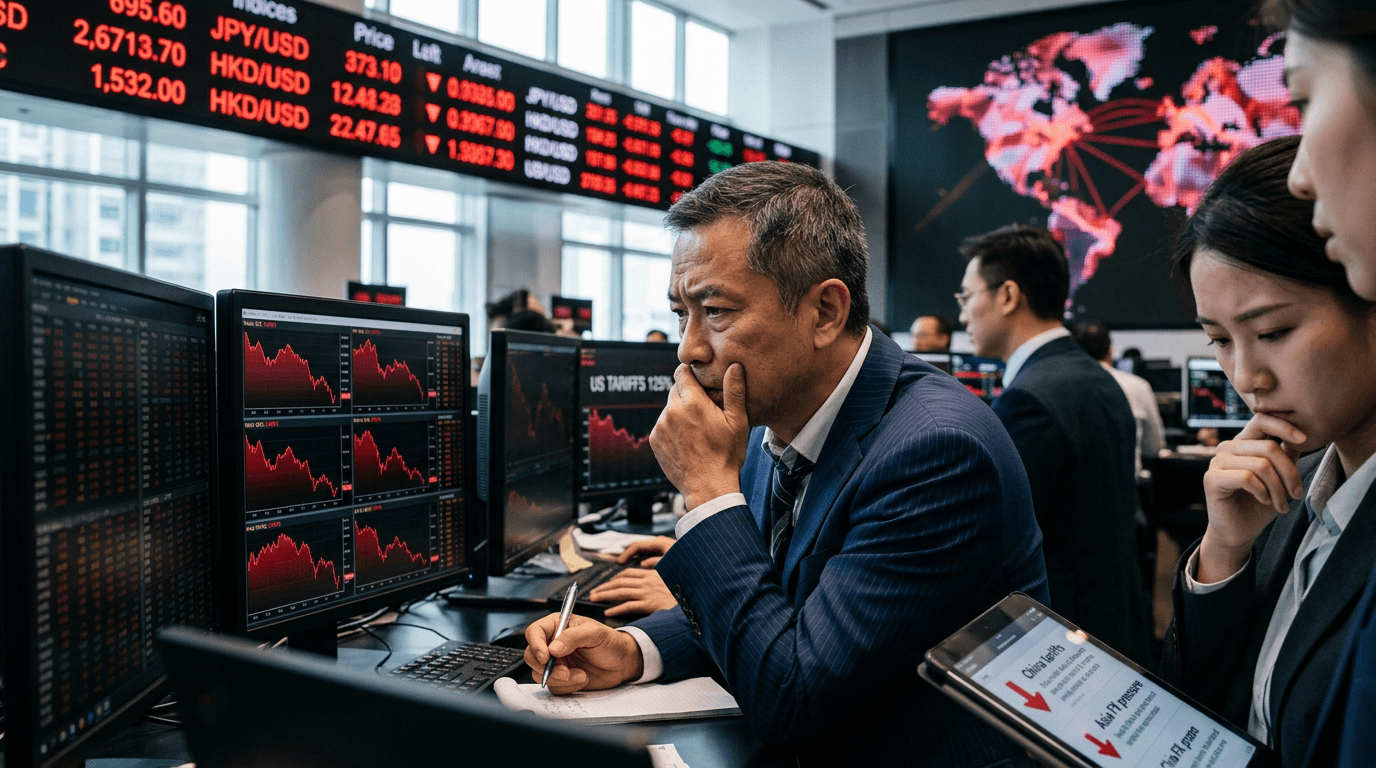
Tariff tensions between the world’s two largest economies have resurfaced, with China warning it could impose duties of up to 125% on selected U.S. imports if Washington continues to escalate its own trade measures.[3] Chinese officials have argued that further tariff hikes “no longer make economic sense” and insist that the United States should bear responsibility for any trade-related damage, a tone that has already injected caution into Asia-session FX and equity futures.[3]
What China Is Signaling
China’s latest message is not just about numbers; it is about leverage and narrative.[3] By openly floating tariffs as high as 125% on certain U.S. goods, Beijing is reminding markets that it still has substantial room to retaliate if the U.S. ratchets up duties again.[3] The focus on “selected” imports suggests that any new measures would likely be targeted, aimed at politically sensitive sectors or industries where U.S. exporters are heavily reliant on Chinese demand.
At the same time, Chinese authorities are framing the move as a reluctant response rather than aggressive first strike.[3] By saying that continued U.S. escalation “no longer makes economic sense,” Beijing is signaling to investors and international partners that it views the tariff spiral as inefficient and destabilizing, but will respond if forced.[3] This positioning matters because markets are increasingly sensitive not only to what policymakers do, but how they justify it.
For traders, the key takeaway is that tariffs are back on the table as an active policy tool, not a relic of the last trade war cycle. The more both sides lean on tariffs as a default response to disputes, the more frequently markets will have to price in policy shocks.
HOW WE GOT HERE: FROM TARIFF PEAKS TO A FRAGILE TRUCE
To understand why this warning matters, it helps to recall how high the last tariff confrontation climbed. During the previous escalation, the United States raised duties on Chinese exports to rates as high as 145%, prompting Beijing to retaliate with steep tariffs on U.S.-origin goods that reached up to 125%.[3] Those measures targeted a wide swath of U.S. exports, from agriculture to energy and industrial machinery.[3]
The economic hit was significant enough that, in May 2025, both sides agreed to a partial, time-limited de-escalation.[4] The U.S. reduced its 125% reciprocal tariffs on Chinese goods to 10% for 90 days, while China similarly cut its retaliatory tariffs on most U.S. imports from 125% to 10% over the same window.[4] This temporary rollback gave markets hope that the worst of the trade war might be over and offered some breathing room for exporters and supply chains.
China’s new warning that duties could again climb as high as 125% on some U.S. products threatens to undo that fragile stability.[3] Even if the final measures prove narrower than the previous across-the-board hikes, the signal is clear: the truce was tactical, not permanent, and tariff risk remains a structural feature of the U.S.–China relationship.
Market Reaction: Fx, Equities, And Commodities
The initial market response has been classic “policy risk” behavior. The warning injected caution into Asian FX trading, with investors favoring safer currencies and stepping back from higher-beta Asian FX and EM currencies that are most exposed to global trade swings.[3] Equity futures across the region also softened as traders reassessed earnings and growth prospects in sectors tied to cross-border demand.[3]
Past episodes provide a useful template. When China previously lifted tariffs on U.S. goods up to 125%, the shock jolted FX, commodities, and equity markets simultaneously, while pushing volatility higher.[3] Traders saw:
- Stronger safe-haven currencies such as JPY.
- Pressure on export-sensitive indices and cyclical sectors.
- Softer industrial commodities tied to manufacturing and trade volumes.[3]
If today’s warning evolves into concrete tariff moves, a similar cross-asset pattern is likely. Tariffs at or near 125% effectively price many U.S. exporters out of the Chinese market unless they accept sharply lower margins or redirect shipments elsewhere.[3] That stress can ripple through global supply chains, affect shipping demand, and weigh on investment decisions.
Analysts have previously estimated that the prevailing tariff structure, when fully enforced, could shave around 0.2% off global merchandise trade—a meaningful drag in an already uneven growth environment.[3] Even a partial return to those levels would complicate the outlook for export-driven economies and the companies that depend on them.
Why This Matters For Global Growth And Sectors
At the sector level, the threat of triple-digit tariffs is especially acute for industries that rely on scale and narrow margins. Earlier rounds of Chinese retaliation concentrated on agriculture, energy, and industrial equipment, sectors where the U.S. has significant export interests and where rerouting trade is costly and slow.[3] If new measures again concentrate on these areas, we could see renewed strain on:
- U.S. farmers and agribusinesses that depend on Chinese buyers.
- Energy exporters shipping LNG, crude, and refined products to Asia.
- Capital goods manufacturers that supply machinery and vehicles to Chinese industry.[3]
For global investors, this is not only a U.S.–China story. Economies and corporates tied into these value chains—commodity producers, logistics companies, Asian manufacturers using U.S. components—can also feel the impact. That is why tariff headlines often trigger moves in European and emerging-market assets even before any local policy changes.
How Traders Can Navigate Tariff Headlines
The recurring nature of tariff shocks means traders need a framework, not a one-off reaction. Several principles are particularly useful in both live and simulated trading environments:
First, watch cross-asset relationships. Tariff risk rarely moves just one market. It can strengthen safe-haven FX, weaken trade-sensitive equities, and pressure industrial commodities at the same time.[3] Observing how these pieces fit together helps you distinguish a localized move from a broader risk-off regime.
Second, stress-test correlation assumptions. In calm conditions, many portfolios rely on stable historical correlations between EM FX, global equity indices, and commodities. Trade war headlines often disrupt those patterns.[3] Using a SimFi setup or other simulated environment, you can replay tariff scenarios and examine how hedges behave when correlations break down.
Third, practice risk management around event risk. Policy news tends to cluster around official announcements, press conferences, and scheduled reviews of tariff lists, and volatility often spikes around those moments.[3] Traders can:
- Reduce position sizes or leverage into known risk events.
- Use options to define downside while keeping upside open.
- Set wider but well-planned stop levels to avoid getting whipsawed by intraday headlines.
Finally, think in scenarios, not single forecasts. Trade policy is driven by politics, negotiation tactics, and domestic narratives, all of which are difficult to predict precisely.[3] A more robust approach is to map out a few plausible paths—further escalation, sector-specific deals, or renewed de-escalation—and consider how each would affect your strategies. That mindset encourages flexibility rather than anchoring on one “base case.”
Key Takeaways For Traders
For now, China’s warning of tariffs up to 125% on some U.S. imports is a reminder that the trade war never fully ended—it merely paused.[3] The immediate impact has been a tilt toward caution in Asian FX and equity futures, with traders reassessing exposure to trade-sensitive assets.[3] If rhetoric hardens into formal tariff decisions, the market reaction is likely to broaden and deepen, echoing previous episodes of cross-asset volatility.[3]
The opportunity for active traders lies in preparation. By studying how markets behaved during earlier rounds of 125%–plus tariffs, using simulated environments to test strategies, and building clear event-risk playbooks, you can respond to future headlines with a plan rather than emotion.[3] In a world where tariffs can move from idea to implementation in a matter of days, that preparation is becoming a core part of modern risk management.