
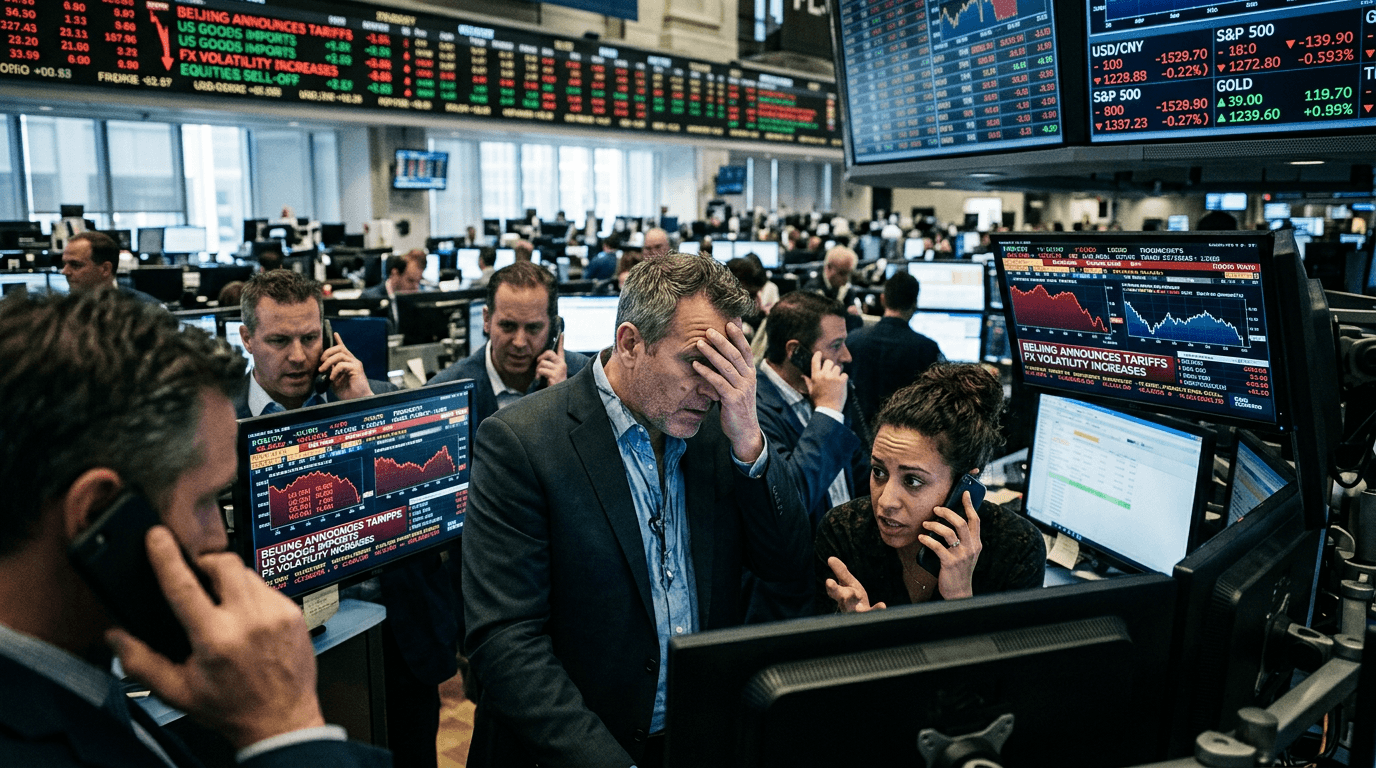
China’s latest move to sharply increase tariffs on a range of US goods marks a new escalation in the trade standoff between the world’s two largest economies. Some levies are reportedly being pushed as high as 125%, signaling Beijing’s willingness to absorb economic pain to gain leverage and to make clear it will not bow to further US pressure.[3][6] The announcement has immediately dented global risk sentiment, hitting China-sensitive currencies, equity futures, and pushing flows back toward traditional safe havens.
Global Context: A Re-escalation Of The Trade War
The US–China trade dispute never fully disappeared; it has shifted through phases of confrontation, uneasy truces, and partial rollbacks since 2018.[7] In previous rounds, the US dramatically raised tariffs on Chinese exports, and China responded with its own higher tariffs on US goods.[4] At one point, the average US tariff on Chinese imports surged to more than 120% before later being reduced, illustrating how extreme this policy tool has already become.[4]
More recently, Washington has layered on new measures via global and China-specific tariffs. A 10% global tariff on most US imports was imposed under Section 122 for 150 days in early 2026, adding broad pressure to global trade.[6] In parallel, the US Trade Representative has pushed fresh Section 301 investigations, with proposals for additional duties on Chinese goods tied to allegations such as forced labor and unfair practices.[3]
Beijing’s new move to raise select tariffs up to 125% on US products fits into this longer pattern of tit-for-tat escalation.[3][6] The rhetoric accompanying the announcement is equally important: Chinese officials have warned they will ignore further US pressure and insist Washington must bear responsibility for tariff-related damage to trade and growth.[3] In other words, this is not framed as a bargaining opening—it is framed as a line in the sand.
Key Market Reactions: Risk-off, Safe-haven Flows
Markets are reacting along familiar lines seen in prior trade war flare-ups:
- China’s offshore yuan (CNH) is under pressure as investors price in weaker growth, capital outflow risks, and the potential for further policy easing from Beijing to cushion the blow.
- The Australian dollar (AUD), often treated as a liquid proxy for Chinese growth and commodity demand, is also softening as traders reassess the outlook for Asia-Pacific trade flows.
- Equity index futures in the US and Asia are softer as investors rotate away from cyclical, trade-linked sectors and into more defensive names, or step to the sidelines altogether.
- Safe havens such as the Japanese yen (JPY), Swiss franc (CHF), and US Treasuries tend to benefit in these episodes as risk is reduced and global portfolios rebalance toward perceived security.
Behind these moves is a simple narrative: higher tariffs raise costs, distort supply chains, and threaten global growth. The larger and more sustained the tariff shock, the greater the risk that corporate investment slows, export orders decline, and earnings forecasts are revised lower.
Currencies, Commodities, And The Macro Link
From a macro perspective, tariffs function as a tax on trade. When a major player like China slaps steep duties on US goods, it shifts relative prices, profit margins, and ultimately currency dynamics:
- For the US dollar, the picture is mixed. Trade tensions can be USD-supportive in risk-off environments, but they also raise questions about US export competitiveness, corporate profits, and the impact on the Fed’s reaction function over time.
- For CNH, higher tariffs signal weaker export demand (if US retaliation follows) and may encourage China’s authorities to allow a more competitive exchange rate to absorb some of the shock. Historically, escalations in the dispute have coincided with CNH depreciation phases.[4]
- For commodity currencies like AUD, the key channel is Chinese demand. If tariffs weigh on China’s manufacturing and export sectors, demand for raw materials can soften, pressuring commodity-linked FX.
Commodities themselves may see cross-currents. Industrial metals and energy prices could weaken on lower growth expectations, while some agricultural or niche products might spike if tariffs disrupt specific trade flows. Traders need to distinguish between broad macro moves (growth and risk sentiment) and idiosyncratic shocks in particular products subject to the steepest duties.
Impact On Equities And Global Growth Expectations
Equity markets tend to react both directly and indirectly to tariff news. Directly, companies with high exposure to US–China trade—exporters, global manufacturers, tech hardware, autos, and capital goods—face potentially lower margins and disrupted supply chains. Indirectly, tariffs can weigh on business confidence, delaying capex plans and hiring, which then feeds back into earnings.
Earlier waves of the US–China trade conflict showed that sustained tariff walls can lift average tariff rates across almost all traded goods.[4] As these barriers become embedded rather than temporary, firms start to rewire their supply chains—reshoring production, diversifying suppliers, or shifting assembly to third countries. This reconfiguration is costly in the short term and can be inflationary, especially if it reduces efficiency and scale.
From a global growth standpoint, the main risk is that repeated tariff escalations harden into a more permanent regime of economic fragmentation. That can mean lower potential growth, higher price levels, and more policy uncertainty. Central banks then must weigh weaker trade and investment against any inflationary impacts from higher import costs, complicating the rate outlook.
How Traders Can Navigate The New Tariff Landscape
For traders, particularly those using Simulated Finance (SimFi) environments, this kind of macro shock is both a risk and an opportunity. The key is to treat tariffs as a structural theme, not a one-day headline.
Here are practical ways to adapt
1. Trade the volatility, not the headline Initial tariff announcements often trigger sharp moves in CNH, AUD, equity indices, and safe-haven assets—sometimes overshooting as sentiment swings. Watching how price reacts in the first 24–48 hours can help identify whether the market is trending, mean-reverting, or simply repricing to a new range.
2. Focus on cross-asset relationships Tariff shocks are classic cross-asset events. FX, equities, rates, and commodities move together in patterns that often repeat across episodes. For example, weaker CNH and AUD, softer equity futures, and lower bond yields can confirm a risk-off regime. Tracking these relationships can improve conviction and timing.
3. Differentiate between short-term noise and long-term shifts Some tariff announcements are quickly watered down or delayed; others become entrenched policy. Historical experience shows that large tariff increases have at times been partially rolled back after negotiations.[4][5] Traders should monitor follow-up statements, negotiation schedules, and any signs of carve-outs or exemptions that might reduce the impact.
4. Use SimFi to stress-test strategies A simulated environment is ideal for exploring how your strategies behave amid tariff shocks: • How does your system respond to sudden spikes in volatility? • What happens when correlations between assets change quickly? • Does your risk management adjust fast enough when spreads widen or liquidity thins?
By replaying prior trade war episodes and combining them with current market data, traders can refine entries, exits, and position sizing rules without exposing live capital.
5. Maintain a macro calendar and scenario map Tariffs rarely occur in isolation. They interact with central bank decisions, key data releases, elections, and corporate earnings. Building a simple scenario map—best case, base case, worst case—for US–China trade relations can help you anticipate rather than react. For each scenario, outline your expectations for CNH, AUD, major indices, and safe-haven flows.
Ultimately, the new Chinese tariffs are a reminder that geopolitical and trade risks remain central drivers of modern markets. Traders who integrate these dynamics into their process—rather than treating them as occasional surprises—will be better positioned to navigate the volatility and uncover opportunity in the noise.