
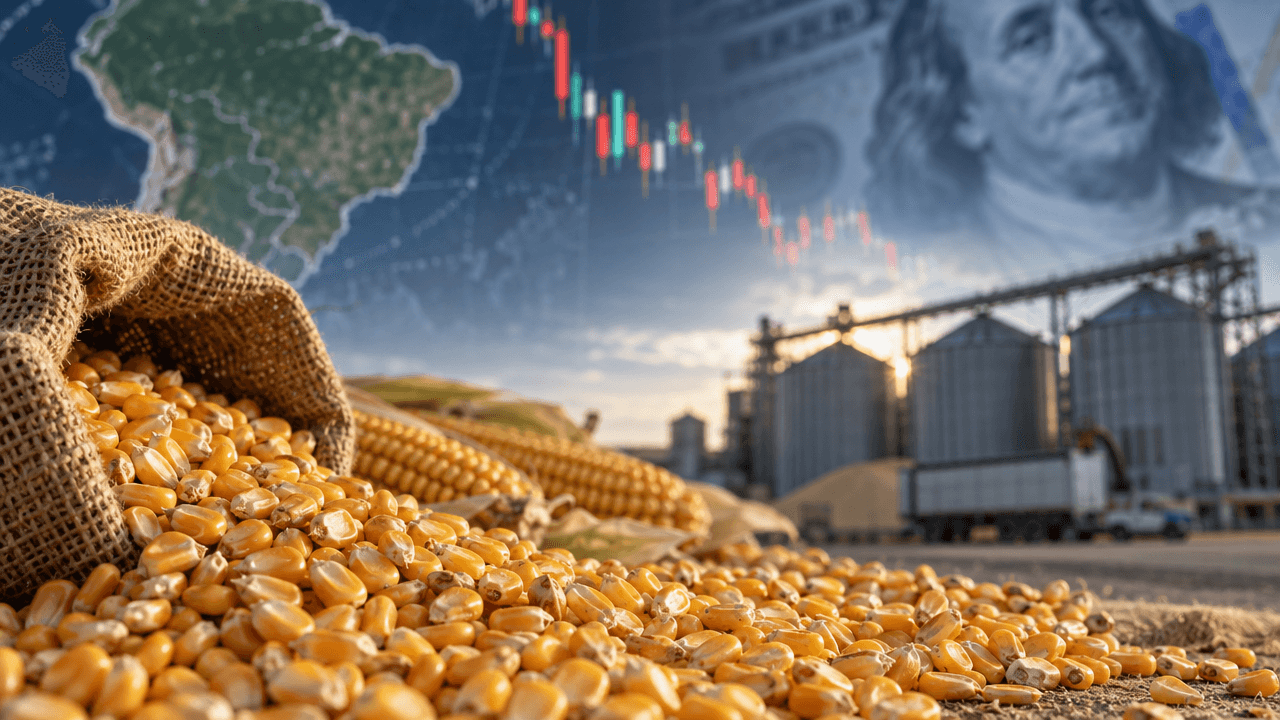
Corn futures are facing renewed pressure as improving South American production expectations collide with a stronger U.S. dollar. Prices recently slipped toward 446 cents per bushel, reflecting a market that is balancing tighter-than-expected U.S. supply projections against the possibility of heavier export competition from Brazil and Argentina.
The decline is not necessarily a signal that corn demand has collapsed. Instead, it shows how quickly agricultural markets can reprice when the outlook for global availability changes. For traders, the key question is whether larger South American supplies will create a lasting bearish trend or merely limit rallies until more information arrives about weather, exports, and feed demand.
South American Supply Expectations Rise
Brazil and Argentina are central to the current bearish narrative. The U.S. Department of Agriculture recently raised its 2026/27 Brazilian corn production forecast to 141 million metric tons, 1% higher than the previous month and 8% above the five-year average. Argentina’s projection was increased 4% from the prior month to 57 million metric tons. [1]
Those revisions matter because Brazil and Argentina are major suppliers to international markets. When production expectations improve, buyers may have more options beyond the United States. That can reduce the urgency to purchase U.S. corn and place pressure on Chicago futures, particularly when prices attempt to rally.
Brazil’s crop is especially important because its production cycle differs from the U.S. schedule. Brazil can supply global buyers during periods when U.S. export activity traditionally becomes more important. Expectations for expanded Brazilian acreage and favorable crop prospects have therefore raised the possibility of stronger competition in coming months. [6]
However, production forecasts are not final harvest results. South American crops still face risks from rainfall patterns, planting progress, input costs, and the potential effects of El Niño. A forecast increase today can be reversed if weather conditions deteriorate during critical development stages.
The Dollar Adds Another Headwind
Currency markets are also influencing corn prices. A stronger U.S. dollar makes dollar-denominated commodities more expensive for international buyers using other currencies. If importers must pay more in local-currency terms, they may delay purchases, switch suppliers, or negotiate more aggressively.
Recent dollar strength has reduced the competitiveness of U.S. grain exports and amplified the effect of better South American supply expectations. Corn futures fell below $4.50 per bushel as the greenback strengthened, while favorable South American weather added to selling pressure. [6]
The currency effect can be particularly significant when global buyers have several sources of supply. If Brazilian or Argentine corn is competitively priced, a rising dollar may encourage buyers to shift demand away from U.S. origins. This does not eliminate American export demand, but it can slow the pace of new sales and limit upside momentum.
U.S. FUNDAMENTALS OFFER A COUNTERWEIGHT
The bearish outlook is not one-sided. The latest U.S. supply picture includes some supportive elements. The USDA lowered its U.S. corn yield forecast to 179.6 bushels per acre from 181.2 previously, while projected ending stocks were reduced to 1.758 billion bushels from 1.849 billion. [6]
Export demand has also shown strength. Weekly export sales reached 2.88 million metric tons for the week ended November 5, the highest volume of the 2026/27 marketing year, with Mexico representing the largest share. [6]
These figures suggest that lower prices may be attracting buyers and that U.S. corn remains competitive in important markets. If export demand continues to improve, it could offset part of the pressure created by a stronger dollar and larger South American projections.
The market is therefore weighing two opposing forces. Reduced U.S. yield and solid export sales support prices, while improved foreign production and currency strength restrict rallies. This conflict can produce choppy trading rather than a smooth directional move.
What Traders Should Watch Next
Weather remains one of the most important variables. Traders should monitor planting progress and crop conditions in Argentina, along with rainfall and acreage expectations in Brazil. Forecasts can change rapidly, and futures markets often react before official production estimates are updated.
Export data is another critical signal. Continued strong U.S. sales would indicate that buyers are willing to purchase American corn despite currency disadvantages. Conversely, a slowdown in sales could confirm that South American competition and the stronger dollar are affecting demand.
Currency direction should also remain on the trading checklist. If the dollar continues higher because of changing interest-rate expectations, corn may struggle to build a sustained rally. If the dollar weakens, U.S. grain could become more attractive internationally, potentially allowing futures to recover.
Technical levels can help traders manage risk, but they should not replace fundamental analysis. The $4.00 area has historically attracted attention as a psychological support level, while recent market commentary identified nearby support around $4.30 per bushel. [11] A decisive move below support could encourage additional selling, while a recovery above resistance would suggest that buyers are responding to tighter U.S. fundamentals.
Practical Takeaways For Simfi Traders
For SimFi traders, the current corn market provides a useful lesson in cross-market analysis. Do not focus solely on the futures chart. Track production estimates, export sales, weather, and the U.S. dollar together.
A bearish supply headline does not automatically justify an immediate short position. First, consider whether the news is already reflected in price, whether U.S. demand remains strong, and whether weather risks could invalidate the forecast. Traders should define their entry, stop-loss, and profit target before taking a position rather than reacting emotionally to a single headline.
Position sizing is equally important. Agricultural futures can move sharply when weather models, government reports, or currency markets change. Using smaller exposure during uncertain conditions can help protect an account while preserving the ability to participate if a clearer trend develops.
Conclusion
Corn futures near 446 cents per bushel are being pressured by a combination of larger South American production expectations and a stronger U.S. dollar. Yet tighter U.S. yield projections and robust export sales provide meaningful support beneath the market.
The next major move will likely depend on whether foreign supply estimates continue rising, whether the dollar maintains its strength, and whether U.S. export demand can absorb the added competition. For traders, the most effective approach is to treat the market as a balance of competing forces, stay alert to new data, and manage risk carefully when fundamentals remain unsettled.