
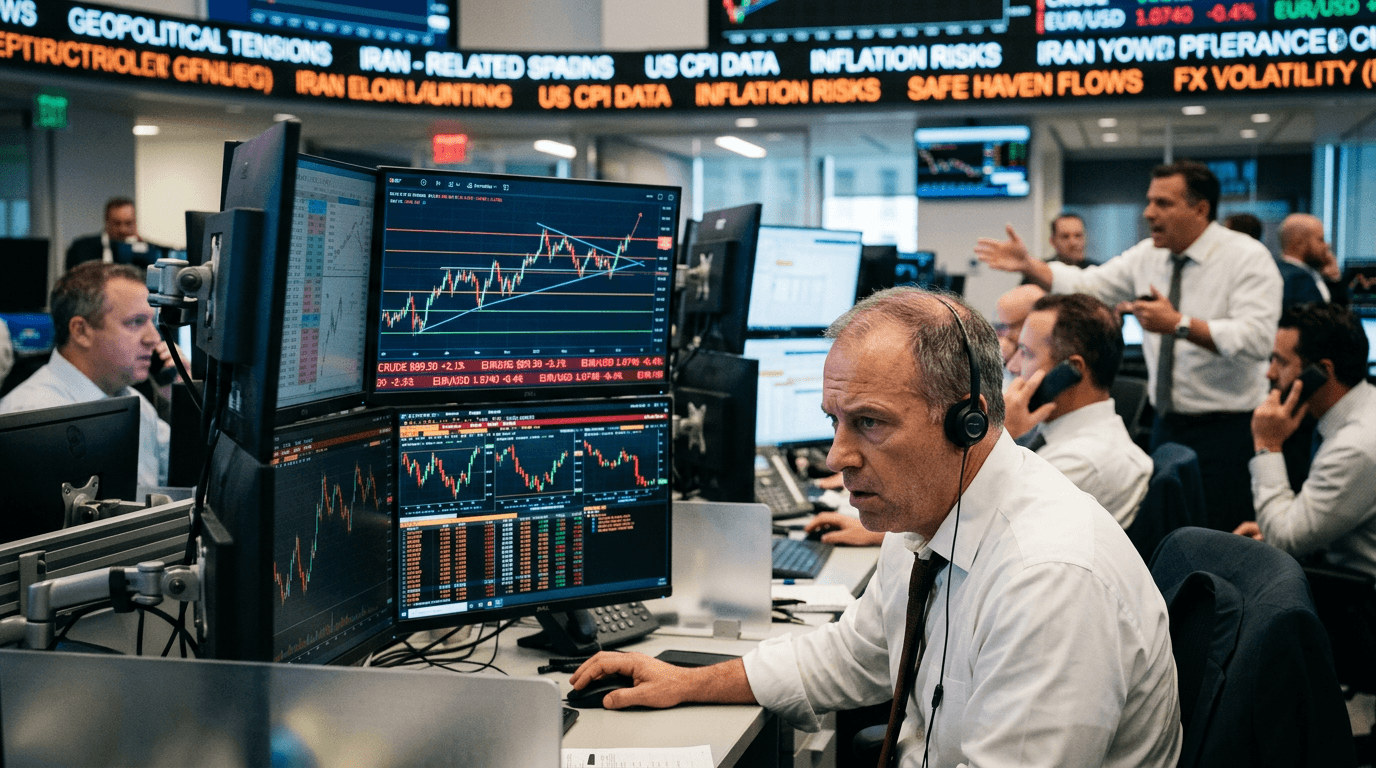
The U.S. dollar is firming in a volatile, headline‑driven market as traders juggle rising tensions with Iran and the next U.S. Consumer Price Index (CPI) release, a combination that keeps major FX pairs range‑bound but injects bursts of intraday volatility. Safe‑haven demand is supporting the greenback and the yen, even as investors remain reluctant to take strong directional bets before the inflation data lands.[3][5]
WHAT IS DRIVING THE DOLLAR RIGHT NOW?
Two forces are pulling at the dollar at the same time: geopolitics and data‑dependent central banks. On one side, escalating tensions and military strikes involving Iran are pushing investors toward perceived safe havens such as the U.S. dollar, U.S. Treasuries, and, to a lesser extent, the yen.[3][5] On the other side, traders are laser‑focused on upcoming U.S. CPI, which will heavily influence expectations for Federal Reserve policy.
Recent episodes of conflict in the Middle East have already shown that the dollar tends to strengthen when uncertainty and tail‑risk fears rise, as global investors seek liquidity and safety in U.S. assets.[5] At the same time, the Federal Reserve is widely expected to keep rates on hold in the near term, with prediction markets assigning a very low probability to imminent rate cuts while the inflation outlook remains unclear.[5] That combination—elevated geopolitical risk plus a still‑restrictive Fed—provides an underlying floor for the dollar, even when data comes in mixed.
The result in the short term is not a one‑way trend but a “choppy up‑bias”: the dollar index holding near recent highs, safe‑haven currencies outperforming in risk‑off episodes, and risk‑sensitive FX pairs like AUD/USD and emerging‑market currencies experiencing sharper swings as headlines and expectations shift.[3][5]
Geopolitics, Oil, And Fx: Why Iran Tensions Matter
Iran‑related tensions matter for FX markets primarily because they are tightly linked to the global oil supply. Any perceived threat to production or transport routes in the region tends to push oil prices higher. Analysts have already revised U.S. inflation forecasts upward to reflect higher oil prices stemming from the Iran conflict, while marking down growth expectations as households and businesses face higher energy costs.[6]
Higher oil prices feed into inflation through gasoline, transportation, and input costs for a wide range of goods and services.[6] That can create an uncomfortable trade‑off for central banks: inflation pressures rise even as global growth softens. For the Fed, the key question becomes whether the shock is temporary or persistent—an assessment policymakers have explicitly said will influence their rate decisions.[5]
For FX traders, this geopolitical‑oil‑inflation link has several practical implications:
- Oil importers such as the euro area, Japan, and some emerging markets may face weaker currencies if higher energy costs worsen trade balances and growth prospects.
- Oil exporters and “petro‑currencies” (like CAD and some Middle Eastern currencies) can gain support from higher crude prices, though that benefit can be offset if global risk aversion spikes.
- Safe‑haven currencies, led by the dollar and to a lesser degree the yen, often benefit from capital seeking stability when war or escalation risk rises.[3][5]
In other words, Iran headlines are not just “noise”—they are a real driver of risk sentiment, commodity prices, and, ultimately, inflation expectations and monetary policy.
U.S. CPI IN FOCUS: WHY THIS PRINT MATTERS
If geopolitics sets the tone, U.S. CPI sets the tempo. Inflation data remains the single most important macro release for the dollar because it directly shapes expectations for the Fed’s next moves. When inflation has recently run above target, any upside surprise in CPI reinforces the case for keeping rates higher for longer—and sometimes even revives talk of further tightening.[5]
Analysts and traders typically break CPI into two components:
- Headline CPI, which includes volatile food and energy prices.
- Core CPI, which strips out food and energy and is often seen as a better gauge of underlying inflation trends.
In the current environment, oil‑driven energy costs could lift headline CPI, while core CPI will be watched to see whether underlying price pressures are easing or proving sticky.[4][6] A hotter‑than‑expected reading on either measure can push U.S. yields higher, strengthen the dollar, and pressure risk assets like equities and some high‑beta currencies. A softer print, by contrast, can weaken the dollar as traders bring forward expectations for rate cuts and rotate into risk assets.
For simulated traders, the key is not predicting the exact CPI number, but understanding the reaction function:
- “Hot” CPI (above consensus): typically dollar‑positive, yield‑positive, risk‑negative.
- “Cool” CPI (below consensus): typically dollar‑negative, yield‑negative, risk‑positive.
- “In‑line” CPI: often leads to initial whipsaw moves as positions unwind, then a re‑focus on geopolitics and the broader trend.
Trading Implications: Ranges, Volatility, And Risk Management
When markets are juggling both war risk and major data releases, price action tends to be jumpy but contained: ranges hold until a truly disruptive headline or data surprise breaks them. That creates a nuanced environment for traders:
- Major pairs like EUR/USD, USD/JPY, and GBP/USD may oscillate within established technical zones, with spikes around headlines and data, but no sustained breakout until a clear narrative emerges.
- Safe‑haven flows can cause sharp intraday drops in higher‑beta currencies, followed by partial reversals as immediate fears fade.[3][5]
- Cross‑asset correlations tighten—equities, oil, yields, and FX move together more visibly around key events.
For SimFi users, this is fertile ground to practice:
- Range‑trading strategies: identifying support and resistance in pairs like EUR/USD or USD/JPY and testing mean‑reversion setups, while strictly defining stop losses in case of breakout.
- Event‑driven trading: planning trade ideas for “hot CPI” vs “cool CPI” scenarios, then comparing the plan to real‑time market reaction.
- Volatility management: experimenting with position sizing and leverage around scheduled releases, and seeing how different risk parameters affect drawdowns during data spikes.
Because spreads can widen and liquidity can thin around CPI releases and major geopolitical headlines, it is crucial—even in a simulated environment—to account for slippage and gap risk when placing stops and targets.
A Practical Playbook For Simulated Traders
To turn this environment into a learning opportunity, consider a structured playbook before, during, and after the event:
Before the CPI release, define your bias and key levels. Note consensus expectations for headline and core CPI and outline your “if‑then” scenarios: for example, “If core CPI beats by 0.2 percentage points or more, I expect USD/JPY to test recent highs; if it misses, I expect DXY to pull back toward recent support.” Map relevant levels on the charts and decide where you would enter, exit, and invalidate each idea.
During the release, focus less on prediction and more on observing market reaction. Monitor how quickly FX pairs, yields, and equities adjust, and how long it takes for the initial spike to stabilize. Use smaller simulated positions or even stay flat and simply track how your pre‑planned scenarios compare to reality.
After the dust settles, conduct a detailed post‑mortem. Which pairs were most sensitive to the data? Did geopolitics amplify or dampen the reaction? How did safe‑haven currencies behave compared to risk currencies? Did your risk management rules protect you from extreme swings, or would you need to adjust sizing, stops, or timing?
By repeating this process across multiple events, you build a personal playbook for navigating environments where macro data and geopolitical risk collide—exactly the kind of complex backdrop professional traders face.
Conclusion
A firmer dollar in volatile, range‑bound trade amid Iran tensions and an impending U.S. CPI release is a textbook example of how macro, geopolitics, and market psychology interact. Safe‑haven demand, oil‑driven inflation risks, and a data‑dependent Federal Reserve are all feeding into FX pricing.[3][5][6] For traders, especially in a simulated environment, this is not just “news”—it is a live laboratory to practice scenario planning, risk management, and cross‑asset thinking. The more methodically you approach these episodes, the better prepared you will be when similar conditions return in real‑money markets.