
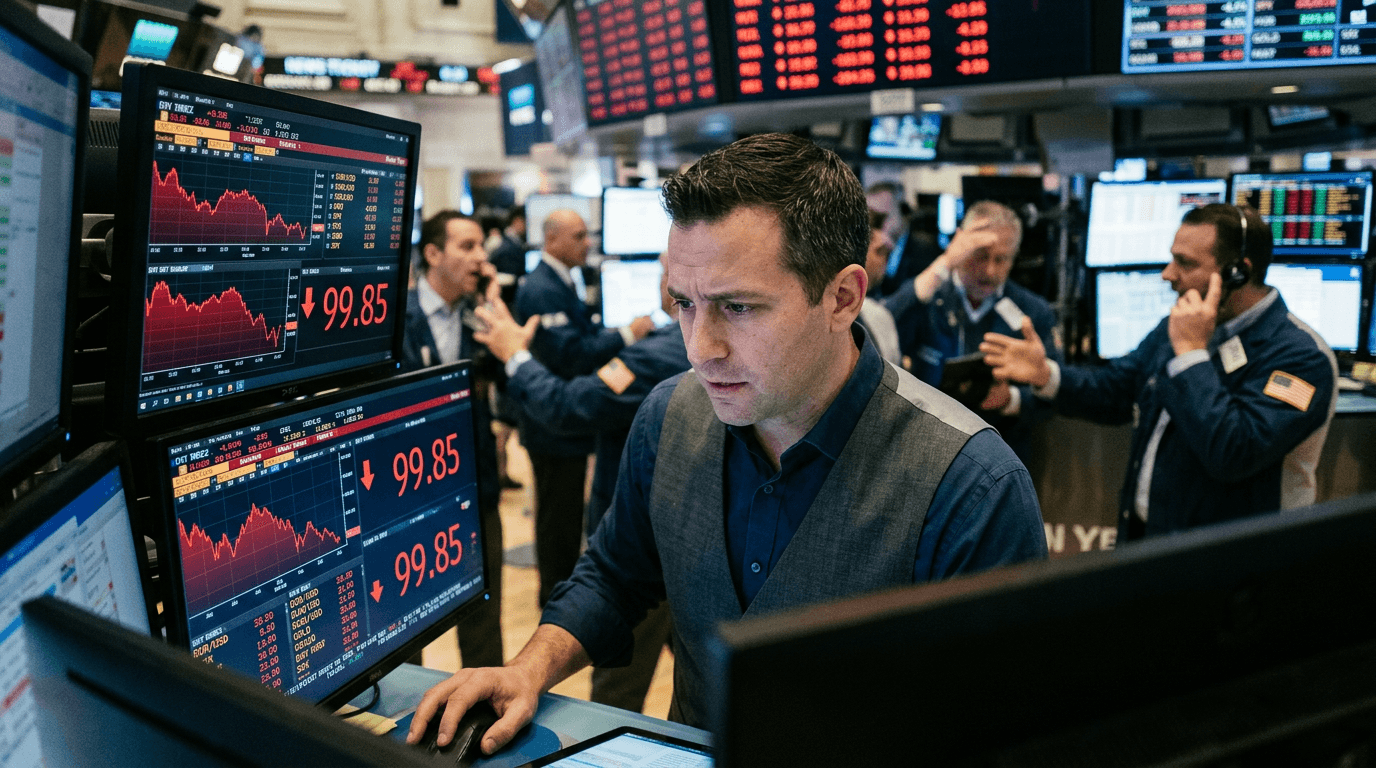
The U.S. Dollar Index (DXY) has slipped below the 100 mark for the first time since July 2023, breaking a major psychological floor for currency markets.[1] The move extends an already sharp dollar selloff, reshaping trends across FX, commodities, rates, and risk assets.[1][6]
What A Sub-100 Dollar Index Really Means
The U.S. Dollar Index measures the dollar’s value against a basket of key currencies, heavily weighted to the euro, along with the yen, pound, Canadian dollar, Swedish krona, and Swiss franc.[4] When the index falls, it signals broad-based dollar weakness rather than just a move in a single pair.
A drop below 100 is important for two reasons: it is both a widely watched psychological level and a zone that has historically acted as a pivot between strong-dollar and weak-dollar regimes.[1] Breaking that level reinforces the idea that markets are transitioning into a weaker dollar environment.
This decline has followed a reversal from peaks near 110, marking roughly a 10% swing lower in the dollar index within a relatively short period.[1] That kind of shift is large enough to reprice expectations for global trade, capital flows, and cross-border investments.
Even after dipping below 100, the index has seen some intraday attempts to stabilize around the high-99 area, but it remains near the lows of the current move, reflecting ongoing selling pressure.[3][6] The key message: the trend is still down, and traders are positioning for continued dollar softness.
Why The Dollar Is Under Pressure
There is rarely a single driver behind a significant currency move; instead, a cluster of factors tends to align. In the current episode, three themes stand out: interest-rate expectations, relative growth, and risk appetite.
First, changing views on Federal Reserve policy have been central. Markets are now pricing in a softer rate path compared with the peak-hawkish period when the dollar index traded near 110.[1][6] When traders expect fewer hikes or earlier cuts, U.S. yields become less attractive versus other economies, pulling the dollar lower.
Second, the growth differential between the U.S. and the rest of the world has narrowed. Signs of cooling in certain U.S. data releases have coincided with improving or at least stabilizing conditions in other major economies, encouraging investors to diversify away from U.S.-centric exposures.[6]
Third, risk sentiment has shifted. When investors are less worried about global shocks, safe-haven demand for the dollar tends to ease, and capital can rotate into higher-yielding or higher-beta currencies and assets.[6] A weaker dollar often goes hand-in-hand with stronger performance in risk assets such as equities and emerging-market FX.
Taken together, these forces have encouraged systematic trend followers, macro funds, and corporate hedgers to rotate into more bearish dollar positioning, reinforcing the downward move.[1]
Winners, Losers, And Key Fx Pairs To Watch
Dollar weakness is never neutral; it redistributes momentum across major and minor currency pairs, as well as commodities and equity markets.
On the FX side, the most immediate effects show up in pairs like EUR/USD, GBP/USD, and AUD/USD, where the dollar is the quote currency. As the index has broken below 100, these pairs have seen upside pressure, with the euro and pound benefiting from both the weaker dollar and narrowed rate differentials.[1][4]
USD/JPY can behave differently, because both the dollar and the yen have safe-haven characteristics. In a risk-on environment with lower U.S. yields, the dollar can still fall against the yen, especially if Japanese yields are allowed to edge higher. However, if risk sentiment stays strong and Japanese rates remain very low, yen weakness could partly offset dollar softness.
Emerging-market currencies often gain when the dollar falls, particularly those from countries with stronger external balances or compelling real yields. A softer dollar can ease pressure on dollar-denominated debt and encourage capital inflows into higher-yielding EM assets.[5]
Commodities are another big beneficiary. Many key commodities, including gold and oil, are priced in dollars, so a weaker USD typically makes them cheaper in other currencies and can support higher prices in dollar terms. Gold, in particular, tends to gain from both a lower dollar and lower real yields in the U.S.
Equity markets, especially in regions outside the U.S., may also receive a boost. A softer dollar can be supportive for multinational earnings, trade volumes, and risk sentiment, while U.S. stocks may see sector-specific impacts depending on their international exposure.
How Traders Can Adapt Their Strategy
For traders, the message is not simply “sell dollars,” but to understand where the risk-reward is most attractive and how the macro narrative could evolve from here.
First, track key technical levels on the dollar index. Recent price action has highlighted zones of support just below 100 and additional downside levels around the mid-to-high 90s on some analyses.[1][2] If the index holds above initial support, a corrective bounce is possible; a clean break lower opens up a deeper weak-dollar phase.
Second, focus on relative stories, not just the U.S. side. For example, being bullish EUR/USD is a bet not only on a weaker dollar, but also on the euro area maintaining policy credibility and economic resilience. Similar thinking applies to GBP, AUD, CAD, and EM currencies.
Third, consider diversifying trade structures. Instead of only trading majors, some traders may explore crosses that express a view on non-dollar dynamics, such as EUR/GBP or AUD/JPY, especially if the dollar’s direction becomes less one-way and more range-bound.
Fourth, monitor correlations. A weaker dollar often correlates with stronger risk assets, but that relationship can change quickly if a growth scare appears. Being aware of how your FX exposure interacts with equities, bonds, and commodities in your portfolio is essential.
For SimFi and practice-account traders, this environment is a valuable testing ground. It offers the chance to rehearse how you would manage positions if a strong macro trend suddenly reversed, or if volatility spikes around key events like central bank meetings and major data releases.
Risk Management In A Weak-dollar Environment
A sharp move in a macro anchor like the dollar index is a reminder that risk management should be built for regime shifts, not just day-to-day noise.
Key practical points
- Reassess position sizing. Trends can accelerate quickly; ensure your dollar-related trades are sized so that a continuation of the move does not trigger outsized drawdowns.
- Review correlation exposure. If you are long EUR/USD, long gold, and long emerging-market equities, you may be running a concentrated “weak dollar / risk-on” bet. Make sure this is intentional, not accidental.
- Use scenarios, not guesses. Map out at least two alternate paths: one where the dollar index stabilizes and rebounds above 100, and another where it breaks lower toward prior cycle lows.[1][2] Consider how each would affect your portfolio.
- Keep an eye on policy risk. A sudden hawkish shift from the Fed or surprise strength in U.S. data could squeeze crowded dollar shorts, leading to a sharp counter-trend rally.
Trading in a simulated or low-leverage environment can help you test how your strategy behaves under these different scenarios without taking on full capital risk.
Conclusion: From Breakdown To Playbook
The dollar index breaking below 100 is more than a headline; it signals a potential shift in the underlying regime that has supported a strong dollar for much of the last cycle.[1][4] For traders, the move opens up new opportunities across FX, commodities, and global equities, but it also introduces fresh risks.
By understanding what the index represents, why the dollar is weakening, and how this translates into specific markets, you can build a structured playbook rather than reacting emotionally to each new low. Whether you are trading live capital or testing strategies in a simulated environment, the key is the same: align your positions with the evolving macro narrative, respect technical levels, and let disciplined risk management guide how aggressively you express your views.