
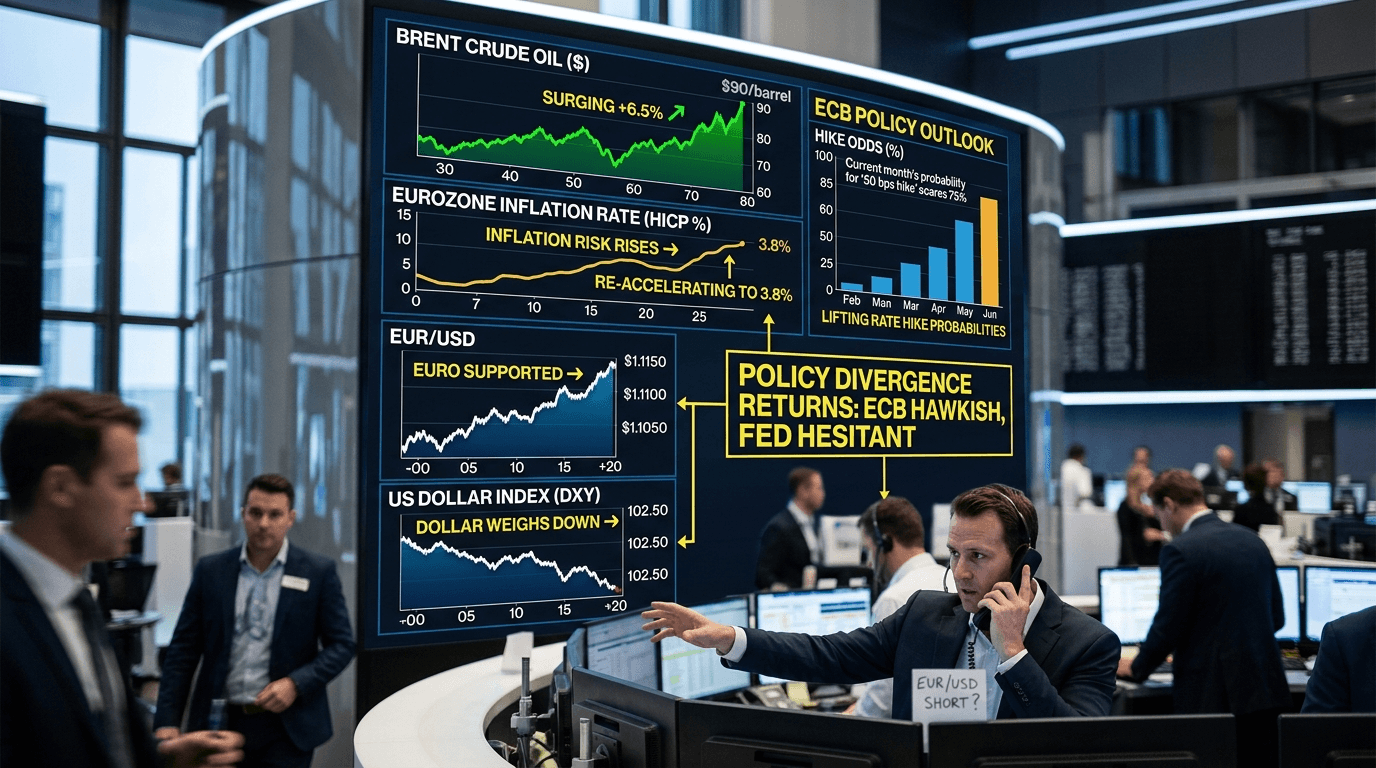
The dollar’s latest slip against the euro isn’t just a routine pullback; it reflects a meaningful shift in how markets are pricing future European Central Bank (ECB) policy in the face of rising oil prices and renewed inflation risks[2][8]. As traders reassess the odds of additional ECB hikes, the euro has found support, while broad dollar indices have edged lower from recent highs[1][10]. For traders, this is a classic example of how commodity shocks feed directly into FX via the central bank channel.
Global Fx Landscape: Dollar Index Under Pressure
Over recent sessions, the U.S. dollar has eased against both the euro and a broader basket of currencies as investors focus on the inflationary implications of higher energy prices for the Eurozone[2][8]. Reports highlight that surging oil has disrupted earlier assumptions that global central banks were largely done tightening, putting Europe back in the spotlight for potential renewed rate hikes[1].
At the same time, softer-than-expected U.S. inflation data has reduced the urgency for additional Federal Reserve tightening, leaving the dollar without a strong policy-support tailwind[8][10]. As a result, major dollar indices have hovered near recent lows and are heading for a modest weekly decline, even as geopolitical tensions and oil risks linger in the background[1][10].
Takeaway: In FX, a currency doesn’t have to “collapse” for the story to matter—small but persistent moves in the dollar index tied to policy repricing can set the tone for EUR/USD and broader risk sentiment.
Policy Divergence: Ecb Out-hawks The Fed
The core driver of the euro’s relative strength has been a shift in central bank expectations: investors now see the ECB as more likely to lean hawkish to contain energy-driven inflation, while the Fed remains comparatively cautious[2]. Market commentary suggests that after a “marathon” of recent central bank meetings, policy divergence—not risk appetite—has become the dominant theme in FX markets[2].
On the European side, some banks and research houses have raised the probability of another ECB rate increase, pointing to oil’s potential to push headline and core inflation back above target[2][8]. ING, for example, notes that while the ECB may keep rates unchanged at its next meeting, a surprise hike cannot be ruled out and a move later in the year is seen as increasingly realistic[12].
In contrast, in the U.S. the combination of softer CPI prints and still-solid but not overheated labor data has led markets to dial back immediate Fed hike expectations, even if “higher for longer” remains the broad narrative[8][10]. This leaves rate differentials looking slightly less favorable for the dollar versus the euro than they did when the Fed was seen clearly ahead of the ECB on tightening[2][6].
Takeaway: When one central bank is perceived to be turning more aggressive while another steps back, FX pairs tied to those banks—like EUR/USD—often reprice quickly, even without an actual rate move on the calendar.
Oil, Inflation, And The Eurozone
Europe’s sensitivity to energy shocks has been a recurring macro theme, and the latest oil price spike is reviving concerns that inflation could prove more stubborn than previously hoped[1][2]. Higher oil prices feed into headline inflation via fuel costs, and into core inflation through second-round effects on transport, production, and services. This dynamic tends to be more pronounced in economies that are net energy importers, such as the Eurozone[7].
Analysts have long highlighted that surges in oil can be particularly challenging for Europe’s growth-inflation mix: demand may be soft, but price pressures stay elevated due to external cost shocks[7]. That combination often forces the ECB into a difficult trade-off between supporting activity and preserving price stability, which is why renewed energy price spikes quickly translate into higher odds of additional tightening[2][8].
Interestingly, ECB research has noted that the relationship between oil prices and the U.S. dollar is not mechanically fixed; the co-movement depends on the nature of the underlying shocks[4]. In the current environment, the key transmission channel is less about a simple oil–dollar correlation and more about market expectations that European policymakers will respond more forcefully than their U.S. counterparts[2].
Takeaway: Oil doesn’t just move commodity markets—it shifts inflation expectations, pushes central banks to reconsider their stance, and can rapidly alter the trajectory of currencies that are closely tied to energy imports.
Trading Implications For Simulated And Live Markets
For traders operating in both live and simulated environments, this episode offers a valuable case study in how macro narratives evolve. The price action in EUR/USD and the dollar index is being driven less by day-to-day volatility and more by a re-rating of policy paths in response to new information about inflation risks[2][8].
Practically, that means the key variables to watch are not just spot FX rates, but also expectations embedded in interest-rate futures, overnight index swaps, and bond yields. A rising implied probability of ECB hikes alongside stable or declining Fed hike odds is a classic setup for euro support and mild dollar weakness[2][12]. Traders can use simulated platforms to test strategies that exploit this divergence—such as spread trades that benefit from widening Eurozone–U.S. yield differentials, or directional EUR/USD positions aligned with changing rate expectations.
Risk management is crucial: oil markets remain volatile, and any sharp reversal in prices or surprise data from the U.S. could quickly swing the narrative back in favor of the dollar[1][10]. Simulated trading environments are well suited for stress-testing portfolio ideas against alternative scenarios, such as an upside surprise in U.S. inflation or a more dovish-than-expected ECB communication.
Takeaway: Macro-driven FX moves are often about evolving expectations, not just current data. Using simulation to rehearse “policy divergence” scenarios can improve preparedness when similar dynamics unfold in real time.
What To Watch Next: Data, Central Banks, And Oil
Looking ahead, markets are likely to focus on three main pillars: inflation data, central bank communication, and the path of oil prices. Any upside surprise in Eurozone inflation figures would strengthen the case for additional ECB tightening and could further support the euro[2][8]. Conversely, evidence that energy-driven price pressures are contained would reduce the urgency for hikes and potentially cap EUR/USD gains[6].
ECB meetings will be critical moments, not only for rate decisions but for forward guidance. Analysts currently see a small but non-negligible chance of a near-term hike, with a more realistic window later in the year if inflation stays elevated[12]. For the Fed, the emphasis will be on whether softer inflation persists and how policymakers balance “higher for longer” rhetoric with incoming data[8][10].
Finally, oil itself remains the swing factor. Persistent strength in crude prices would keep inflation risks alive and maintain pressure on central banks to stay hawkish, particularly in energy-importing regions[1][2]. A significant retreat in oil, especially tied to easing geopolitical tensions, could flip the script—reducing ECB hike odds and potentially restoring more support for the dollar[6][11].
Takeaway: The current dollar–euro story is still being written. Traders should track the interplay of oil prices, inflation releases, and central bank messaging, as any shift in one leg of this triangle can quickly reshape FX trends.