
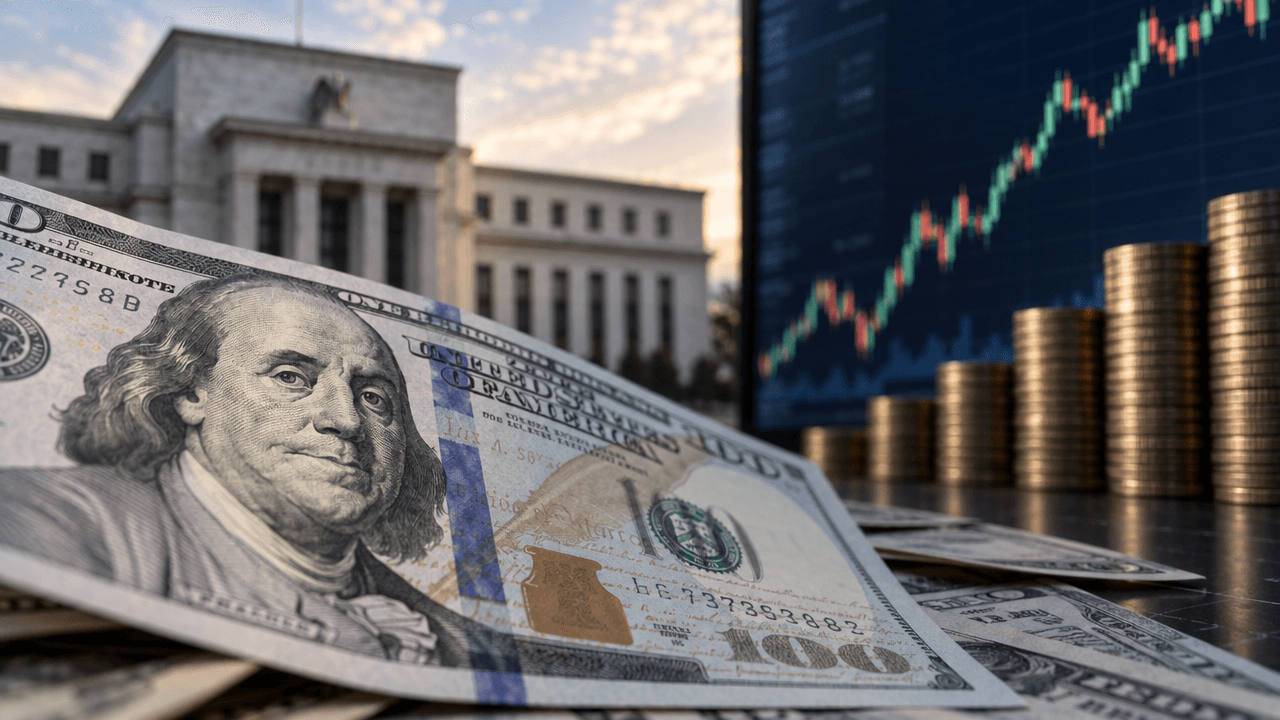
The U.S. dollar pushed higher on Wednesday as rising Treasury yields and anticipation around the Federal Reserve’s latest meeting minutes drew capital back toward U.S. assets[1][6][7]. For traders, this move is more than a headline: it reflects shifting expectations for the interest-rate path and sets the tone for currency, bond, and equity markets in the days ahead[1][10].
Market Backdrop: Dollar And Yields
The dollar index gained around 0.3%, trading near the 102 level as investors positioned ahead of the Fed’s September meeting minutes release at 2 p.m. Eastern time[6][7]. This broad-based strength weighed on major counterparts, with the euro and yen under pressure and emerging-market currencies facing renewed headwinds[7][12].
On the rates side, long-term U.S. yields climbed after a brief pullback, with the 10-year Treasury yield up over 7 basis points around 5.35% and the 30-year near 5.72%, levels not seen in decades[1][10]. Higher yields increase the relative attractiveness of dollar-denominated assets, reinforcing the currency’s safe-haven profile when policy uncertainty is elevated[1][5].
The dollar’s rise is also occurring against the backdrop of a Federal Reserve that has recently resumed rate hikes, with policymakers in September raising the policy rate for the first time since 2023[1]. Markets are now trying to assess whether this move marks the start of another tightening phase or a one-off adjustment, and the minutes are expected to offer important clues[1][3].
Why Fed Minutes Matter For Fx And Bonds
Federal Reserve minutes are not policy decisions, but they provide a detailed window into how officials view inflation, growth, financial conditions, and the appropriate path for rates[2][3]. Traders study them to understand the degree of consensus or division within the Committee and to gauge how reaction functions might evolve with incoming data[2][13].
For bond markets, the release of minutes is a well-documented event risk: research has shown that Treasury yields often jump at the time of publication and remain elevated for hours, as investors reprice the policy outlook[13]. That intraday volatility tends to spill into currency markets as yield differentials—the gap between U.S. and foreign interest rates—are a key driver of FX trends[11][13].
Minutes following a rate increase, like the recent September hike, are particularly important because they reveal whether policymakers see the move as part of a broader hawkish pivot or a data-dependent adjustment amid lingering inflation pressures[1][5]. If the tone is more hawkish than markets expect, the dollar can extend gains and yields may move higher; a more balanced or cautious tone could see the currency give back some ground[11][13].
KEY LEVELS TO WATCH: USD/JPY, EUR/USD AND EM FX
In the current environment, USD/JPY is trading near 158.40, a level that brings renewed focus on the trade-off between U.S. yield support and potential Japanese policy responses[7][12]. The wide rate differential between U.S. and Japanese bonds continues to favor dollar strength, but traders are sensitive to any signs of intervention or shifting guidance from Tokyo[11][12].
EUR/USD has slipped below the 1.1220 area, reflecting both dollar strength and ongoing concerns about the eurozone’s growth and inflation mix[7][12]. When U.S. yields rise and Fed risks tilt hawkish, the euro often underperforms, particularly if European yields fail to keep pace or if investor sentiment turns defensive[11][15].
Emerging-market currencies and assets are feeling the pressure as well, as higher U.S. yields and a firmer dollar typically tighten financial conditions for borrowers that rely on dollar funding[5][15]. History shows that periods of rapid yield increases and dollar appreciation can trigger outflows from EM bonds and equities, widen spreads, and increase volatility in local FX markets[11][13].
For traders, these levels are not just numbers on a screen—they are markers of where positioning, stop-loss orders, and optionality are concentrated. Fed minutes that surprise markets can drive sharp moves through these thresholds, creating both risks and opportunities for those prepared to act quickly[11][13].
Implications For Traders And Simulated Finance Users
In live markets, an event like Fed minutes combined with elevated yields can compress reaction time; prices in FX and rates can adjust within seconds of key phrases hitting the tape[11][13]. That makes preparation—scenario mapping, level identification, and risk-sizing—critical for both discretionary and systematic traders.
On a Simulated Finance platform like E8 Markets, traders can rehearse these scenarios without capital at risk, using real-time or delayed market data to test how strategies respond to surprise hawkish or dovish signals. SimFi environments allow users to stress-test stop placement, position sizing, and diversification across FX, rates, and indices under different Fed communication outcomes.
One practical takeaway is to build playbooks for each narrative: a hawkish read (focus on persistent inflation and need for further tightening), a neutral or balanced stance (data-dependent with limited bias), and a more dovish interpretation (emphasis on growth risks and gradual easing ahead)[2][8]. For each scenario, traders can define expected moves in yields, key FX pairs, and risk assets, then simulate execution and risk management.
Another important angle is correlation. When yields rise, the dollar often strengthens, but the magnitude of the FX move depends on how surprising the information is and where positioning stands going into the release[11][13]. SimFi tools let traders study historical minutes events, draw analogies to current conditions, and calibrate strategies accordingly.
How To Navigate This Environment
Heading into the minutes, risk management should be the priority. That starts with recognizing that spread-widening and volatility spikes are common around major Fed communications, particularly when the backdrop already features multi-decade-high yields and elevated policy uncertainty[1][10][13].
Traders can consider reducing leverage around the event, widening stop distances to account for intraday swings, or temporarily tightening their universe to the most liquid pairs, such as EUR/USD and USD/JPY. Liquidity tends to be deepest in these major crosses, which can help mitigate slippage during fast-moving headlines[11][12].
Positioning with clear time horizons is essential. Short-term traders may focus on the first 30–60 minutes after the release, aiming to capture knee-jerk reactions and mean reversion. Longer-term participants might instead look for confirmation of broader trends—such as sustained dollar strength supported by structurally higher U.S. yields—and adjust portfolios over days rather than minutes[11][13].
For SimFi users, the key is to treat this as a learning laboratory: record simulated trades, review execution quality, analyze what went according to plan and where the playbook fell short. Over time, repeated practice around events like Fed minutes can build disciplined habits that are transferable to live markets.
Conclusion
The firming U.S. dollar ahead of Federal Reserve minutes underscores how closely currency and bond markets are tied to expectations about monetary policy and inflation[1][6][7]. Elevated Treasury yields and sensitive FX levels in pairs like USD/JPY and EUR/USD mean that today’s release has the potential to reshape short-term trends and volatility across asset classes[1][10][12].
Whether the minutes reinforce a hawkish pivot or signal a more balanced path, prepared traders—especially those using simulated environments to rehearse their strategies—will be better positioned to navigate the moves that follow. In a world where policy communication can move billions in seconds, understanding the mechanics behind a “firmer dollar” is no longer optional; it is a core trading skill.