
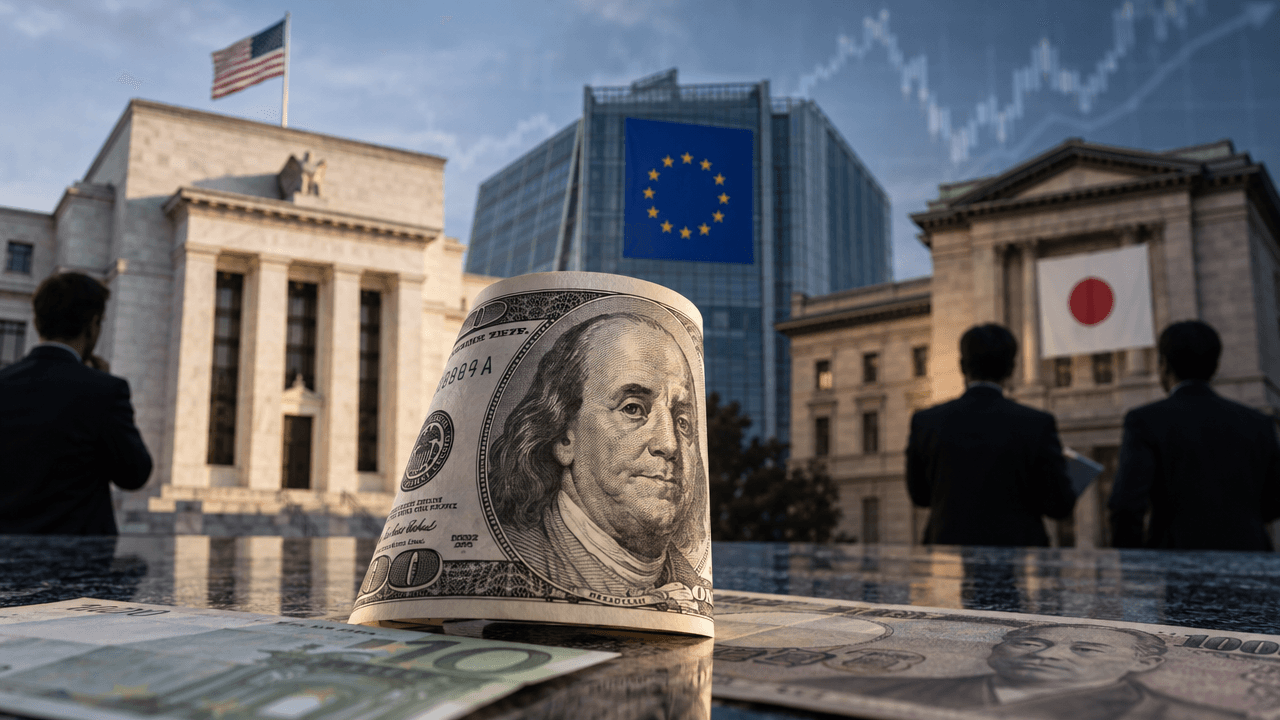
The dollar edged higher against the euro, yen and pound on Tuesday as traders positioned for a crowded week of central-bank decisions. The Federal Reserve is scheduled to announce its policy decision on Wednesday, the European Central Bank follows on Thursday, and the Bank of Japan concludes the sequence on Friday. Although all three institutions are widely expected to leave interest rates unchanged, markets are preparing for potentially important changes in forward guidance. [1]
For currency traders, a rate decision is only half the story. The more significant question is how policymakers interpret inflation, economic growth and financial conditions—and what those assessments imply for the next move. A central bank that holds rates steady but signals a possible hike later in the year can strengthen its currency. Conversely, a seemingly hawkish institution may trigger a selloff if officials sound less concerned about inflation than investors anticipated.
Why The Dollar Is Gaining Momentum
The dollar’s advance reflects a combination of positioning, interest-rate expectations and renewed appetite for risk. The greenback rose against the yen to around 157.73, while the euro slipped to approximately 1.1154 dollars and sterling declined to about 1.3324 dollars. [1]
Investors have also been watching US bond yields and the performance of technology shares. A rebound in major technology stocks has helped revive risk appetite, reducing demand for some safe-haven currencies while keeping the dollar near recent highs. The dollar index was reported close to a one-week high near 102.04. [6]
That strength does not necessarily mean traders expect an immediate Federal Reserve rate increase. Instead, it suggests that market participants are attempting to protect themselves against a range of outcomes. If the Fed emphasizes persistent inflation or leaves the possibility of a December increase open, US yields could rise and provide further support for the dollar.
The opposite outcome is also possible. If policymakers highlight slowing growth, easing price pressures or downside risks in the labor market, investors may reduce expectations for future tightening. In that scenario, the dollar could give back its pre-meeting gains even if the Fed leaves rates unchanged.
The Federal Reserve Sets The Initial Tone
The Federal Reserve decision is likely to establish the direction of global currency trading for the rest of the week. The current market expectation is for the Fed to hold its policy rate in a range of 3.75% to 4.00%. Market attention is focused on whether officials will preserve the possibility of another increase and how Chair Kevin Warsh describes the balance between inflation risks and economic activity. [10]
A neutral statement could produce a muted initial reaction, but even small changes in language may influence Treasury yields and the dollar. Phrases describing inflation as “elevated,” “persistent” or “broadly balanced” carry different implications for future policy. Traders will also examine the press conference for clues about the Fed’s confidence in the economy.
The key lesson for traders is to avoid treating a rate hold as an automatic non-event. Markets price expectations before decisions are released. When the announcement arrives, prices respond to the gap between the expected message and the actual message—not simply to whether rates moved.
Ecb And Boj Guidance Could Redirect Currency Flows
The European Central Bank is expected to keep its deposit rate at 2.50% on Thursday. However, investors are assessing whether the ECB could leave the door open to a December increase, particularly as inflation pressures remain relevant and fiscal concerns in France continue to influence sentiment toward the euro. [6]
For the euro, the risk is two-sided. A firm ECB message could support the currency by lifting expectations for future policy tightening. A cautious statement focused on weak growth or financial-market stress could push the euro lower, especially if the Federal Reserve sounds comparatively hawkish.
The Bank of Japan is also expected to leave its policy rate unchanged, with the rate widely reported at 1.25%. Markets are nevertheless watching for signs that officials remain prepared to raise rates as inflation pressures develop. [8]
The yen has been particularly sensitive to the difference between US and Japanese yields. If the Fed points toward tighter policy while the BOJ postpones further increases, that interest-rate gap could weigh on the yen and support dollar-yen. If the BOJ signals a December move more clearly, the yen could strengthen quickly as traders unwind short positions.
How Traders Can Manage The Volatility
Central-bank weeks often produce sharp price movements, wider spreads and false breakouts. Traders should consider reducing position size before announcements and defining risk in advance rather than reacting emotionally to the first price spike.
It is also useful to separate the initial market reaction from the broader trend. A currency may rise immediately after a statement and then reverse during the press conference when policymakers provide more detail. Waiting for confirmation through price action, bond yields and interest-rate futures can help filter out temporary volatility.
Traders should monitor three relationships in particular: the dollar against the euro, the dollar against the yen and US Treasury yields. A stronger dollar accompanied by rising US yields generally indicates growing expectations for tighter Federal Reserve policy. A stronger dollar alongside falling yields may instead reflect risk aversion or weakness in overseas currencies.
Economic data and corporate earnings could add another layer of uncertainty. Major technology-company results, global equity performance and changing expectations around US economic growth may amplify or counteract the central-bank signals.
The Bigger Market Lesson
This week demonstrates why currency markets are driven by expectations rather than headlines alone. Three major central banks may leave rates unchanged, yet their guidance could produce meaningful shifts in exchange rates, bond yields and equity markets.
The dollar’s current firmness is therefore best viewed as a positioning signal, not a guaranteed prediction of its next move. Traders are preparing for the possibility that US policy remains relatively restrictive, while also comparing the Fed’s outlook with the ECB’s inflation assessment and the BOJ’s plans for normalization.
For SimFi traders, the practical takeaway is straightforward: study the consensus, identify what the market has already priced in, and focus on the surprise in the guidance. The most valuable opportunities often emerge when official language differs from expectations—but those opportunities should be approached with disciplined risk controls. In a week dominated by policy signals, patience may be just as important as prediction.