
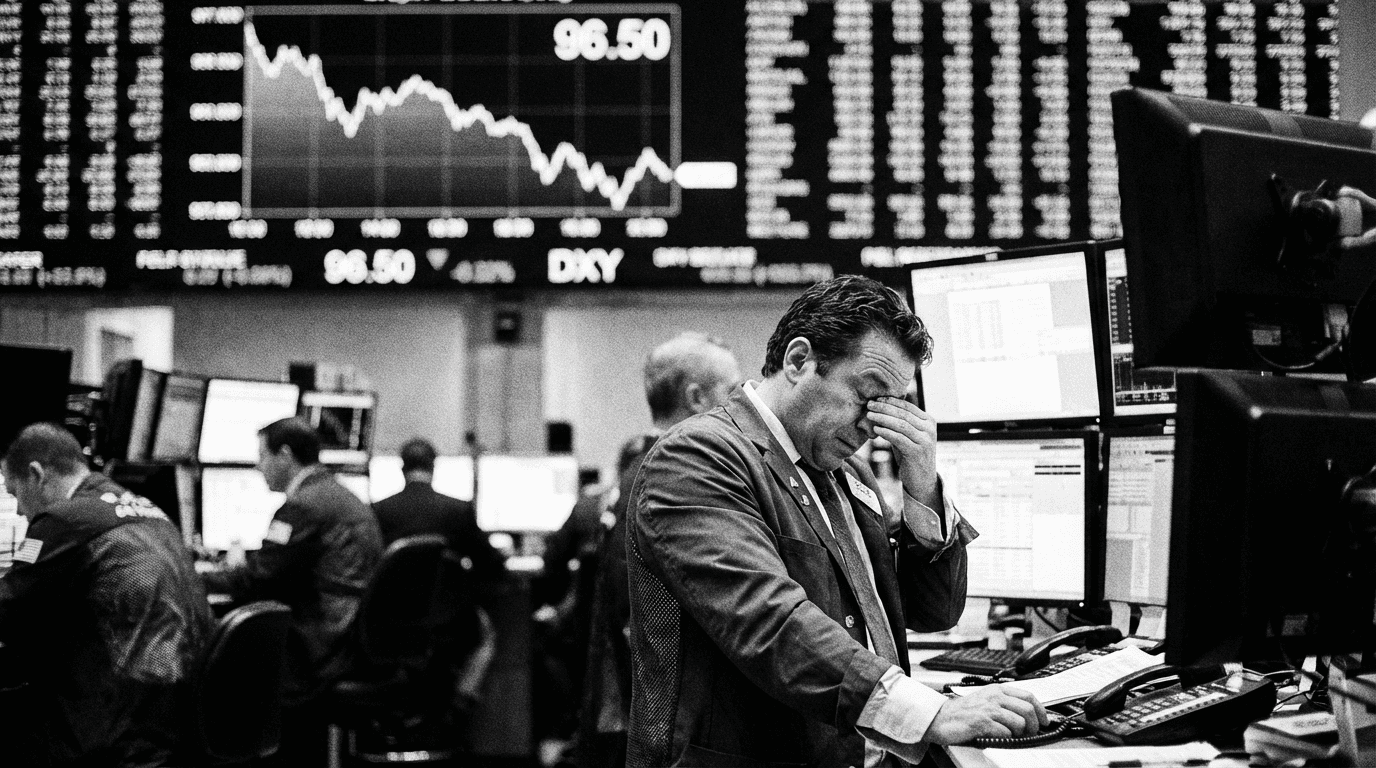
The U.S. Dollar Index has declined sharply from its late-2025 highs, dropping approximately 4% and falling back into the critical 96-97 support zone that has historically acted as a strong floor for buyers.[1] This recent weakness marks a significant shift in the currency markets, with the dollar now testing levels not seen in months as macroeconomic conditions and Federal Reserve policy expectations reshape investor sentiment toward dollar-denominated assets.
The current weakness in the dollar, contrary to recent headlines suggesting strength, reflects a broader market rotation away from the greenback as a safe haven asset. Expectations around Federal Reserve policy have shifted decidedly toward eventual easing, which has eroded the rate advantage that previously supported the dollar's strength throughout 2025.[1] As inflation data has cooled and real yields show signs of having peaked, capital has increasingly rotated into risk assets and real assets rather than seeking shelter in cash or dollar-denominated instruments. This rotation represents a fundamental change in how markets are pricing currency valuations heading into 2026.
Technical Picture And Key Support Levels
The technical structure of the dollar index tells a compelling story of failed strength and emerging weakness. On the weekly chart, the DXY has clearly failed to reclaim the 101-102 resistance zone, a level that capped every rally attempt following the prior impulse move.[1] This area now represents a major distribution zone where sellers have consistently overwhelmed buyers attempting to push higher. The inability to break above this resistance after multiple attempts suggests that momentum has shifted decidedly into the hands of sellers.
The critical support zone lies at 96-97, which represents structural support that has historically held during broader consolidation phases.[1] If this level fails to hold and price sustains a break below 96, downside risks open toward 94-95 as the next technical target. Conversely, a reclaim of the 101-102 resistance would invalidate the current bearish thesis and restore upside potential toward 103 and higher. At current levels near 97.4, the dollar remains in a precarious position where the next directional move will prove decisive for global markets.[2]
The Currency Pair Breakdown
The weakness in the dollar manifests clearly across multiple currency pairs tracked by traders. EURUSD is approaching 1.19 resistance with 1.20 in sight as the euro strengthens against the weakening greenback.[3] GBPUSD has pushed toward 1.37 with eyes on 1.39, showing bullish momentum as sterling benefits from dollar weakness rather than pound-specific strength, according to JP Morgan analysis.[4] The most dramatic moves have appeared in USDCHF, which now trades near 14-year lows at 0.7729, confirming historic dollar weakness across multiple pairs simultaneously.[3]
This broad-based weakness across majors is not random; it reflects synchronized central bank policy divergence. While the Federal Reserve has delivered 175 basis points worth of cuts since September 2024, the European Central Bank has concluded its easing cycle, and the Bank of Japan looks to embark on its first meaningful tightening cycle in decades.[4] This policy divergence creates structural headwinds for dollar strength as international investors reassess carry trade dynamics and yield differential advantages.
Macroeconomic Drivers Reinforcing Technical Weakness
The technical breakdown makes perfect sense when examined through a macroeconomic lens. The Federal Reserve sits at a policy crossroads, having already delivered substantial rate cuts while inflation continues cooling. This reality has prompted markets to price in further easing through 2026, reducing the rate advantage that had supported the dollar.[1] As real yields have peaked and nominal rates drift lower, the attractiveness of dollar-denominated assets diminishes relative to other asset classes.
Risk sentiment has also improved meaningfully, reducing the need for safe-haven flows into the dollar. When markets feel calmer and volatility subsides, capital naturally gravitates away from defensive positioning and toward higher-yielding or growth-oriented alternatives. Additionally, other central banks have begun closing the policy gap with the Federal Reserve, further narrowing the dollar's traditional yield advantage. All of these factors combined create a structural headwind for dollar appreciation that likely persists throughout 2026.
Scenarios And Market Implications
Three distinct scenarios are emerging for dollar direction from current support levels. The stabilization scenario holds that the dollar consolidates at 96-97 support and enters a sideways range, allowing markets to digest macroeconomic shifts without further downside acceleration.[1] This represents approximately a 45% probability and would keep volatility contained while the market reassesses policy expectations.
A bearish breakdown scenario carries 35% probability and would see a decisive weekly close below 96, opening downside risk toward 94-95 and confirming a sustained trend shift lower.[1] This scenario would have outsized implications for commodity prices, emerging market currencies, and global liquidity conditions. Finally, a 20% probability bullish reversal scenario posits that unexpectedly strong U.S. data or a repricing of Fed expectations pushes the dollar back above 101, reclaiming range resistance.
The current positioning in currency markets suggests this is a critical inflection point for global financial markets. The dollar is no longer driving price action; it is responding to broader macro shifts and central bank policy divergence. How price behaves at these critical support levels will help determine not only currency trends but also the trajectory for gold, commodities, equities, and global liquidity flows through the remainder of 2026.