
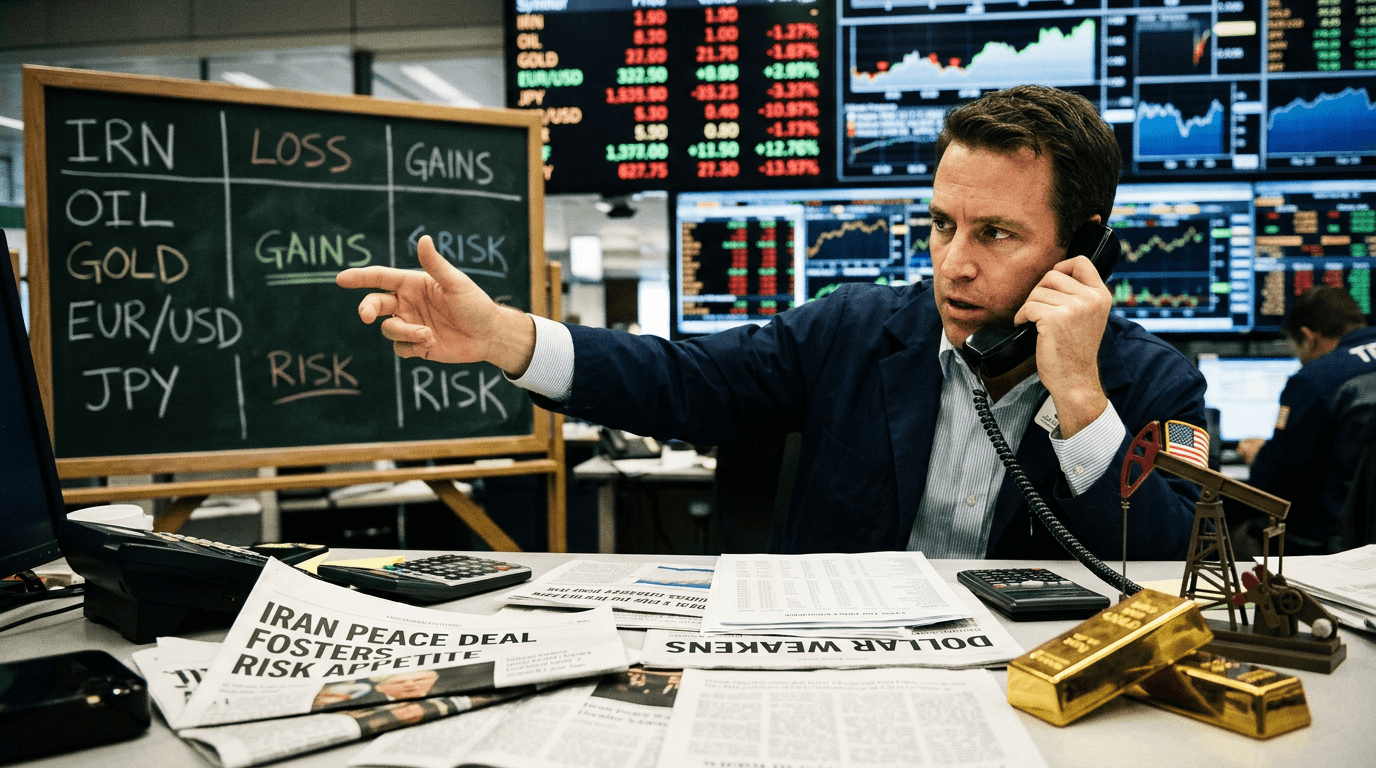
The U.S. dollar is on track for a weekly loss as markets latch onto growing hopes of a peace deal between the United States and Iran, shifting capital away from safe havens and back into riskier assets.[6] Improving risk sentiment has boosted demand for major currencies like the euro and the pound, as well as select Asian and commodity-linked currencies, while also reshaping the outlook for gold and oil-linked futures.[3][6] For traders, this is a textbook example of how geopolitics, risk appetite, and cross-asset flows interact in real time.
Shift In Risk Sentiment
For months, heightened tensions surrounding Iran had supported classic safe havens such as the U.S. dollar and gold, as investors sought protection against the risk of escalation in the Middle East.[3][7] When conflict risk rises, global portfolios tend to de-risk: capital flows into U.S. Treasuries, the dollar, the yen, and sometimes the Swiss franc, while risk-sensitive assets like equities and high-beta currencies often lag.
Recent headlines pointing to progress toward a potential peace deal between Washington and Tehran have started to reverse that pattern.[6] As perceived tail risks of a sharp escalation fall, investors are more willing to rotate back into higher-yielding or higher-beta assets, including:
- European currencies such as the euro and the pound
- Emerging market and Asian currencies, with some, like the Indian rupee, outperforming on the week[6]
- Global equities and credit markets, which tend to benefit from an improved growth and stability narrative[2][6]
The key idea: as fear recedes, the “safety premium” embedded in the dollar erodes, and the currency can weaken even if U.S. economic data hasn’t materially deteriorated.
Why Peace Hopes Weigh On The Dollar
The dollar’s direction is driven by more than just U.S. data or Federal Reserve expectations; it is also a barometer of global risk sentiment.[7] In periods of geopolitical stress, investors often borrow or sell foreign currencies to buy dollars, pushing the greenback higher. When the risk environment improves, that flow can flip.
Recent reports indicate
- The dollar has slipped into the end of the week and is headed for a weekly decline as hopes for a U.S.-Iran peace deal gain traction.[6]
- Risk appetite has improved, with investors rotating into Asia FX and other risk-sensitive currencies.[3][6]
- Safe-haven demand has faded, removing a key pillar of dollar strength that had been in place during earlier phases of the Iran-related tensions.[7]
In practical terms, broad dollar softness tends to:
- Support pairs like EUR/USD and GBP/USD, where the dollar is the quote currency
- Boost commodity-linked currencies such as AUD, NZD, and CAD when risk sentiment is firm and volatility is contained
- Ease pressure on emerging market currencies that had been under stress from both strong USD and geopolitical headline risk
However, it is crucial to recognize that the dollar is still influenced by interest-rate differentials and U.S. data surprises. If incoming U.S. data were to re-ignite expectations of more aggressive Fed tightening, that could offset the positive effect of peace headlines on risk sentiment.
Winners And Losers Across Asset Classes
Shifts in Iran-related risk have not only moved the dollar; they have rippled through commodities and other macro markets as well.
For energy and metals
- Oil prices have fluctuated on news of diplomatic progress, as a peace deal could eventually lead to higher Iranian supply and lower geopolitical risk premia in crude.[2][3]
- Gold, another classic safe haven, tends to lose some support when geopolitical fears ease and real yields stabilize, particularly if investors are confident enough to embrace risk assets.[3][7]
For currencies
- Asian FX has generally firmed as traders price in lower regional and global risk, with some emerging currencies outperforming as carry trades become more attractive again.[6]
- Pro-cyclical currencies such as the Australian dollar can benefit when markets pivot from “fear” to “growth,” especially if commodity demand expectations improve.
For indices and futures traders, these cross-currents open up a range of tactical opportunities:
- Equity index futures may see support from reduced geopolitical tail risk and stronger risk appetite.
- Gold futures can become more two-sided, with geopolitical premium fading but inflation and rate expectations still in play.
- Oil-linked contracts may price a narrower risk premium but remain sensitive to any sign that talks are stalling or supply dynamics are shifting.
How Traders Can Navigate This Environment
For both live and simulated trading, this episode offers valuable lessons in macro-driven market behavior.
1. Map the narrative to the asset Start by translating the headline (“Iran peace hopes”) into a risk framework. Lower conflict risk usually means weaker safe havens (USD, gold, sometimes JPY) and stronger risk assets (equities, high-beta FX, EM). Use that framework to structure directional biases rather than reacting to each headline in isolation.
2. Focus on multi-asset confirmation A durable shift in sentiment typically shows up across markets. For example, the current environment features:
- A softer dollar heading for a weekly loss[6]
- Firmer Asia FX and selective EM strength[3][6]
- Fluctuating but generally less “panicky” price action in oil and gold[2][3]
When multiple markets tell the same story, conviction in the theme (in this case, improving risk sentiment) is higher.
3. Define scenarios, not certainties Geopolitical news is inherently binary and headline-driven. Traders can benefit from defining clear scenarios:
- Peace progresses: Dollar drifts lower or remains capped; risk FX, equities, and some commodities gain.
- Talks stall or reverse: Safe-haven demand may return quickly, boosting the dollar and gold while weighing on risk assets.
- Mixed or drawn-out negotiations: Range-bound conditions dominate, rewarding mean-reversion strategies.
Having clear “if–then” plans makes it easier to respond when unexpected news hits the tape.
4. Use simulated environments to stress-test strategies Periods like these are ideal for strategy testing in SimFi environments. Traders can:
- Backtest how their systems performed in prior episodes of geopolitical de-escalation
- Simulate trading EUR/USD, GBP/USD, gold, or oil futures around news-driven volatility
- Practice risk management rules for gap risk, slippage, and sudden reversals that often accompany geopolitical headlines
Key Risks To Watch
While the current theme is one of improving sentiment, traders should remain alert to several key risks:
- Headline reversals: A single negative development in talks can quickly unwind risk-on positioning and trigger a dollar rebound.
- Central bank policy: If peace optimism coincides with stronger U.S. data or a more hawkish Fed tone, the dollar could find support despite softer risk premia.
- Liquidity conditions: Holiday-thinned markets, which have accompanied some of the recent moves, can exaggerate both rallies and pullbacks in FX and futures.[3]
Ultimately, the dollar’s weekly loss amid Iran peace hopes is a reminder that macro trading is as much about understanding global narratives and sentiment as it is about reading economic data. For active traders, the edge lies in connecting those narratives to clear, risk-managed trade ideas—and being ready to adapt when the story changes.