
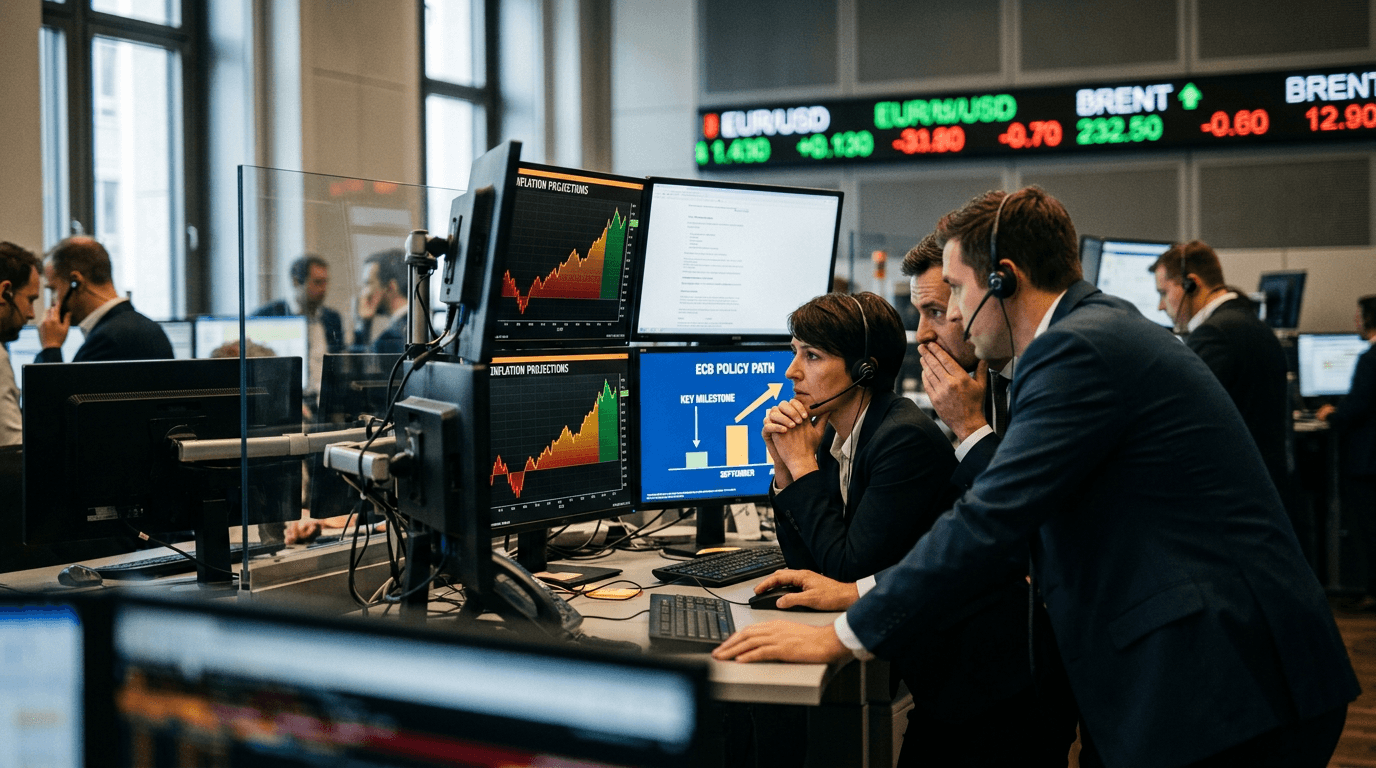
Markets are heading into the next European Central Bank (ECB) meeting with one dominant expectation: policy rates will stay on hold, but the tone of the guidance could shift meaningfully as energy‑driven inflation risks re‑emerge.[6][10] The recent surge in oil and gas prices linked to Middle East tensions has complicated the euro area outlook, reviving upside risks to inflation and downside risks to growth.[5][6] For traders, the key story is not the near‑term rate decision, but what the ECB signals about September and beyond.[6][8]
Ecb Pause, But Not A Neutral Signal
All 74 economists in a recent Reuters poll expect the ECB to leave its deposit rate unchanged at 2.25% at the upcoming meeting, a view largely embedded in market pricing.[6] The central bank already raised this rate in June, marking its second tightening step in 2026 as energy costs began to rise again.[1][6] With no new forecasts scheduled this time and much of the recent tightening still working through the economy, the Governing Council is widely seen as staying in “wait-and-see” mode.[10][15]
Importantly, “on hold” does not mean “done.” Policymakers have repeatedly emphasized a data‑dependent stance aimed at ensuring inflation returns to, and stabilises around, the 2% target over the medium term.[5][8] ECB communication has stressed that large, sustained deviations from this target call for forceful action, even if the initial shock stems from energy rather than domestic demand.[3] The pause therefore functions as a tactical delay, not a declaration of victory against inflation.
For traders and investors, this distinction matters. A “hawkish hold” – keeping rates unchanged but warning about upside risks – can support short‑dated yields, firm rate‑hike expectations for later in the year, and a mildly stronger euro, even if the policy rate itself does not move.[6][11] The nuance of the press conference and statement will likely drive market reaction more than the headline decision.
Energy Shocks And The Inflation Outlook
The immediate catalyst for the ECB’s caution is the renewed surge in energy prices triggered by the war in the Middle East, which has made the macro outlook “significantly more uncertain.”[5] Higher oil and gas prices are expected to push euro area inflation above 2% in the near term, after a period of gradual easing.[5][2] The central bank’s own projections still see headline inflation falling back toward 2% next year and stabilising close to target further out, but these forecasts are subject to growing upside risk.[2][8]
ECB officials are clear that monetary policy cannot directly lower energy prices.[3][5] Instead, the focus is on preventing indirect and “second‑round” effects – such as higher transport and production costs feeding into broader consumer prices, or workers demanding larger wage increases to maintain real incomes.[3][12] If these dynamics start to embed into inflation expectations, the case for further tightening strengthens materially.[3][5]
Policymakers are therefore tracking a wide range of indicators: energy futures curves, measures of underlying inflation, wage settlements, and survey‑based expectations.[3][8] Scenario analysis is central to the strategy, because the impact of large price shocks on inflation and growth can be non‑linear.[3] A short‑lived spike may be “looked through,” but a persistent shock – for instance, oil stabilising around very high levels and gas remaining elevated – would put more pressure on the ECB to act.[11][3]
Market Pricing: Rates, Euro, Bonds And Futures
Rate markets have already adjusted to the energy‑driven shift in risk balance. Traders are now pricing in at least one additional hike by year‑end, with a growing consensus among analysts that the next move will come in September if current energy trends persist.[6][11] Earlier in the year, the implied path was much flatter, reflecting confidence that inflation was heading back to target without the need for further tightening.[7][2]
This repricing has several market implications. Short‑maturity euro‑area government bond yields have edged higher as investors demand more compensation for the risk of future hikes.[6] Euribor and other interest rate futures have moved to reflect a steeper expected rate path, particularly in the front end of the curve.[6][10] At the same time, risk assets are grappling with the combination of tighter financial conditions and weaker growth prospects, a classic late‑cycle challenge.
In foreign exchange, the prospect of additional ECB tightening tends to offer some support to the euro, especially against currencies where central banks are closer to cutting.[6] However, the single currency is still contending with a robust US dollar, underpinned by relatively strong US growth and higher yields, which can limit EUR/USD upside even as euro rate expectations firm.[6] For traders, this creates a more tactical environment: the euro may react positively to hawkish guidance but remain in a broader range if global dollar strength persists.
What Traders Should Watch In Ecb Guidance
Because the rate decision itself is widely anticipated, the main trading opportunities lie in interpreting the ECB’s guidance. Several elements will be particularly market‑moving:
First, any explicit or implicit timeline for potential future hikes. If the ECB clearly signals that September is “live” and ties that to specific conditions (for example, energy prices or wage data), markets will likely solidify expectations for another 25‑basis‑point increase.[6][11]
Second, the balance of risks language. Strong emphasis on upside inflation risks and downside growth risks caused by energy costs would reinforce the narrative of a cautious but hawkish stance.[5][7] Conversely, greater confidence that the shock will be temporary could moderate expectations for sustained tightening.
Third, comments on second‑round effects. References to wage dynamics, services inflation, or signs of broadening price pressures would suggest the ECB is more worried about persistence, which is typically negative for duration (longer‑dated bonds) and supportive of higher front‑end yields.[3][12]
For active traders, preparing scenario maps in advance – “dovish hold,” “hawkish hold,” and “surprise hike” – can help frame potential moves in rates, FX, and equity indices around the meeting. Simulated environments are particularly useful for testing these reactions without real‑money risk, allowing traders to refine strategies for live conditions.
Using Simulated Markets To Prepare For Policy Shocks
Energy‑driven policy uncertainty is a textbook case where simulation can add real value to a trading process. The non‑linear nature of shocks, the importance of guidance over the headline rate, and the cross‑asset ripple effects all make this a complex event to trade.[3][5]
In a simulated finance setup, traders can construct scenarios that vary energy prices, ECB reaction functions, and market positioning simultaneously. They can practice trading rate futures around different guidance outcomes, explore how higher front‑end yields feed into regional equity indices, or model FX responses to combinations of ECB and Federal Reserve messaging. This provides a safe space to understand how narratives evolve and how quickly markets can reprice when central banks switch from “wait‑and-see” to “ready to act.”
Conclusion
The upcoming ECB meeting is unlikely to deliver fireworks on the headline rate, but it comes at a pivotal moment for the euro area’s inflation and growth outlook.[6][10] The resurgence of energy prices linked to geopolitical tensions has re‑opened the debate about how much more tightening may be needed to secure the 2% inflation target.[5][6] Markets are increasingly focused on September as the next possible inflection point, and the guidance delivered now will shape that trajectory.[6][11]
For traders, this is an environment where subtle shifts in language can move rates, FX, and bonds meaningfully even without an immediate policy change. Understanding the ECB’s approach to energy shocks, tracking second‑round inflation indicators, and planning for multiple guidance scenarios are essential steps. Those who prepare systematically – including through simulated trading – will be better positioned to navigate the next phase of Europe’s evolving energy‑driven monetary cycle.