
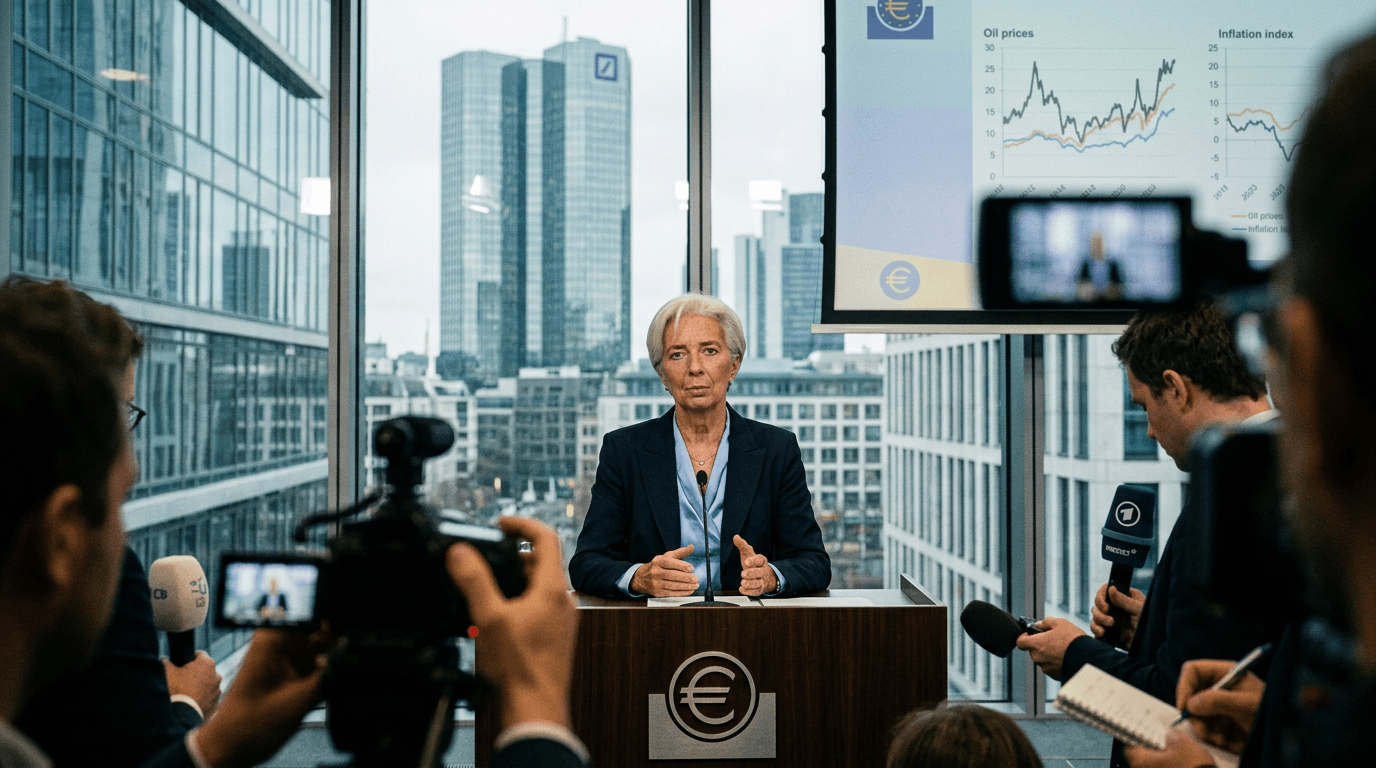
The European Central Bank (ECB) has opted to keep interest rates on hold, but the tone from policymakers is anything but complacent. By flagging the latest oil price spike as a clear upside risk to inflation, the ECB has effectively reminded markets that the tightening cycle may not be over, especially if the Middle East-driven energy shock proves persistent.[1][2][5] For traders, that mix of “pause today, optionality tomorrow” is fertile ground for volatility in rates, equities, and the euro.
WHAT THE ECB DECIDED – AND WHY IT MATTERS
At its latest meeting, the ECB left all three of its key policy rates unchanged: the deposit facility at 2.25%, the main refinancing rate at 2.40%, and the marginal lending facility at 2.65%.[1][9] That decision was broadly in line with market expectations, as previous hikes have already brought borrowing costs from ultra-low levels to territory seen as restrictive for the economy.[3][10]
The important shift was not in the rates themselves, but in the language. Officials stressed they are “closely monitoring the intensity and duration” of the new energy shock and its “indirect and second-round effects,” signaling that higher oil prices could derail progress in bringing inflation back to target.[5] In parallel, President Christine Lagarde highlighted that renewed hostilities in the Middle East and the rebound in crude prices pose upside risks to the euro area inflation outlook.[2]
This is a classic central bank balancing act: the ECB wants to avoid choking off a fragile recovery, but it also cannot ignore a fresh inflationary impulse coming from energy. Holding rates steady keeps financial conditions tight, while hawkish messaging preserves the option of further tightening if inflation fails to ease.
Key takeaway: The decision itself is neutral, but the guidance is hawkish. The ECB has deliberately kept the door open to additional rate hikes.
The Oil Shock: How Energy Prices Feed Into Eurozone Inflation
Energy is the transmission channel that worries the ECB most right now. A widening conflict in the Middle East has pushed oil prices higher again, reversing part of the earlier decline that had helped pull eurozone inflation down toward the 2% target.[5][8]
Oil affects inflation in at least three key ways
1) Direct impact on energy inflation Higher crude prices flow directly into fuel and heating costs, lifting the energy component of headline inflation. This effect can be fast and visible: petrol prices, utility bills, and transport costs respond quickly to oil shocks.
2) Indirect impact via production and transport costs When energy becomes more expensive, it raises input costs for firms across manufacturing, transport, and services. If companies pass those higher costs on, you get higher prices for goods and services beyond the energy sector itself.
3) Second-round effects via wages and expectations If households and firms start to expect higher inflation to persist, workers demand higher wages to protect real incomes, and businesses preemptively adjust prices. These second-round effects are what central banks fear most, because they can turn a temporary energy shock into a more persistent inflation problem.[5]
Recent ECB projections had assumed that inflation would settle near 2% over the next couple of years, helped by earlier drops in energy prices and a stronger euro.[8] A durable oil spike would challenge that narrative, forcing policymakers to choose between tolerating somewhat higher inflation or tightening policy further into a slowing economy.
Key takeaway: Oil-driven energy shocks matter not just because energy is volatile, but because they can unanchor inflation expectations if they last long enough.
Market Reaction: Rates, Bonds And The Euro
Even though rates were left unchanged, markets quickly focused on the implications of the ECB’s inflation warning. Traders have increased the probability of at least one additional 25-basis-point hike by the September meeting, effectively repricing the path of policy rates higher.[2][5]
In interest-rate markets, that typically shows up as:
- Higher yields at the front end of the curve, as short-dated bonds reflect the risk of another hike.
- A flatter or even inverted yield curve if investors believe tighter policy now will mean slower growth and lower inflation later.
The foreign exchange market is also sensitive to these shifts. A more hawkish ECB stance—especially if other major central banks are closer to cutting—tends to support the euro, particularly on dips, as investors favor currencies backed by higher expected real yields. The recent communication has indeed helped underpin the euro against peers, even without an actual rate move.
Equity markets face a more nuanced backdrop. On one hand, higher oil prices can support energy sector stocks. On the other, the prospect of tighter financial conditions and higher input costs can weigh on more rate-sensitive or energy-intensive sectors, such as industrials, discretionary consumer names, and some growth stocks.
Key takeaway: The ECB’s message has shifted risk pricing, not just policy expectations. That can create short-term trading opportunities in rates, FX, and sector rotations.
What Traders Should Watch Next
For traders—whether in live markets or simulated environments—the next phase is all about data and geopolitics. The ECB has tied its next move explicitly to how the energy shock evolves and how it feeds into the broader economy.[5]
Key data and drivers to monitor include
Energy prices and futures curves Sustained elevated oil prices, or a move higher in futures curves, would reinforce the case for prolonged inflation pressure. A rapid retracement would ease the urgency for additional hikes.
Inflation releases Headline inflation will react first to energy, but core inflation (excluding food and energy) will be crucial for gauging second-round effects. Persistent strength in services prices or wage-sensitive components would worry the ECB more than a one-off spike in fuel.
Wage growth and labor market indicators Strong wage gains in tight labor markets can amplify energy shocks. If wage settlements remain moderate, the ECB may tolerate some overshoot in headline inflation without further tightening.
Growth and survey data Business surveys, PMIs, and consumer confidence data will show how sensitive the real economy is to current interest-rate levels and higher energy costs. A sharp slowdown would give the ECB a reason to pause, even if inflation is sticky.
Key takeaway: This is a data-dependent, energy-dependent ECB. The meeting is over, but the trade is not.
Practical Takeaways For Simulated Traders
For traders using simulated finance platforms, this environment is a valuable testing ground for macro strategies without real capital at risk. The combination of an oil shock, a vigilant central bank, and shifting market expectations is a classic macro puzzle.
Several practical approaches to consider in a simulated setting:
Scenario-based trading Build scenarios around different paths for oil and ECB policy: for example, “oil spike persists and ECB hikes again” versus “oil retraces and ECB stays on hold.” Test how rates, the euro, and equity indices respond in each scenario.
Relative value across regions Compare the ECB’s stance with that of other major central banks. If the ECB appears more hawkish than the Federal Reserve or Bank of England, that may support euro strength in certain crosses. Simulated trades in FX pairs can help you explore these divergences.
Curve and sector strategies Experiment with trades that express views on the shape of the yield curve (steepeners vs. flatteners) or sector rotations in equity indices (energy vs. rate-sensitive sectors) as policy expectations shift.
Risk management under uncertainty An energy-driven inflation shock is, by nature, uncertain and geopolitical. Use the simulated environment to practice sizing positions, setting stop levels, and adjusting exposure as new data on inflation, growth, and oil prices arrive.
Key takeaway: The current ECB-oil dynamic is an ideal laboratory for building and stress-testing macro trading frameworks.