
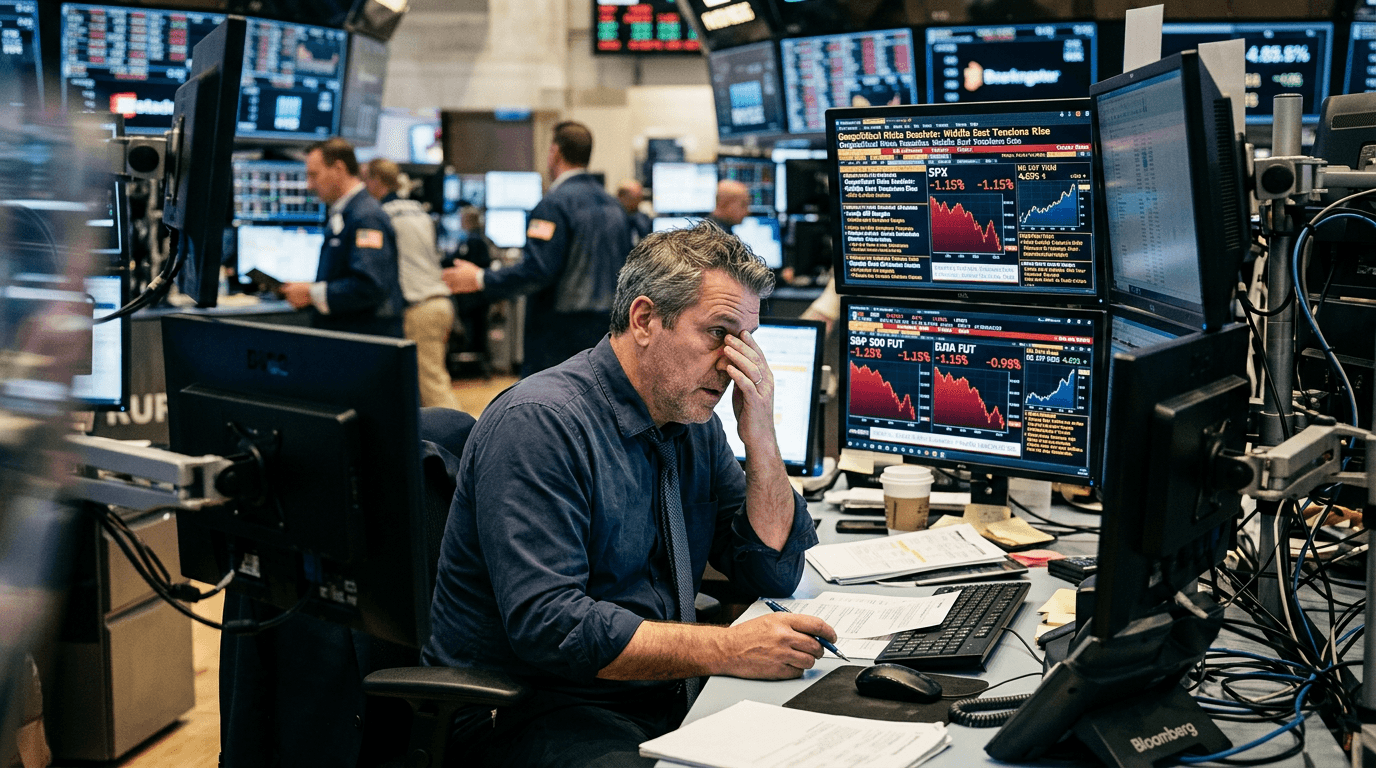
Stock index futures were under pressure again as rising bond yields and renewed geopolitical tensions pushed investors toward a more cautious stance, reinforcing a risk-off tone that has been building across markets[3][5][7]. U.S. contracts linked to the S&P 500, Dow, Nasdaq 100 and Russell 2000 all traded lower in early activity, reflecting broad-based stress rather than stock-specific weakness[3][5][9]. At the same time, longer-dated Treasury yields climbed to multi‑month highs, reminding traders that the era of cheap money is far from guaranteed[6][7][12].
Markets Pull Back As Yields Climb
Recent sessions have seen a clear pattern: equity futures soften whenever bond yields lurch higher, especially at the longer end of the curve[3][6][8]. S&P 500 futures have been down around 0.5% at times, with Nasdaq 100 futures underperforming and falling close to 1% as growth and tech names tend to be more sensitive to higher discount rates[3][5][8]. The weakness has coincided with the start of a historically softer period for equities, adding a seasonal headwind to the macro pressure from yields and oil[3][9].
Higher yields are coming from a broad selloff in government bonds, with the U.S. 10‑year moving toward the 4.7–4.75% range and 30‑year yields touching their highest levels in years[6][7][8]. Similar moves in Japan, France and Germany point to a global repricing of interest-rate expectations, not just a U.S.-only story[6][12]. For equity traders, the message is straightforward: the “risk-free” rate is rising, and the hurdle for owning stocks is going up with it.
Takeaway: When bond yields rise across the curve, index futures are likely to see pressure, particularly in rate‑sensitive growth sectors and leveraged strategies.
Why Higher Yields Pressure Stock Index Futures
To understand why futures slip when yields rise, it helps to revisit a basic valuation principle: the present value of future cash flows falls as the discount rate increases. Stock indices, especially those dominated by growth and tech names, are priced on expectations of earnings many years into the future. When Treasuries offer higher yields, investors demand a bigger risk premium to hold equities, leading to lower implied valuations and weaker futures pricing.
There is also a straightforward portfolio effect. Elevated yields on “risk‑free” government bonds make it more attractive for asset allocators to rotate out of equities and into fixed income[3][6][8]. That shift can be subtle and gradual, but index futures are highly sensitive to marginal changes in allocation flows, which show up as reduced demand on the bid side. For leveraged traders, higher yields also mean increased financing costs, making it more expensive to hold futures positions overnight—another factor that encourages de‑risking.
For SimFi participants, this dynamic is educational and practical. Simulated trading environments like E8 Markets allow traders to see in real time how a 20–30 basis point move in the 10‑year yield can translate into percentage moves in major equity futures contracts, without actual capital at risk. This is invaluable for building intuition around macro‑driven volatility.
Takeaway: Rising yields reduce equity valuations and shift relative appeal toward bonds, which tends to drag stock index futures lower and amplify risk aversion.
Geopolitics, Oil And Risk Aversion
The current risk-off tone is not only about yields. Persistent tensions in the Middle East have heightened worries about energy supply, shipping routes and broader regional stability[6][7][14]. Those concerns have helped push oil prices higher, feeding market fears that inflation could remain stickier than previously hoped[3][5][11]. When oil and other input costs rise, investors worry that central banks will need to keep policy rates elevated for longer, reinforcing the upward pressure on yields and the downward pressure on equity futures[5][14].
This combination—higher yields, higher oil, and geopolitical stress—creates a classic risk‑aversion setup. Investors are more reluctant to take on new positions in riskier assets, volatility premia rise, and futures markets become more prone to abrupt swings as liquidity thins out. In multiple recent sessions, futures have softened even before the cash market open, signaling that institutional traders are using the futures complex to adjust exposure quickly in response to headlines and data[3][6][13].
Takeaway: Geopolitical tension and rising energy prices can reinforce the impact of higher yields, creating a feedback loop where risk aversion grows and futures markets become more volatile.
What Traders And Simfi Participants Can Do Now
In a risk‑off environment driven by yields and geopolitics, traders benefit from focusing on process over prediction. One practical step is to integrate rate and macro indicators into a regular pre‑market checklist: tracking the 10‑year and 30‑year Treasury yields, key oil benchmarks, and major geopolitical headlines before making futures decisions. This helps ensure that index trades are made with full awareness of the broader context, not just technical patterns on a single chart.
Risk management also becomes more critical when volatility picks up. That means using position sizing and leverage more conservatively, widening stop‑loss levels thoughtfully to account for intraday swings, and avoiding overconcentration in the most rate‑sensitive indices, such as the Nasdaq 100, during sharp yield moves. For many traders, shifting emphasis from outright directional bets to relative-value or spread strategies—such as trading the performance gap between different indices—can reduce exposure to macro shocks.
SimFi platforms like E8 Markets offer an ideal environment to practice these adjustments. Traders can test scenarios such as “What happens to my equity index strategy if 10‑year yields jump 25 basis points and oil spikes 3–4%?” and observe the simulated P&L impact. Over time, this builds a more robust playbook for navigating real‑world episodes of risk aversion without emotional overreaction.
Takeaway: Use rising-yield episodes to refine macro awareness and risk management, and leverage simulated environments to stress‑test strategies before deploying real capital.
Conclusion
The slip in stock index futures as yields rise and risk aversion builds is a reminder that equity markets do not trade in isolation; they sit at the intersection of interest rates, inflation expectations, energy prices and geopolitics[3][5][6]. When multiple forces point in the same direction—higher yields, higher oil, and heightened regional tension—it is rational for investors to step back from risk and demand better compensation for owning equities[3][7][11].
For traders and SimFi participants, these periods are not just episodes of stress; they are rich learning opportunities. By paying close attention to how futures respond to shifts in yields and sentiment, and by adapting risk frameworks accordingly, market participants can turn short‑term volatility into long‑term skill. The goal is not to avoid risk altogether, but to understand it well enough that each decision is deliberate, informed and aligned with a cohesive macro view.