
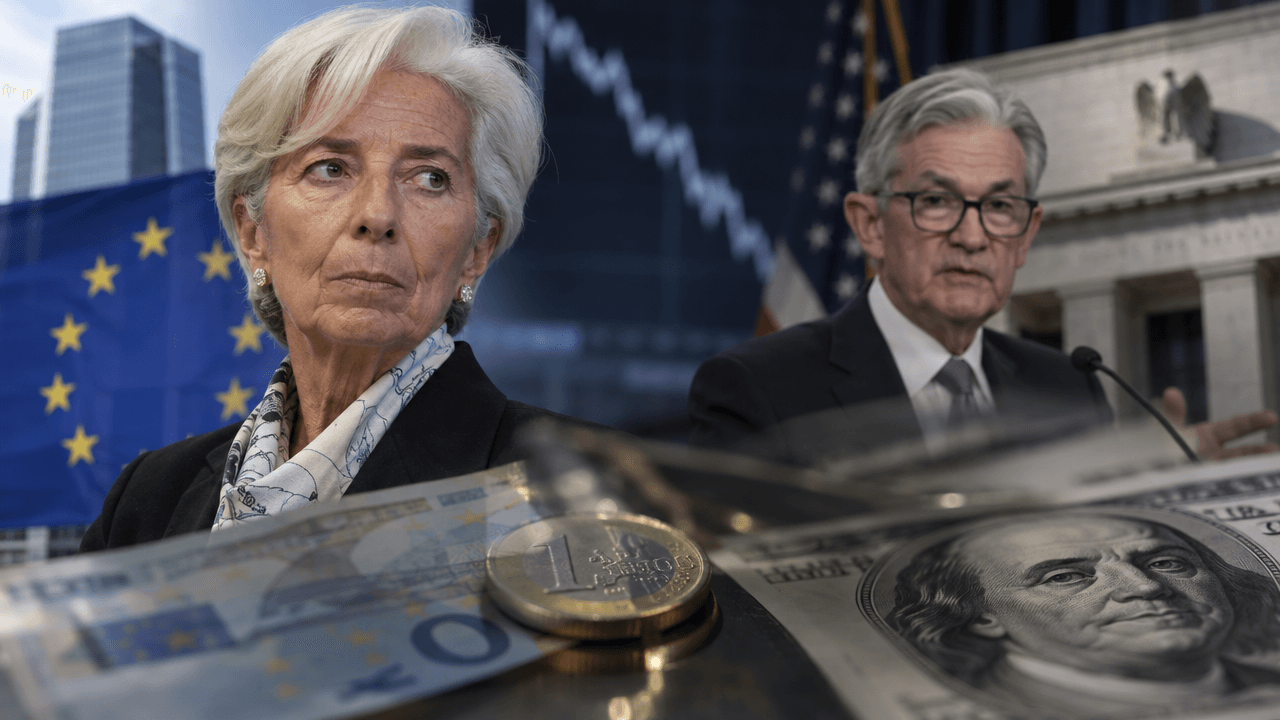
The euro’s renewed slide toward a two-month low against the US dollar is more than a headline; it is a live case study in how central bank expectations and global risk sentiment interact in FX markets[1][10][15]. With Christine Lagarde set to testify before the European Parliament, traders are recalibrating views on the European Central Bank’s (ECB) next moves while the dollar continues to draw support from higher US yields and stronger data[1][10][15].
Market Snapshot: Euro Under Pressure
In Monday’s European session, the euro resumed its decline against the dollar after a brief rebound late last week, drifting back toward levels last seen two months ago around the 1.14 area for EUR/USD[1][15]. Recent price action shows the pair fading from around 1.1390 and retesting lows near 1.1359, underscoring how rallies have been quickly sold in favor of the dollar[1]. This weakness is not isolated to EUR/USD; the euro has been soft against a basket of major currencies as investors favor the US dollar as a defensive, yield-bearing asset amid geopolitical tensions and elevated energy risks[1][9][12]. Stronger-than-expected US business surveys and a steady drumbeat of hawkish Federal Reserve commentary have reinforced expectations that US rates could stay higher for longer, further anchoring dollar strength[10][15]. Against that backdrop, every ECB communication, including Lagarde’s testimony, becomes a potential catalyst for either relief or fresh downside in the euro.
WHY LAGARDE’S TESTIMONY MATTERS
Christine Lagarde is scheduled to deliver remarks and take questions before the European Parliament’s Committee on Economic and Monetary Affairs, a venue where lawmakers often press the ECB on inflation, growth, and policy direction[1][3][7]. Markets will parse her language for hints about whether the ECB is inclined to keep raising rates or transition toward a pause after September’s increase[8][13]. Earlier this month, the ECB lifted its key rates by 25 basis points, bringing the deposit rate to roughly 2.5%, but Lagarde emphasized that the bank was not “pre-committing” to future moves, suggesting a meeting-by-meeting approach[8][11][13]. Since then, ECB projections have shown inflation staying above target well into 2027, driven in part by elevated energy prices and geopolitical shocks, implying that underlying price pressures remain a concern[9][12]. If Lagarde leans more hawkish than markets currently expect—stressing persistent inflation and openness to further tightening—EUR/USD could find support as traders price in a higher terminal rate for the euro area[1]. Conversely, if her tone signals growing caution about growth and financial conditions, markets may infer a lower ceiling for ECB rates, leaving the euro vulnerable to another leg down.
Policy Divergence: Fed Vs Ecb
The euro’s struggle is closely tied to a widening policy gap between the Federal Reserve and the ECB. The Fed recently delivered a 25 basis point hike to bring its target range to about 3.75%–4.00%, reinforcing its commitment to fighting inflation even as financial conditions tighten[10]. The ECB’s move to a 2.5% deposit rate, while significant by its own standards, leaves euro-area interest rates meaningfully below US levels and sustains an interest-rate differential that favors the dollar[8][10][13]. At the same time, euro-area inflation is expected to stay elevated for longer than previously anticipated, with energy price shocks and geopolitical conflicts prolonging the price spike[9][12]. Lagarde has signaled that the inflation shock will be more persistent, yet the ECB has opted for a more measured tightening path than the Fed, partly because European growth remains more exposed to energy and external demand risks[9][12]. For FX traders, this divergence translates into a simple but powerful narrative: a relatively hawkish Fed, a comparatively cautious ECB, and a currency pair that tends to drift lower unless the ECB’s tone or data meaningfully shifts the balance[10][15].
TRADING EUR/USD AROUND CENTRAL BANK EVENTS
From a trading perspective, Lagarde’s testimony is a textbook event where expectations, positioning, and liquidity can combine to generate sharp intraday swings in EUR/USD. In recent sessions, the pair’s range has clustered around 1.1440–1.1495, with downside probes toward the mid-1.13s marking key support zones watched by technical traders[1][10]. Short-term fair value estimates from major banks have slipped below 1.150 for the first time since late July, suggesting that markets now see lower equilibrium levels unless the ECB surprises on the hawkish side[10]. Traders will typically structure their approach around a few scenarios. In a hawkish surprise—Lagarde emphasizing persistent inflation risks and signaling tolerance for more hikes—EUR/USD could squeeze higher as short positions are covered and rate expectations move up[1][10]. In a dovish or cautious scenario—greater emphasis on downside risks to growth or financial stability—existing bearish bias may be reinforced, leaving support around the recent lows exposed[1][15]. Operationally, event-driven traders often reduce leverage ahead of such testimonies, widen stops to account for volatility, and focus on key inflection levels where liquidity may thin out, increasing the risk of slippage.
How Simulated Traders Can Turn Volatility Into Learning
For traders using simulated finance platforms like E8 Markets, this euro move offers a high-quality environment to test and refine FX strategies without real capital at risk. Central bank events are ideal for practicing disciplined preparation: mapping macro narratives, defining trading scenarios, and setting clear rules for entries, exits, and maximum drawdowns. A simulated trader might, for example, build three clear playbooks around Lagarde’s testimony—hawkish, neutral, and dovish—and pre-assign tactics for each, such as whether to fade the initial move or trade breakouts if price surges through key levels. Because EUR/USD is one of the most liquid pairs globally, it allows participants to explore different time frames, from fast reaction trades on the initial headlines to slower swing trades based on how rate expectations evolve in the days that follow. Importantly, simulated environments make it easier to study mistakes: chasing moves too late, ignoring risk limits, or failing to adjust to new information once the full text of Lagarde’s remarks is available. Documenting each decision in a trading journal—what was expected, what occurred, and how the strategy performed—turns market volatility into lasting skill-building.
Practical Takeaways For The Coming Sessions
As the euro hovers near its weakest levels in two months, EUR/USD is at a point where incremental shifts in central bank communication can have outsized price effects[1][10][15]. Traders should anchor their short-term view around a few key principles. First, understand that the dominant medium-term driver is the policy gap between the Fed and ECB; unless that gap narrows, rallies in the euro may continue to be sold[8][10][13]. Second, recognize that Lagarde’s testimony can alter expectations at the margin—especially if she offers clearer guidance on how persistent inflation might shape future decisions[9][12]. Third, manage event risk proactively: define acceptable loss limits, avoid over-leveraging into binary outcomes, and be prepared for rapid repricing once lawmakers’ questions elicit more candid responses. For simulated traders, this is an opportunity to stress-test strategies under real-world conditions, using live market narratives without the emotional weight of real P&L swings. Regardless of experience level, the lesson is the same: when currencies press toward multi-month extremes on policy and data themes, disciplined preparation and flexible thinking matter more than trying to predict every headline.
Conclusion
The euro’s slide toward a two-month low ahead of Christine Lagarde’s testimony captures a broader story of shifting rate expectations, persistent inflation, and a strong US dollar backed by higher yields and firm data[1][10][15]. Whether this move extends or reverses will depend heavily on how the ECB frames the trade-off between inflation control and economic resilience, and on whether markets see room for the euro area to close the policy gap with the United States[8][9][12][13]. For traders and simulated investors alike, this episode is a reminder that currencies do not move in isolation; they respond to the evolving dialogue between central bankers, data releases, and geopolitical shocks. Staying attentive to that dialogue—rather than just the price chart—can turn moments of volatility into informed, structured decision-making, both in live markets and in the SimFi environment.