
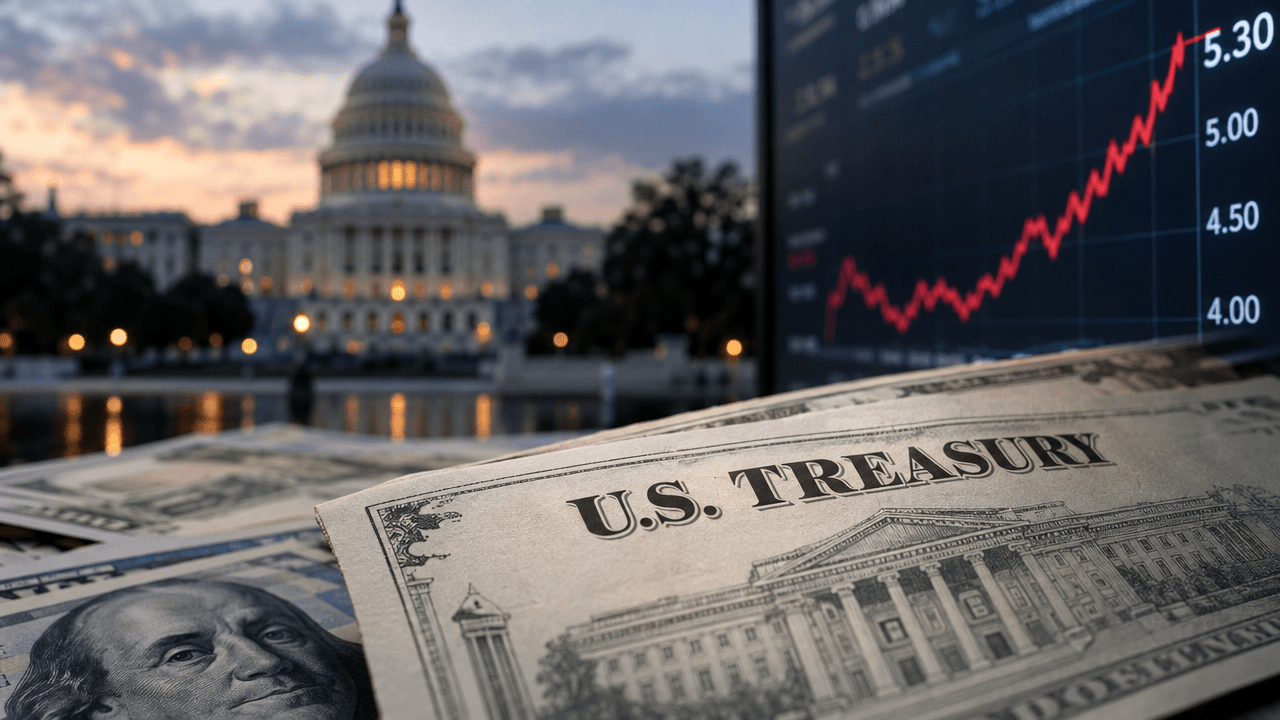
When the U.S. 10-year Treasury yield trades near 5%, financial markets pay attention. That level affects borrowing costs, equity valuations, currency markets, commodities, and futures pricing across the global economy. After briefly reaching approximately 5.3%—the highest level since 2002—the benchmark yield recently moved back toward 5.1%, but it remains historically elevated. [1][7]
For traders, the key message is not simply that yields are high. It is that markets remain highly sensitive to every inflation report, Federal Reserve signal, Treasury auction, and economic indicator that could influence the future path of interest rates.
Why Treasury Yields Matter
Treasury yields represent the return investors demand to lend money to the U.S. government. Because Treasuries are widely used as a benchmark for pricing financial assets, a move in the 10-year yield can quickly affect mortgages, corporate borrowing, stock valuations, and derivatives markets.
The 10-year note is especially important because it reflects more than expectations for the next Federal Reserve meeting. Its yield incorporates anticipated future interest rates, inflation expectations, government borrowing needs, and the term premium—the additional compensation investors require for holding a longer-maturity bond.
At roughly 5.1%, the 10-year yield is close to levels last seen nearly two decades ago. Market data showed the yield at 5.09% on October 16, 2026, more than one percentage point above its level a year earlier. [5] This creates a significantly different environment from the low-rate period that shaped markets during much of the 2010s and early 2020s.
WHAT IS DRIVING THE RECENT MOVE?
Inflation and Federal Reserve expectations remain the immediate catalysts. Stronger-than-expected economic data or a hot inflation reading can lead traders to price fewer rate cuts—or even a greater probability of additional hikes. Following a recent inflation report, the probability of a quarter-point Federal Reserve hike at the October meeting rose to approximately 35%, up from 22.1% the previous day. [13]
Energy prices have also contributed to the pressure. Higher oil prices can raise transportation and production costs, increasing concern that inflation may remain persistent. When inflation appears difficult to control, the Federal Reserve has less flexibility to ease monetary policy. That tends to push short-term yields higher and can also lift longer-term yields as investors reassess the broader economic outlook. [11]
However, not all of the move is explained by Fed policy. Treasury supply and auction demand matter as well. A weak 10-year Treasury auction can force yields higher as investors demand greater compensation to absorb new government debt. Recent analysis attributed part of the climb above 5% to a rising term premium following lackluster auction demand. [14]
Impact On Stocks, The Dollar, And Futures
Higher yields raise the discount rate used to value future corporate earnings. This tends to place pressure on growth stocks, technology companies, and other assets whose valuations depend heavily on cash flows expected many years in the future. A yield near 5.1% therefore creates a meaningful headwind for equity markets, even when corporate earnings remain solid.
The dollar can also react sharply. Higher U.S. yields may attract international capital, particularly when investors believe the Federal Reserve will maintain restrictive policy. That can support the dollar against other major currencies. However, if rising yields begin to signal recession risk, investors may instead seek safety in the dollar while reducing exposure to risk-sensitive assets.
Futures markets are particularly responsive because traders continuously update expectations for interest rates. Equity-index futures may fall when yields rise quickly, while Treasury futures generally move inversely to yields. A one-day inflation surprise can therefore produce simultaneous movements across bond, stock, currency, and commodity futures.
The relationship is not always straightforward. Recent market commentary noted that Treasuries can still act as a hedge when concerns shift from inflation toward economic growth or technology-sector stress. In that scenario, investors may buy government bonds even while longer-term yields remain historically high. [6]
Practical Takeaways For Traders
First, monitor the direction and speed of yield changes, not only the headline level. A gradual move toward 5% may be easier for markets to absorb than a sudden 20-basis-point surge.
Second, distinguish between short-term and long-term yields. Short-term rates are closely tied to expected Federal Reserve policy, while the 10-year yield is also influenced by inflation, government borrowing, auction demand, and economic growth expectations.
Third, watch scheduled economic releases. Inflation data, employment reports, retail sales, manufacturing surveys, and Federal Reserve speeches can all trigger rapid repricing.
Fourth, avoid treating a high yield as an automatic signal to sell stocks or buy the dollar. Market reaction depends on why yields are rising. Yields driven by stronger growth may affect assets differently from yields driven by renewed inflation or fiscal concerns.
For SimFi traders, this environment provides a useful framework for practicing cross-market analysis. Instead of viewing Treasury futures, equity-index futures, and currency pairs as separate instruments, consider how a single inflation surprise can connect them.
The Bigger Picture
U.S. Treasury yields remaining near 5.1% signals that markets are operating in a higher-rate regime. The recent move above 5.3% demonstrated how quickly inflation data, Federal Reserve expectations, and Treasury supply can reshape prices. [2][9]
The most important question is whether elevated yields become a stable new normal or continue rising because inflation and borrowing concerns are intensifying. Until that answer becomes clearer, traders should expect continued volatility and keep interest-rate expectations at the center of their market analysis.