
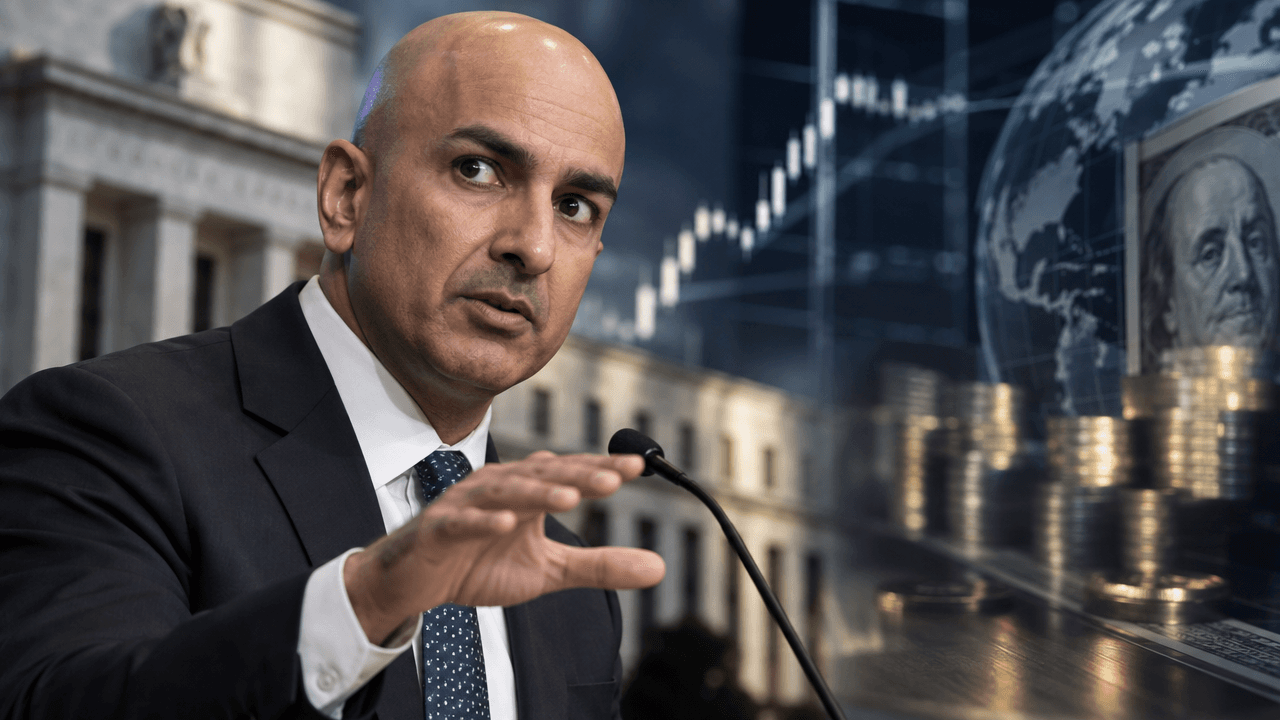
Federal Reserve commentary is once again anchoring market expectations around the possibility of another rate hike, keeping the “higher for longer” narrative firmly in focus for traders across asset classes.[4][6][11] For anyone active in rates, FX, or equity futures—whether live or in simulated environments—understanding how these signals translate into price action is essential.
WHY KASHKARI’S COMMENTS MATTER
Minneapolis Fed President Neel Kashkari has recently emphasized that inflation in the United States is still too elevated, even as some data points have come in softer than economists expected.[1][5][13] His message is that underlying price pressures remain broad-based and persistent, not confined to volatile components like energy.[7][13] That stance supports the view that restrictive policy may need to be maintained, and possibly tightened further, to bring inflation credibly back toward the Fed’s 2% target.[5][11]
Kashkari’s comments are not occurring in isolation; they sit alongside Fed projections that still point to at least one additional hike in the current cycle.[11][6][12] In recent dot plots, a majority of Federal Open Market Committee (FOMC) members signaled they see one more 25 basis point increase as appropriate before year-end.[6][11] Major brokerages similarly anticipate one further hike, with some houses even floating the possibility of more than 25 basis points of additional tightening depending on incoming data.[4][9] For traders, the key takeaway is that the probability of another hike is not a tail risk—it is part of the base case priced into many models.
Inflation, Rates, And The Dollar
The persistent inflation narrative is central to the Fed’s hawkish tone and its impact on the U.S. dollar.[1][5][13] When policymakers emphasize that inflation is “still too high,” markets infer that the policy rate is more likely to remain above neutral for longer, compressing the timeline for any future cuts.[1][11][12] That expectation typically supports the dollar relative to currencies whose central banks are closer to pausing or easing, as rate differentials move in favor of the United States.
Current Fed projections and market pricing suggest policy rates holding near recent highs, with at least one more incremental hike before a potential plateau.[6][10][11] In parallel, options and futures markets have increased the probability attached to a follow-up hike later this year, reflecting the influence of recent data and commentary.[4][8][12] For FX traders, that combination—hawkish talk plus supportive data—often translates into sustained demand for the dollar, especially against currencies backed by more dovish policy paths.
For rate-sensitive futures, the relationship runs in the opposite direction. Higher expected policy rates generally pressure the front end of the yield curve and weigh on instruments tied to funding costs, such as short-term interest rate futures and highly leveraged equity exposures.[4][8][12] When the market converges on a “higher for longer” scenario, it can also dampen the appeal of long-duration assets that are more sensitive to discount rate assumptions.
Impact On Rate-sensitive Futures And Risk Assets
A Fed path that includes at least one more hike this year keeps implied funding costs elevated and volatility alive in rate-sensitive futures.[4][6][11] Eurodollar and SOFR-linked futures, for example, tend to reprice aggressively when the distribution of rate outcomes shifts toward more tightening, pushing forward contracts lower as yields rise. Equity index futures with strong exposure to growth and high-valuation names can also feel pressure as discount rates move higher and earnings multiples compress.
Brokerage forecasts now cluster around scenarios with either one additional 25 basis point move or, in more aggressive cases, two separate hikes before year-end.[2][4][9] That range of outcomes keeps a meaningful “hawkish tail” in play, encouraging traders to maintain hedges against upside surprises in yields. In practice, that can mean short positions in long-duration bond futures, higher demand for protective put options on equity indices, and selective positioning in sectors more resilient to higher borrowing costs, such as financials.
At the same time, the Fed’s emphasis on data dependence—echoed by Kashkari and others—means that any shift in inflation or labor market indicators can quickly reshuffle odds and repricing.[1][11][14] Traders who ignore this conditionality risk treating a probabilistic path as a certainty, which can be costly when new information breaks the narrative. The core lesson: rate-sensitive assets remain exposed to both policy decisions and the evolving macro data that drives those decisions.
How Traders Can Position In A Higher-for-longer Scenario
In a world where another hike is seen as likely and cuts are pushed further out on the horizon, traders should think in terms of scenarios, not single-point forecasts.[6][11][12] One practical approach is to map positions to three broad cases: no further hikes, one additional hike, and more than one hike. By stress-testing portfolios under each, traders can see where their exposures are most vulnerable and adjust sizing or hedges accordingly.
For FX traders, the hawkish backdrop favors strategies that respect dollar strength while remaining alert to overextension. Pairs where the opposing central bank is closer to easing, or facing weaker growth, may offer more sustained trend opportunities aligned with the Fed’s stance.[12][13] For equity and index futures, focusing on quality balance sheets, positive free cash flow, and lower leverage can help cushion the impact of higher discount rates on valuations.
Rate traders can use simulated environments to practice managing curves that bear-flatten or bear-steepen as the market digests more hikes.[4][8][12] For example, running scenarios where front-end yields move up 25–50 basis points while the long end reacts less—or even rallies if the market believes the Fed will eventually succeed in cooling inflation—can teach valuable lessons about curve trades, butterflies, and relative value positioning.
Simulated Finance: Practicing Hawkish-fed Environments
Simulated Finance (SimFi) platforms give traders a risk-free way to explore how portfolios behave under shifting Fed narratives and rate expectations. By recreating conditions where policymakers like Kashkari are signaling persistent inflation and the possibility of additional hikes, traders can experiment with different strategies without capital on the line.[1][5][11] This is particularly useful for understanding how small changes in probabilities—say, moving from a 40% to a 60% chance of an extra hike—can ripple through futures curves and FX markets.[4][8][12]
Within a SimFi environment, traders can run playbooks for various macro releases, test policy surprise scenarios, and learn to adjust positions as central bank communication evolves. They can also track how hypothetical portfolios would have performed during recent periods of hawkish commentary and dot-plot revisions, building intuition about the interplay between Fed guidance, market expectations, and realized volatility.[6][10][11] The outcome is a more disciplined, data-driven approach to trading in live markets, grounded in repeated practice under realistic constraints.
Conclusion
Fed commentary that keeps rate-hike expectations elevated is more than background noise—it is a central driver of pricing in rates, FX, and equity futures. Kashkari’s insistence that inflation remains too high, combined with Fed projections and brokerage forecasts pointing to at least one more hike, reinforces a higher-for-longer regime that traders must take seriously.[1][4][6][11] The practical edge lies in treating policy paths as probabilities, stress-testing portfolios across scenarios, and using both live and simulated environments to refine strategies. For active traders, the message is clear: hawkish Fed signals are not just headlines, but actionable inputs for risk management and opportunity generation.