
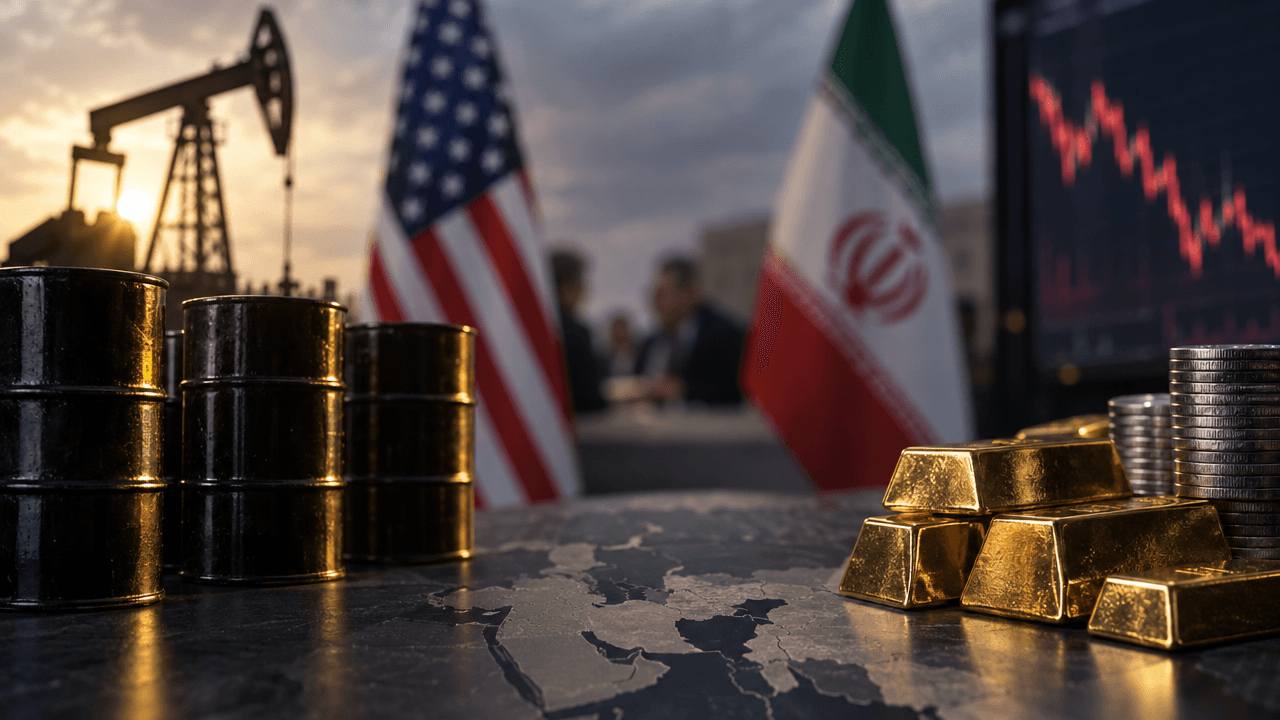
A stalemate in U.S.–Iran talks is reinforcing a cautious mood across global markets, with traders reluctant to add risk even as oil prices hover near recent highs rather than launching a fresh rally.[5][8] Earlier episodes of military escalation and shipping disruption in the region had already driven Brent and WTI sharply higher, leaving prices elevated and volatility firmer even when headlines briefly calm.[10][12][13] Against this backdrop, gold and other perceived safe-haven assets have attracted renewed interest, and risk-management demand in currencies and futures has picked up.
Geopolitical Tensions And Risk Appetite
When geopolitical shocks threaten energy supply, markets tend to reprice risk across asset classes, not just in oil.[4] Analysis of U.S. financial markets shows that oil-related geopolitical shocks typically reduce economic activity, lift inflation and are accompanied by higher risk premia in equities and credit.[4] In one calibrated scenario, a shock severe enough to cut U.S. stock prices by about 10% in the first month is associated with roughly a 30% rise in oil prices that stays above pre-shock levels for around two quarters.[4] That kind of shift forces investors to reassess growth, inflation and policy expectations all at once.
Corporate players feel this uncertainty acutely. Surveys of U.S. shale executives suggest that conflict in Iran has made planning difficult, with West Texas Intermediate crude climbing about 36% since hostilities began and year-ahead price expectations moving higher.[15] For financial traders, the takeaway is similar: prolonged tensions can compress risk appetite for equities and high-yield credit while keeping energy-linked assets in a regime of elevated volatility and wider risk premia.
How Oil Markets Price Conflict Risk
The relationship between geopolitical headlines and day-to-day moves in oil is not always straightforward.[2] Historical studies find that many geopolitical events do not produce large, immediate price spikes, and some shocks are quickly faded if supply continues to flow.[2] However, when tensions threaten key transit routes such as the Strait of Hormuz, the reaction can be far more pronounced.[9][10] U.S.–Iran confrontation has hampered oil and gas shipping through the strait, with tanker data showing that recent vessel transits have been well below typical 10-day averages even as official statements suggest flows are “near normal.”[9][10][13]
This kind of disruption sustains a risk premium in crude futures. Recent weeks have seen Brent hovering in the mid‑90s to above $100 per barrel, with weekly gains of more than 7% at times and U.S. crude rising nearly 10% over comparable periods as concerns about Middle East supply routes persisted.[10][13] Conflicting statements from U.S. and Iranian officials about cease-fire prospects and reopening Hormuz have kept those supply concerns alive, supporting prices even when intraday moves appear muted.[8] Traders are effectively paying for insurance against future shortages, and that insurance cost is embedded in the curve.
Research from global institutions reinforces how sensitive oil is to perceived supply risk. World Bank work suggests that in periods of surging geopolitical risk, a 1% reduction in oil production can generate a peak price increase of more than 11%, roughly double the impact of typical supply shocks.[7] Energy market studies from the U.S. Energy Information Administration reach similar conclusions: small percentage shocks to supply in a tense environment can translate into double-digit percentage moves in prices.[14] For portfolio and SimFi traders, these elasticities are useful for designing scenario tests.
Safe-haven Flows And Cross-asset Impacts
While oil trades with an embedded risk premium, other assets respond by shifting toward perceived safety. Episodes of heightened U.S.–Iran tension have coincided with the U.S. dollar holding near multi‑month highs, as higher oil prices feed inflation worries and strengthen expectations for a firmer path of interest rates.[11][9] In such periods, Brent has traded above $100–106 per barrel following the rejection of proposed peace deals and ongoing conflict around Hormuz, while investors simultaneously watch inflation data and central bank communication closely.[9][11]
At the same time, geopolitical uncertainty often acts as a negative global demand shock by clouding the economic outlook and dampening consumption, investment and trade.[6] That push‑and‑pull—higher energy costs but softer confidence—can support safe-haven assets like gold and certain government bonds even when yields are elevated, as investors seek diversification against tail risks. For currency and futures traders, this typically shows up as stronger demand for options protection, higher implied volatility in oil-sensitive FX pairs, and more frequent use of spread trades between risk assets and safe havens.
Practical Playbook For Traders And Simfi Users
For traders using real or simulated capital, U.S.–Iran tensions are a reminder that geopolitical risk needs to be treated as a structural factor, not just a headline to trade around. Several practical steps can help:
1) Map exposures to energy risk. Identify where your portfolio or simulated strategies are directly or indirectly tied to oil—energy equities, airlines, transportation, oil-sensitive FX pairs and inflation trades.
2) Build scenario ranges using historical elasticities. With evidence that a 1% production shock can drive oil prices more than 11% higher in high-risk periods, stress test your strategies for 10–20% oil moves and observe P&L impacts.[7][14]
3) Watch correlations and regime shifts. In calm periods, equities and oil may move together, but in conflict regimes, oil can rise while risk assets sell off and safe havens gain. Use correlation analysis in your SimFi environment to detect these shifts.
4) Adjust sizing to volatility. Weekly moves of 7–10% in crude during tense episodes imply much larger intraday swings and gap risk, making smaller position sizes and tighter risk limits prudent.[10][13]
5) Integrate cross‑asset signals. Combine information from oil futures curves, FX markets, and safe-haven assets to form a view on whether risk appetite is stabilizing or deteriorating further, and test how your strategies perform under each scenario.
Conclusion: Turn Uncertainty Into A Structured Plan
U.S.–Iran tensions are currently limiting risk appetite rather than driving a fresh, explosive rally in oil, but prices remain underpinned by a persistent geopolitical premium and fragile supply routes.[5][8][10] History and recent data show that when conflicts threaten key chokepoints, oil can move quickly and stay elevated, while broader markets demand higher compensation for bearing risk.[4][7][10] For traders and SimFi users, the value lies not in predicting the next headline, but in preparing: understand how oil shocks transmit through your portfolio, test scenarios systematically, and align position sizing and hedging with the reality of a more uncertain world. By turning geopolitical noise into structured risk management, you can navigate periods of tension with greater confidence and resilience.