
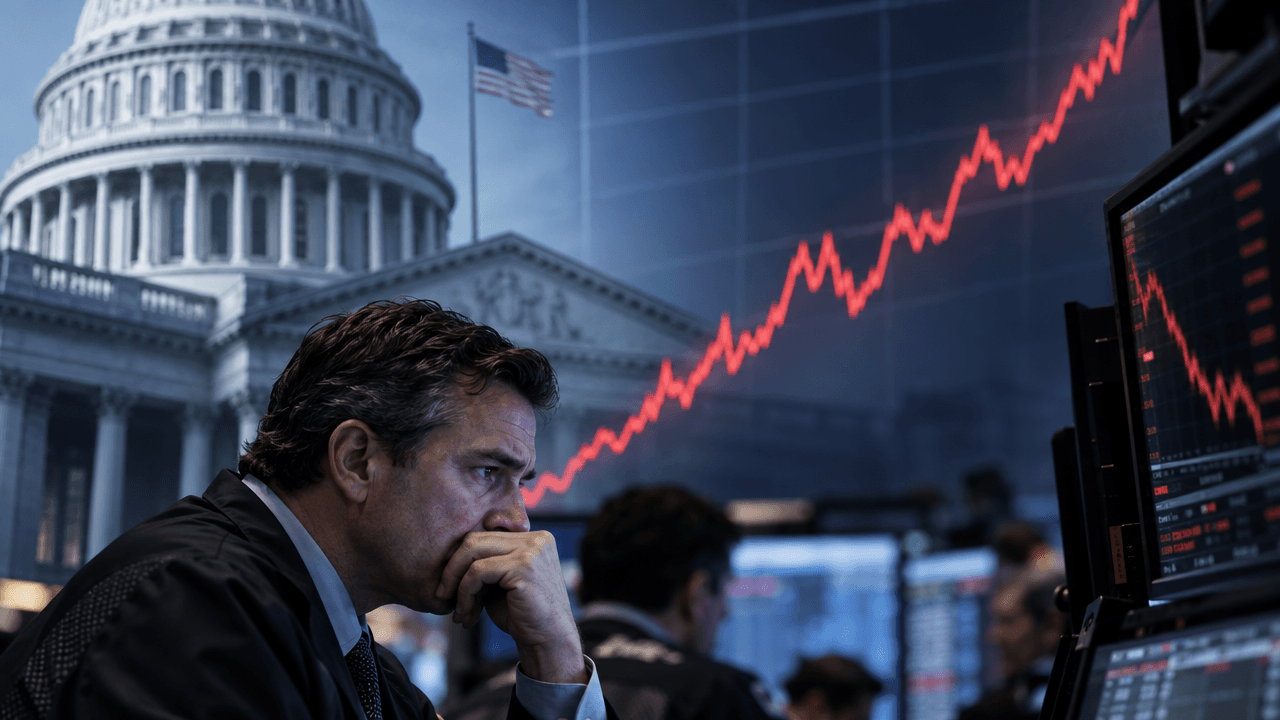
The surge in U.S. Treasury yields is reshaping the trading landscape in real time, forcing investors to reconsider the balance between risk and reward across equities, futures, and currencies. With the 10-year Treasury yield spiking above 5% and hovering around 5.3%—its highest levels since before the global financial crisis—financial conditions are tightening, equity futures are giving back gains, and the dollar is finding renewed support.[2][5][14][15]
Why Treasury Yields Are Surging
The 10-year U.S. Treasury yield now trades near 5.3%, up roughly half a percentage point over the past month and more than a full percentage point year-on-year.[2] It has repeatedly pushed above the 5% threshold in recent weeks, a level last seen in October 2023 and before that in 2007.[5][12][15] This jump reflects a mix of persistent inflation, expectations that policy rates will stay higher for longer, and rising concerns around U.S. fiscal sustainability.[13]
Importantly, the 10-year Treasury sits at the core of the global pricing system for risk, often used as the “risk‑free” rate in valuation models and capital budgeting decisions.[1] When this benchmark rises well above its long‑term average, as it has now, it mechanically lifts discount rates used by analysts and portfolio managers.[1][2] The result is an across‑the‑board repricing of assets, from growth stocks to real estate, as markets absorb a structurally higher cost of capital.[11][13]
How Higher Yields Pressure Equities And Futures
Higher Treasury yields impact equities through two main channels: valuation and fundamentals.[3][11] On the valuation side, future cash flows are worth less when discounted at a higher rate, hitting long‑duration assets such as growth and tech stocks particularly hard.[8][10][11] J.P. Morgan research shows that equity markets can digest gradual, growth‑led increases in yields, but rapid moves—like the recent jump toward 5%—are much more disruptive for prices in the short term.[8][10]
Fundamentally, a higher 10-year yield translates into more expensive borrowing for companies, pressuring margins, slowing buybacks, and weighing on investment plans.[3][11] Sectors that rely heavily on leverage or long-term financing, such as real estate, utilities, and capital-intensive industrials, tend to underperform when yields spike.[11][13] As investors can now earn 5% or more from “risk‑free” government bonds, equities must clear a higher hurdle rate, and marginal capital can shift out of stock indices and into Treasuries.[1][3][9]
Equity futures feel this pressure first. When yields lurch higher in a single session, index futures that were pricing in momentum or relief rallies often pare gains or flip negative as traders re‑run their models.[8][10][11] The move toward 5.3% on the 10‑year has coincided with choppy trading in major U.S. futures contracts and a stronger dollar, reflecting a rapid repricing of risk across global markets.[2][5][14][15]
Wider Market And Macro Implications
Surging long‑term yields tighten overall financial conditions, even if central bank policy rates are unchanged.[11][13] Corporate bond spreads may widen as investors demand additional compensation for duration and credit risk on top of higher risk‑free yields.[11] Households face steeper borrowing costs on mortgages and other loans tied to longer‑term benchmarks, feeding back into consumption, housing demand, and ultimately growth.[3][13]
From a macro perspective, the key question is why yields are rising. Vanguard analysis notes that if the move is driven by stronger real growth, the impact on equities can be relatively benign or even supportive.[13] However, if investors are demanding a higher term premium due to concerns about deficits and fiscal sustainability—as recent commentary suggests—the effect is more clearly negative for valuations and risk appetite.[13] In that scenario, elevated yields act as a tax on leveraged balance sheets and a drag on asset prices over time.[11][13]
The currency channel is equally important. Higher U.S. yields relative to other developed markets draw in capital, supporting the dollar and tightening conditions for economies that borrow or trade heavily in USD.[2][11][13] A strong dollar can weigh on multinational earnings, commodities priced in dollars, and emerging‑market assets, amplifying the global impact of the move in Treasuries.[11][13]
What This Means For Simulated And Real-world Traders
For traders using SimFi platforms like E8 Markets, a high‑yield environment offers a realistic testbed for strategies designed for more volatile, rate‑sensitive markets. The current regime—with the 10-year above 5% and the curve elevated across maturities—differs sharply from the near‑zero rate world many newer traders grew up in.[1][2][7] Simulated environments allow active participants to explore how index futures, sector rotation, and cross‑asset relationships behave when the risk‑free rate is no longer an afterthought but a central driver of returns.
This backdrop favors strategies that explicitly incorporate yields and duration into their frameworks. Growth‑heavy indices with earnings far in the future are more sensitive to discount‑rate shocks, while value and cash‑flow‑rich sectors may offer relative resilience.[8][10][11] Traders can use simulated portfolios to test how quickly to adjust exposures when bond markets move, how to hedge duration risk via futures or options, and how to balance equity beta against direct Treasury exposure.[8][10]
Practical Takeaways
1. Treat the 10-year yield as a core market signal, not just background noise. Track its level and pace of change daily and integrate it into your equity and futures views.[1][2][8]
2. Stress‑test growth and tech exposures for higher discount rates. Focus on cash‑flow timing: the further out the earnings, the greater the sensitivity to yield spikes.[8][10][11]
3. Reassess leverage and duration in portfolios. Elevated yields raise the cost of capital and increase the risk of drawdowns in highly leveraged or long‑duration assets.[11][13]
4. Watch the dollar alongside yields. A stronger USD can reinforce equity and futures volatility and create opportunities in FX‑linked and global macro strategies.[2][11][13]
5. Use simulated trading to rehearse playbooks for rapid yield moves—rotating sectors, adjusting hedge ratios, and scaling risk as conditions tighten.[8][10][11]
Conclusion
The surge in U.S. Treasury yields to levels not seen since 2007 is more than a headline; it is a regime shift that reverberates through equities, futures, credit, and currencies.[2][5][14][15] A higher, more volatile risk‑free rate raises the bar for risky assets, compresses valuations, and tightens financial conditions, with growth‑heavy indices particularly exposed.[8][10][11][13] For traders and investors—whether operating in live markets or simulated environments—the challenge and opportunity lie in adapting quickly: embedding yields into every decision, respecting the cost of capital, and building strategies robust enough to thrive in a world where 5% on Treasuries is once again a central fact of market life.[1][2][11][13]