
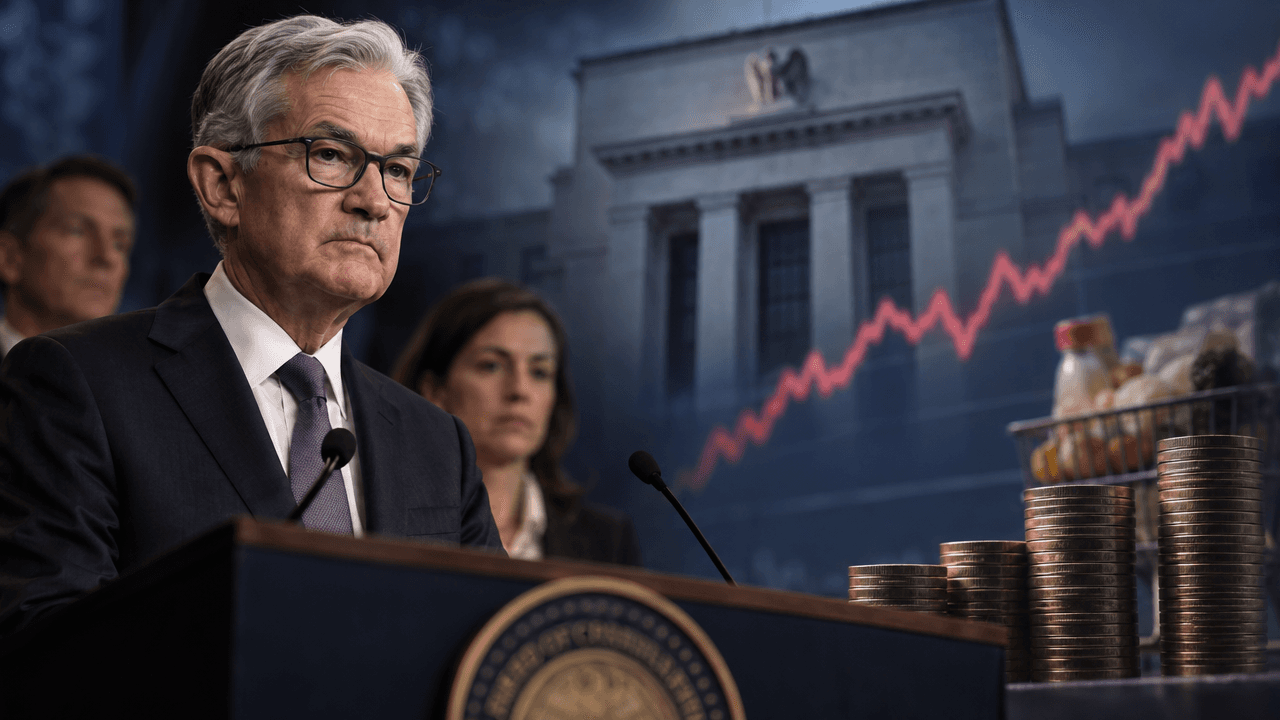
The Federal Reserve’s decision to hold interest rates steady was not a sign that policymakers are comfortable with the inflation outlook. Instead, the October meeting delivered what markets are calling a hawkish hold: the federal funds target range remains at 3.75%–4.00%, but two voting members argued that rates should be higher immediately. With September inflation still running well above the Fed’s 2% target, the pause may represent a temporary checkpoint rather than the end of the tightening cycle. [3]
A split decision matters because it reveals the debate inside the central bank. The Federal Open Market Committee voted 10–2 to maintain the current range, while Governor Lisa Cook and Cleveland Fed President Beth Hammack preferred a quarter-point increase. [2] Their dissent suggests that some officials believe inflation risks are more urgent than the potential damage caused by keeping borrowing costs elevated.
WHAT THE FED’S DECISION MEANS
The unchanged rate itself was widely anticipated. After raising rates by 25 basis points in September, the Fed chose to gather more information before taking another step. Maintaining rates gives policymakers time to evaluate inflation, economic growth, employment conditions and financial-market reactions.
However, a pause should not automatically be interpreted as a shift toward easier policy. The Fed can keep rates unchanged while still preparing markets for another increase. The two dissenting votes reinforce that possibility, particularly because both dissenters wanted a hike rather than a cut.
For traders, the key distinction is between “no change today” and “no more hikes.” October delivered the former, not necessarily the latter.
Inflation Remains The Central Problem
September’s Personal Consumption Expenditures data provided little reason for the Fed to declare victory. Headline PCE inflation increased 0.5% for the month and reached 3.6% over the year. Core PCE, which excludes food and energy, rose 0.3% monthly and 3.1% annually. [1]
The core reading is especially important because it is designed to provide a clearer view of underlying price pressures. At 3.1%, core inflation remains materially above the Federal Reserve’s 2% objective. The monthly increase also shows that progress toward price stability is uneven rather than consistently improving.
There were some encouraging details. On a quarterly basis, headline PCE inflation slowed to an annualized 2.1%, while core PCE eased to 2.5%. [1] Even so, policymakers must decide whether this moderation is durable or merely temporary. Strong consumer demand, rising service costs and persistent wage pressures could keep inflation from returning smoothly to target.
The result is a difficult policy balance. Cutting rates too soon could reignite demand and allow inflation expectations to become entrenched. Waiting too long could weaken employment and economic activity. The dissenters’ position indicates that, for them, the inflation risk currently deserves greater weight.
Markets Are Looking Past The Pause
Interest-rate futures continued to assign a high probability to a December increase. Estimates varied by market and timing, but pricing generally placed the likelihood of a quarter-point hike in the roughly 70%–80% range, with some measures moving closer to 85% after the decision. [16][18]
That pricing affects more than government bonds. A higher expected path for interest rates can support the dollar, lift Treasury yields and place pressure on rate-sensitive assets such as technology stocks, real estate and highly leveraged companies. It can also increase financing costs for businesses and households.
For equities, the impact is not always straightforward. A rate hike can weigh on valuations because future earnings are discounted at a higher rate. At the same time, a hawkish Fed may signal that economic activity remains strong enough to tolerate tighter policy. Markets therefore need to interpret both the rate decision and the reason behind it.
In foreign exchange markets, a stronger expectation of higher U.S. rates can improve the dollar’s relative appeal. In bond markets, traders may demand greater yields, especially at the front end of the curve, where securities are most sensitive to near-term Fed policy.
What Traders Should Watch Next
The next round of inflation and labor-market data will determine whether December expectations remain elevated. Traders should focus on the trend rather than one isolated report. Important indicators include monthly core PCE, consumer prices, wage growth, job creation and evidence of cooling demand.
A hotter-than-expected inflation report could strengthen the case for a December hike and push expectations toward additional increases in 2027. A meaningful decline in core inflation, combined with weaker employment data, could reduce the need for immediate action.
Market positioning also deserves attention. When a rate hike is already heavily priced, the announcement itself may produce a limited reaction. The larger move can come from changes in the expected path after the meeting. For example, a hike accompanied by language suggesting that policy is near its peak could be less damaging to risk assets than a hold accompanied by warnings of multiple future increases.
Practical Takeaways For Simfi Traders
Simulated traders should avoid treating the October hold as a simple bullish signal. Instead, build scenarios around three possibilities: a December hike, a continued pause, or a hawkish hold followed by further increases.
Track the dollar, two-year Treasury yields and rate-sensitive equity sectors together. These instruments can provide a clearer picture of changing policy expectations than any single market. Also consider volatility around inflation releases, when price movements can accelerate quickly.
Most importantly, risk management should take priority over predicting the exact Fed outcome. Use defined position sizes, avoid excessive leverage and consider how a sudden repricing of December expectations could affect correlated trades.
Conclusion
The Fed has paused, but it has not pivoted. A 10–2 vote, two calls for an immediate hike and inflation that remains well above target all support a cautious, hawkish interpretation of the decision. Markets are already preparing for the possibility of higher rates in December.
For traders, the central question is no longer whether the Fed acted in October. It is whether inflation is slowing quickly enough to justify a pause becoming a stopping point. Until the data provides a convincing answer, interest-rate risk will remain a dominant force across financial markets.