
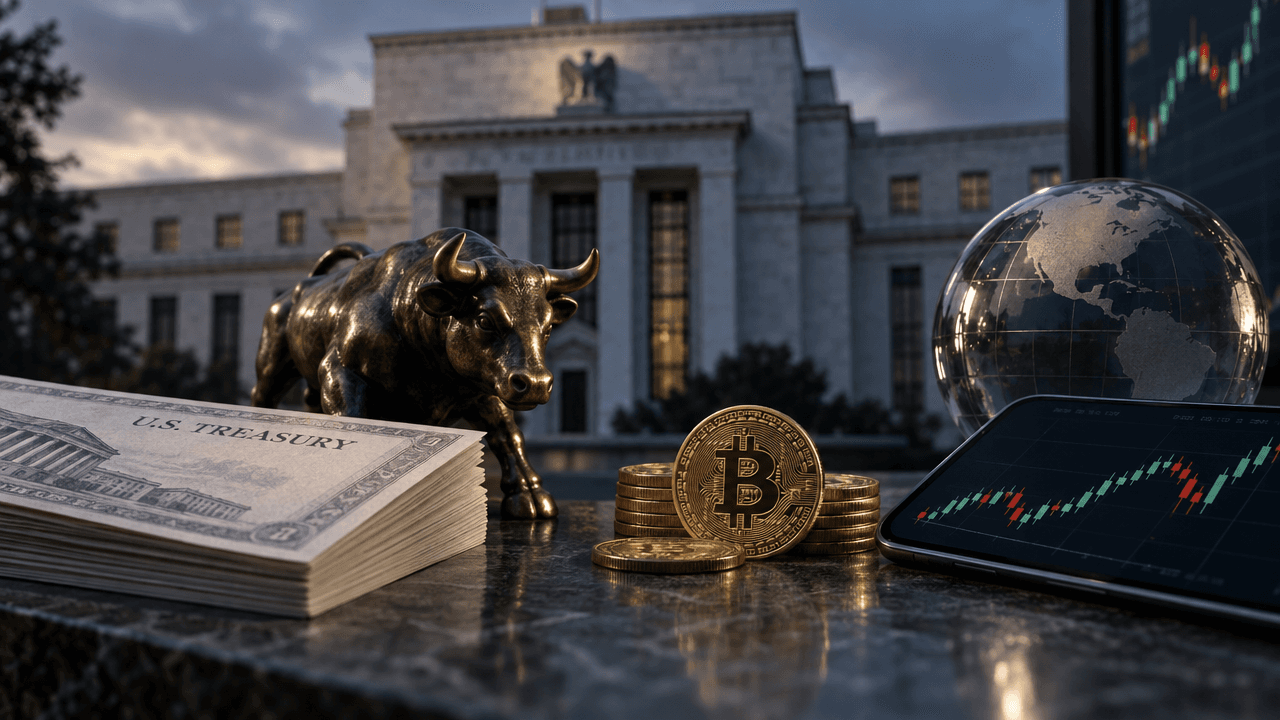
Federal Reserve tightening expectations are intensifying as officials signal that interest rates may need to rise several more times before spring 2027. Markets now broadly anticipate a quarter-point increase at the Fed’s December 8–9 meeting, while a smaller but meaningful probability has emerged for a larger 50-basis-point move. Traders are also considering additional increases in January, March, or April. [1][3]
The shift matters because financial markets had been hoping that the Fed was approaching the end of its tightening cycle. Instead, recent comments suggest policymakers remain focused on bringing inflation sustainably back toward the 2% target, even if that requires further pressure on economic growth, bonds, equities, and crypto assets.
Why Markets Are Repricing Fed Policy
St. Louis Fed President Alberto Musalem delivered the clearest recent warning. He said the economy will likely require “several interest rate increases” before spring 2027 to achieve price stability in a timely manner. Musalem also indicated that the real policy rate may need to rise to between 2% and 2.5% by next spring, roughly one percentage point above its current level. [1][8]
The real policy rate is the nominal interest rate adjusted for inflation. It is important because it measures how restrictive monetary policy is after accounting for the loss of purchasing power. If inflation remains elevated, a nominal rate that appears high may not be sufficiently restrictive in real terms.
Musalem’s comments suggest that policymakers may prefer a sequence of quarter-point increases rather than waiting for inflation to accelerate further. Based on the spacing of upcoming meetings, that could mean hikes in December, January, March, and April. [1][9]
The market does not treat every Fed official’s view as a guaranteed policy decision. Musalem is not a voting member at every upcoming meeting, and other officials may emphasize caution if employment or economic growth deteriorates. However, his remarks reinforce a broader hawkish message that investors cannot ignore.
What A December Hike Means
A December increase is increasingly viewed as the base case. Interest-rate futures have placed the probability of a quarter-point move above 95%, while some market measures have recently implied an almost certain hike. [3][7]
The more important question is what comes afterward. Investors are now weighing two competing possibilities: a single additional increase followed by a pause, or a sustained series of hikes that carries into early 2027.
A 50-basis-point increase would be a more aggressive signal. Recent reporting placed the probability of such a move in the low double digits, after that outcome had been considered nearly impossible only a short time earlier. [12][15] Even if the larger move does not occur, its appearance in market pricing demonstrates how quickly expectations can change when inflation data and official commentary point in the same direction.
For traders, the risk is not limited to the size of the next rate decision. Forward guidance, economic projections, and the tone of the press conference could have an even greater effect. A quarter-point hike accompanied by a promise of more increases may pressure markets more than a single larger hike framed as an exceptional action.
Impact On Bonds, Stocks, And Crypto
Bond markets generally respond negatively to expectations for higher interest rates. As investors demand greater yields to hold fixed-income securities, bond prices tend to fall. Longer-duration bonds are especially sensitive because their distant cash flows are discounted more heavily when rates rise.
Equity markets can also face pressure. Higher rates increase corporate borrowing costs and reduce the present value of future earnings. Growth and technology companies, whose valuations often depend on profits expected many years ahead, may be particularly vulnerable to rising Treasury yields.
That does not mean every stock must decline. Banks and some financial companies may benefit from higher lending rates, while businesses with strong cash flows, low debt, and pricing power may prove more resilient. The key distinction is whether the market is responding to orderly disinflation or to evidence that inflation is becoming harder to control.
Crypto markets are similarly exposed to tightening expectations. Digital assets often perform best when liquidity is abundant and investors are willing to pursue higher-risk opportunities. Higher real yields can make cash and government securities more attractive, reducing demand for speculative assets. Crypto prices may therefore react sharply to changes in rate expectations, even before the Fed formally acts.
Practical Lessons For Simfi Traders
Simulated Finance traders should focus on scenarios rather than trying to predict one exact Fed outcome.
First, monitor the difference between expected and unexpected policy. If a December hike is already fully priced, the immediate market reaction may be limited. A surprise change in the size of the move or the projected path could create the larger opportunity.
Second, watch Treasury yields and the U.S. dollar. Rising yields and a stronger dollar often reflect tighter financial conditions, which can weigh on equities and crypto. These relationships are not automatic, but they provide valuable context for cross-asset analysis.
Third, manage exposure around economic releases and Fed communications. Inflation data, employment reports, and speeches from voting members can quickly alter futures pricing. Position sizing, stop-loss planning, and defined risk are especially important when markets are repricing central-bank policy.
Finally, distinguish headline volatility from trend confirmation. A sharp move immediately after a Fed comment may reverse if subsequent data fails to support the tightening narrative. Building a trade around multiple confirming signals is generally more robust than reacting to a single headline.
The Bigger Market Message
The latest developments indicate that the Fed is prioritizing inflation control over near-term market comfort. Musalem’s warning does not guarantee four additional hikes, but it establishes a credible scenario in which rates remain restrictive well into 2027. [1][9]
For investors and SimFi traders, the central lesson is straightforward: the end of a hiking cycle cannot be assumed simply because rates are already high. Markets are forward-looking, and asset prices will continue adjusting to the expected path of policy rather than only the next meeting’s decision.
If inflation remains sticky, further increases could keep pressure on bonds, equities, and crypto. If economic weakness becomes more visible, the Fed may slow or pause. Until the data resolves that tension, disciplined scenario analysis will matter more than confident predictions.