
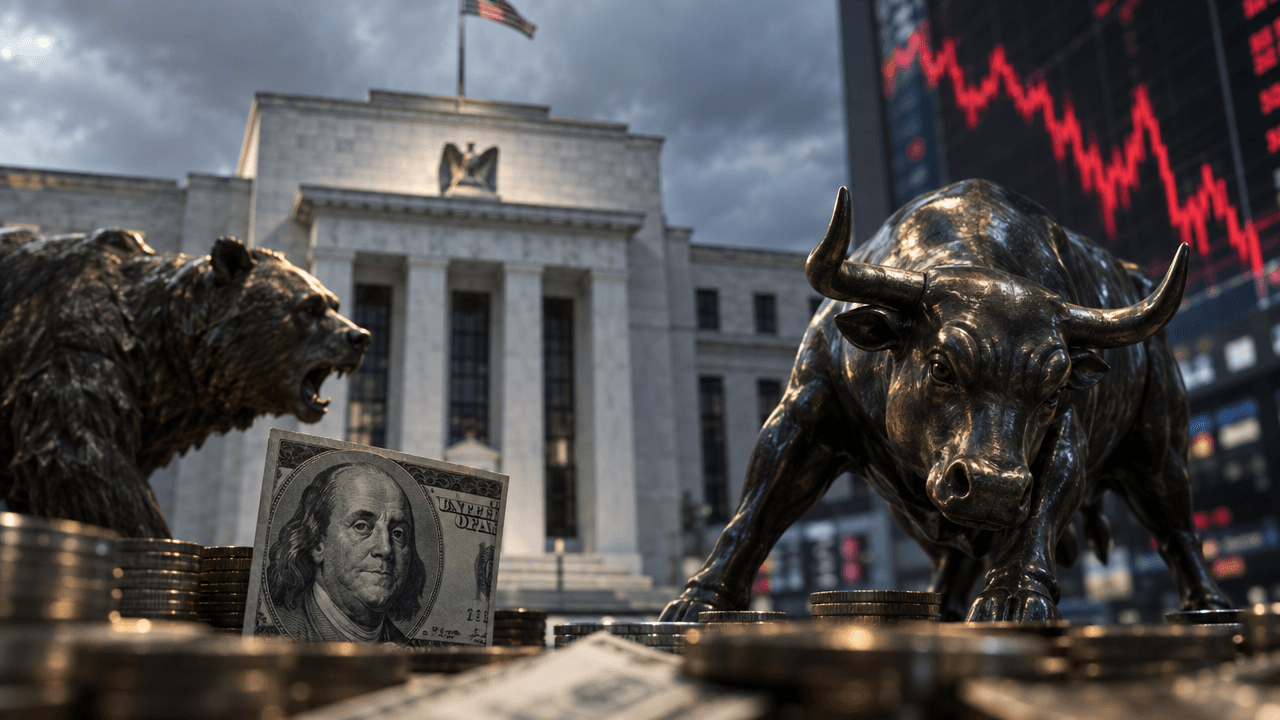
The Federal Reserve has just delivered its first interest rate hike in three years, raising the federal funds rate by 25 basis points to a target range of 3.75–4.00%, in a unanimous decision that marks a clear shift back toward tighter policy.[2][3][8][10] The move, paired with guidance that leaves the door open for another increase later this year, has propelled the U.S. dollar higher and left risk assets—from equities and commodities to crypto—on the back foot as markets rapidly re‑price the path of U.S. monetary policy.[4][7][9][12]
Fed Hike: What Just Changed
After holding rates steady since 2023, the Fed’s September meeting delivered a quarter‑point hike that lifted the benchmark rate to its highest level in this cycle.[2][3][8][10] Officials framed the move as a response to inflation that remains above the 2% target and renewed pressure from higher energy prices, indicating that the battle against price growth is not yet over.[4][11][15] The unanimous 12–0 vote underscores a strong internal consensus that policy needed to move further into restrictive territory.[2][4][7]
Beyond the headline hike, the Fed signaled that another increase later this year is very much on the table if inflation data and labor market conditions fail to cool meaningfully.[4][7][8][11] For traders, this is crucial: the market is no longer debating whether the next move is a cut or a hike—it is now focused on how long rates will stay “higher for longer.”[2][10][11] In practice, this means a sustained period of tighter financial conditions, higher discount rates, and more sensitivity to macro data across all asset classes.
Dollar Surges, Majors And Commodity Currencies Feel The Strain
The immediate winner from the Fed’s decision has been the U.S. dollar, which extended a multi‑month uptrend as traders priced in a more hawkish policy path.[5][12][13] The euro slipped to just below the 1.15 level against the dollar, its weakest point since late July, reflecting the widening policy and growth divergence between the U.S. and the euro area.[9][14] That break lower in EUR/USD reinforces dollar strength as a dominant theme and highlights how quickly FX markets respond when central bank expectations shift.[9][12][14]
Dollar gains have not been limited to Europe. A stronger greenback tends to pressure commodity‑linked currencies such as the Australian and New Zealand dollars, as well as emerging‑market FX, because tighter U.S. policy raises global funding costs and often dampens demand for higher‑beta assets.[5][12][13] At the same time, the yen and other low‑yielding currencies have struggled as rate differentials widen further in favor of the dollar, drawing even more capital flows toward U.S. assets.[12][13] For traders, the key message is that FX is once again a macro story dominated by central bank expectations, not just local data.
Risk Assets Wobble: Equities, Gold, Oil And Crypto
Higher policy rates feed directly into discount rates, and that tends to weigh on risk assets, especially segments of the market priced on long‑duration growth narratives.[2][4][10] U.S. Treasury yields have pushed higher across the curve, lifting real yields and reducing the relative appeal of non‑yielding assets like gold, which often struggles when real rates and the dollar rise in tandem.[4][5][12] Equity futures have turned volatile, with growth and tech names particularly sensitive as investors reassess valuations against a backdrop of tighter financial conditions.[4][12]
Commodity markets are caught in a cross‑current: on one side, a stronger dollar can pressure dollar‑denominated prices; on the other, ongoing supply dynamics and geopolitical tensions continue to support certain energy contracts.[4][11][15] Crypto assets, which typically trade as high‑beta proxies for liquidity and risk appetite, have also felt the impact of the Fed’s hawkish stance, with bitcoin and broader digital asset benchmarks experiencing choppy price action around the announcement.[4] This environment favors disciplined risk management and scenario planning over directional “all‑in” bets.
Implications For Traders Using Simulated Finance Platforms
For traders on SimFi platforms like E8 Markets, this Fed decision is an ideal case study in how macro catalysts ripple through every major asset class.[2][4][9] The 25‑basis‑point hike may sound small, but its signaling effect—affirming that the tightening cycle is alive and potentially not finished—is what drives cross‑market repricing in FX, indices, commodities, and crypto.[2][4][7][8] Simulated environments allow traders to stress‑test their strategies under shifting rate scenarios without putting real capital at risk, which is invaluable during periods of heightened policy uncertainty.
One practical application is to build and test trade ideas around clear macro themes: long‑dollar exposure against weaker currencies, relative value trades between equity sectors more or less sensitive to rates, or tactical positioning in gold and oil based on the interplay between yields, growth expectations, and supply factors.[5][9][12][13] Traders can also use the current environment to refine risk rules—such as widening or tightening stops around major central bank events, adjusting position sizes ahead of FOMC meetings, and running backtests on how their systems performed in previous hiking cycles.[2][10]
Key Takeaways For Your Trading Playbook
First, central bank policy is once again the primary driver of cross‑asset volatility, and the Fed’s move confirms that “higher for longer” is more than just a narrative.[2][4][10][11] Second, a stronger dollar and weaker risk assets tend to go hand in hand when markets shift from expecting cuts to anticipating further hikes, so FX and equity traders should pay close attention to rate‑sensitive sectors and currency pairs.[5][9][12][13] Third, macro events like this often produce short‑term overshoots in price, creating both opportunity and risk for traders who can distinguish between knee‑jerk reactions and durable trends.[4][9]
For SimFi participants, this is the moment to focus on process: build structured trade plans around major events, define clear entry and exit criteria, and monitor how your strategies handle sharp moves in volatility and correlation.[2][4] Use simulated accounts to explore “what if” scenarios—what if the Fed delivers another hike, what if inflation surprises lower, or what if growth slows faster than expected—and see how those outcomes cascade through your portfolio.[4][8][11] The goal is not to predict every Fed meeting perfectly, but to develop robust approaches that can adapt as the macro landscape evolves.
Conclusion
The Fed’s first rate hike in three years has reset the tone for global markets, lifting the policy rate to 3.75–4.00% and signaling that the fight against inflation is still underway.[2][3][8][10][11] The U.S. dollar has strengthened, EUR/USD has slipped below the 1.15 area, and risk assets are wobbling as investors confront a renewed period of tighter financial conditions.[5][9][12][14] For traders, this is less about a single 25‑basis‑point move and more about understanding how shifting expectations around the Fed’s path can reshape trends across FX, commodities, equities, and crypto.[2][4][10] Simulated finance platforms offer a controlled environment to learn, experiment, and refine strategies in real time—so the next time the Fed speaks, your trading plan is ready, not reactive.[2][4][8]