
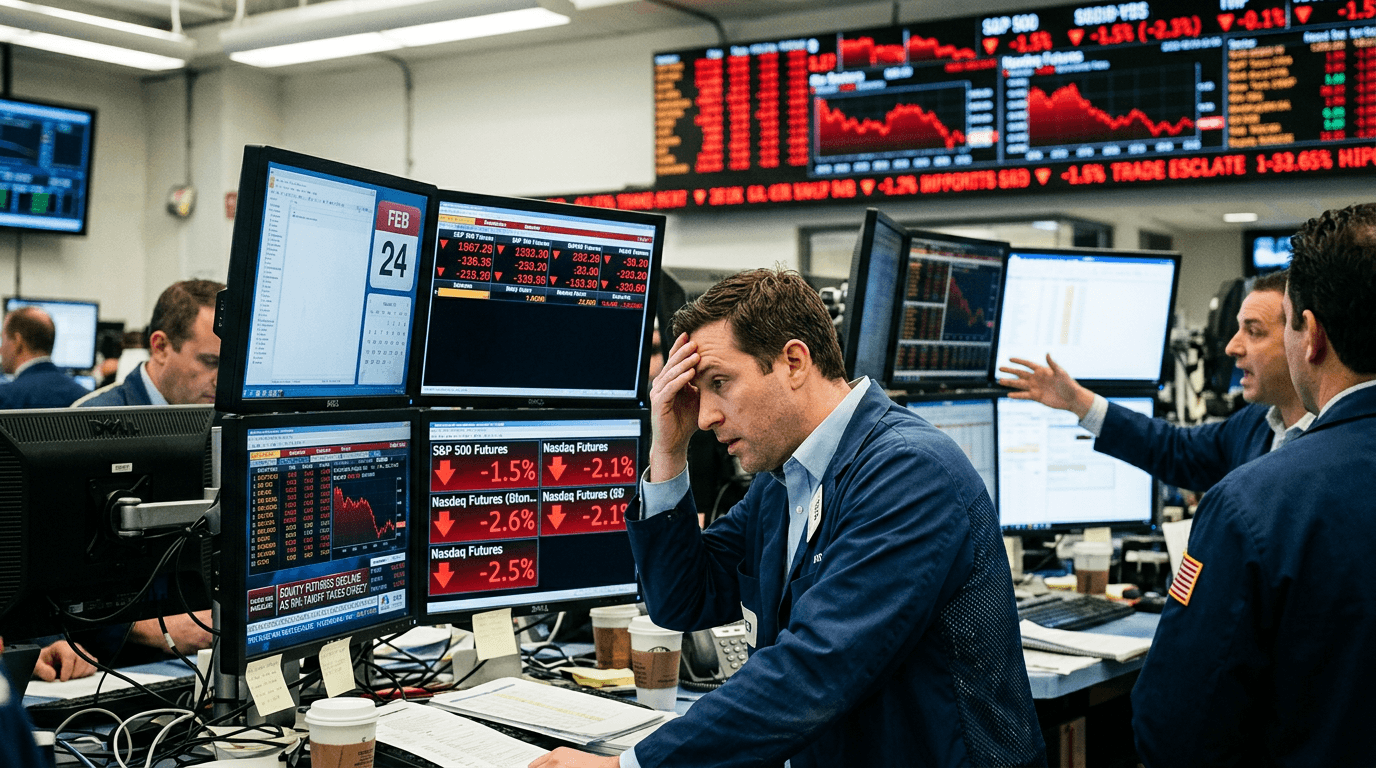
The U.S. tariff landscape shifted dramatically on February 24, 2026, when a sweeping 10% import duty took effect across nearly all incoming goods. Financial markets responded with predictable anxiety, as futures traders priced in the cascading uncertainties of a potential trade war escalation. For simulated finance practitioners and real traders alike, understanding the mechanics of this tariff regime and its market implications has become essential for navigating volatile trading conditions ahead.
The tariff action stems from a Presidential proclamation signed following a Supreme Court ruling that adjusted global import tariff rates.[1][2] The new framework imposes a flat 10% ad valorem import duty on articles imported into the United States for a period of 150 days, with certain exemptions for critical minerals, energy products, agricultural goods, pharmaceuticals, electronics, and specific other sectors.[2][3] Shortly after the initial proclamation, the President announced the rate would be raised to 15%, creating additional uncertainty about the true cost burden facing importers and consumers.[2]
Immediate Market Reactions
The announcement sent equity futures markets lower in early trading, with S&P 500 futures declining as investors factored in both direct and indirect costs of the tariff regime. This reflects a fundamental market reality: tariffs create winners and losers, and the initial shock typically hits broad-based indices as traders struggle to distinguish between sectors that will benefit from import protection versus those that will face higher input costs.
The futures decline captures legitimate economic concerns. Research from Yale's Budget Lab estimates that the current tariff regime will increase the unemployment rate by 0.3 percentage points by the end of 2026, with the long-run economy shrinking by about 0.1%, equivalent to roughly $30 billion annually in 2025 dollars.[2] These aren't trivial impacts, and futures markets correctly identified them as material headwinds for equity valuations.
Sectoral Impact Disparities
Not all sectors face equal tariff exposure, and sophisticated traders can exploit these divergences. The tariff regime falls most heavily on metal products, electrical equipment, and motor vehicles.[2] For traders of commodity futures, this creates both hedging challenges and potential opportunities. Metals prices could rise as tariff-driven input costs ripple through manufacturing supply chains, potentially supporting some commodity futures positions while pressuring companies' profit margins.
Automotive sector futures experienced particular pressure, as this industry sits at the intersection of tariff impacts. Imported finished vehicles face the 10% duty, component suppliers face elevated input costs, and the global automotive supply chain—already stressed from previous trade frictions—confronts additional complexity and expense.
Conversely, certain goods gain relative protection. Agricultural exports benefit from exemptions, and domestic-focused producers in protected industries might experience modest futures strength as import competition diminishes. However, this retaliation risk complicates the narrative. Trading partners facing the new tariffs almost certainly will respond with their own measures, potentially targeting American agricultural exports and other sectors central to specific countries' economies.
Price Level And Household Impact
The Budget Lab's baseline analysis assumes the 10% Section 122 tariffs expire after 150 days as scheduled.[2] Under this scenario, the ultimate price level impact reaches between 0.5% and 0.6%, representing an average household loss of between $600 and $800.[2] If tariffs become permanent, these figures rise to 0.8%-1.0% price impact and $1,000-$1,300 household losses.
For futures traders, this translates into measurable deflation-adjusted commodity price movements and consumer spending compression. Inflation futures and real yield expectations recalibrate as markets process higher embedded input costs that consumers will ultimately bear through higher prices rather than wage adjustments, assuming the Federal Reserve allows price increases rather than accommodating them through monetary expansion.
Revenue And Economic Dynamics
The tariff regime will generate approximately $1.3 trillion in conventional revenue over ten years, with Section 122 tariffs contributing about $30 billion.[2] However, the negative economic effects reduce tax revenue by an estimated $180 billion over the decade, bringing net dynamic revenue to approximately $1.1 trillion. This fiscal arithmetic matters for bond futures markets, as higher revenues could theoretically reduce deficit pressures, though lower growth complicates the picture.
Trading Implications And Forward Outlook
The 150-day expiration window creates a critical decision point. If Section 122 tariffs expire as scheduled, the effective tariff rate will reach 9.1%, the highest since 1947.[2] Futures traders face substantial uncertainty: will the administration extend these duties, negotiate their removal, or allow them to lapse? Each scenario produces dramatically different market outcomes.
The retaliation risk remains the most consequential wild card. Trade partners' responses could accelerate volatility spikes in equity index futures, energy futures, and agricultural commodity futures. Currency futures will respond to shifting trade flows and capital allocation patterns.
For SimFi practitioners, this environment offers genuine educational value. The tariff regime demonstrates how policy actions ripple through interconnected markets, how sectoral divergences create trading opportunities, and how uncertainty premiums embed themselves into futures prices. Successful navigation requires monitoring exemption details, tracking retaliation threats, and positioning defensively until post-150-day clarity emerges.
The futures markets' caution reflects rational risk assessment, not overreaction. Traders should expect continued volatility as the market processes whether trade war escalation accelerates or diplomatic resolution emerges.