
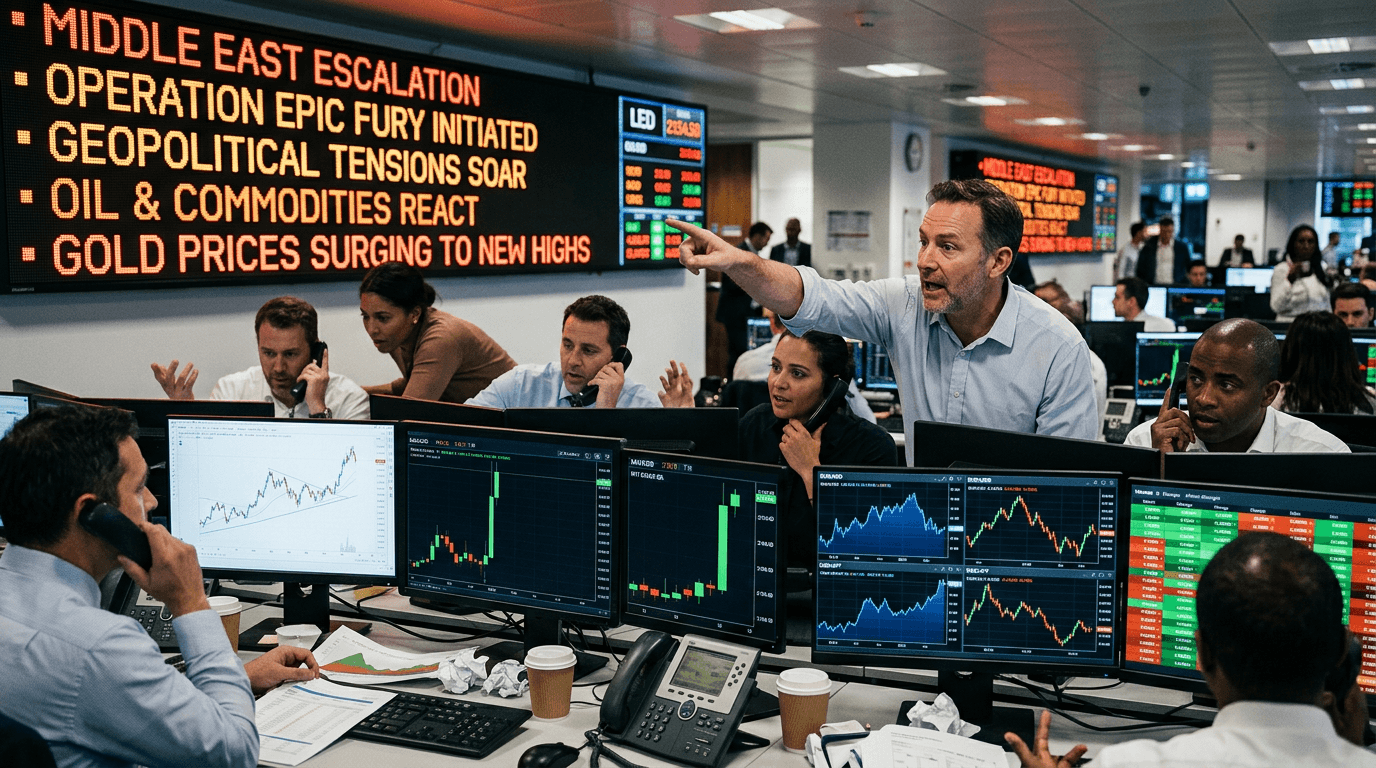
Geopolitical tensions have a way of moving markets in unexpected ways, and the events of today prove why investors constantly monitor global headlines alongside their portfolios. On February 28, 2026, the United States and Israel launched Operation Epic Fury, a major military offensive against Iranian targets, setting off a chain reaction across global financial markets. The immediate winner? Gold, which surged to a record $5,278 per ounce as investors rushed to safe-haven assets in the face of escalating Middle East conflict.[1][2]
This represents more than just a price spike for precious metals traders. It reflects a fundamental shift in market sentiment, where geopolitical risk has reasserted itself as a primary driver of investment decisions. Understanding what happened, why markets reacted this way, and what comes next is essential for any trader navigating today's volatile landscape.
The Geopolitical Trigger
Operation Epic Fury represents a dramatic escalation in U.S.-Iran tensions that had been building for weeks.[1] The joint U.S.-Israeli military campaign targeted Iranian military installations, missile sites, nuclear-related facilities, and reportedly senior leadership figures including Supreme Leader Ayatollah Ali Khamenei.[1] President Trump announced the strikes in an eight-minute Truth Social video, describing the operation as "major combat operations" and framing it as a preemptive measure to neutralize Iran's nuclear program and missile capabilities.[1]
The operation followed the collapse of indirect nuclear negotiations mediated by Oman in Geneva on February 26. The U.S. had demanded Iran fully dismantle key nuclear sites, export enriched uranium, halt ballistic missile development, and cease support for proxy groups.[1] Iran rejected these terms entirely, demanding complete sanctions removal and refusing to destroy facilities. With diplomacy exhausted, military action became the administration's chosen path.[1]
What makes this situation particularly volatile for markets is the Iranian response. Rather than accepting the strikes passively, Tehran retaliated by launching missiles at Israel and U.S. military bases across the Gulf region, including facilities in Qatar, Kuwait, Bahrain, and the United Arab Emirates.[5] This tit-for-tat escalation pattern is precisely what investors fear most: a conflict with momentum that could spiral beyond anyone's control.
Gold's Safe-haven Surge
When geopolitical risks spike, capital flows toward assets perceived as safe and stable. Gold, with its millennia-old role as a store of value, becomes the ultimate defensive position.[1][2] The metal surged to $5,278 per ounce as the conflict unfolded, reflecting investors' collective assessment that this situation could have serious, prolonged consequences.
The timing of this gold rally is significant. It occurred simultaneously with heightened volatility in equity markets, where defense contractors may see temporary gains but broader indices face pressure from uncertainty. Meanwhile, traditional safe havens like U.S. Treasury bonds also attracted demand as investors reassess their risk exposure.
What's particularly noteworthy is that this isn't merely a short-term trading spike. Analysts are forecasting potential rises to $6,750 per ounce if geopolitical tensions remain elevated or deteriorate further.[2] This suggests market professionals view today's events as potentially catalyzing a sustained shift in the macroeconomic environment, not just a brief headline-driven trade.
Forex And Commodities Market Impact
Beyond gold, the military escalation has rippled across global financial markets. Oil prices have likely spiked due to fears of supply disruption in one of the world's most critical energy regions. The U.S. dollar typically strengthens during geopolitical crises as foreign investors seek American safety assets, though this dynamic can shift if the crisis is perceived as directly threatening U.S. interests.
Currency volatility in the region has intensified, with traders avoiding exposure to Middle East-tied assets. This creates both challenges and opportunities for forex traders who understand how to navigate geopolitical risk premiums. The Israeli shekel, the Iranian rial, and other regional currencies face pressure as capital retreats to major reserve currencies.
Commodity markets more broadly have experienced a repricing as investors consider supply chain disruptions. Beyond oil, shipping routes through the Persian Gulf face elevated risk, potentially impacting prices across multiple commodity classes. For SimFi traders, this represents an excellent case study in how a single geopolitical event cascades through interconnected markets.
What Traders Need To Know
First, volatility will likely persist for days or weeks as the situation develops. Markets hate uncertainty, and military operations rarely conclude quickly or cleanly. This creates both opportunities for skilled traders willing to analyze developments closely and risks for those caught off-guard.
Second, diversification becomes critical in environments like this. Traders holding concentrated positions in equities or emerging market assets have already experienced significant drawdowns. Those who maintained precious metals allocations saw those positions surge in value, providing crucial portfolio balance.
Third, geopolitical risk is not easily predictable, but it is observable. Monitoring news flows, official statements, and military movements provides traders with data to make informed decisions about positioning and risk management.
Looking Ahead
The coming days will be crucial in determining whether Operation Epic Fury remains a contained operation or escalates into a broader conflict. Either outcome has profound implications for traders and investors. A rapid resolution might trigger a sharp reversal in gold prices and safe-haven demand. A prolonged standoff could sustain elevated precious metals valuations and continued equity market pressure.
For SimFi traders and investors, this moment serves as an important reminder: geopolitical events matter. Markets don't exist in a vacuum isolated from real-world events. Understanding how conflict, diplomacy, and military action interact with financial systems is essential for navigating modern markets successfully.