
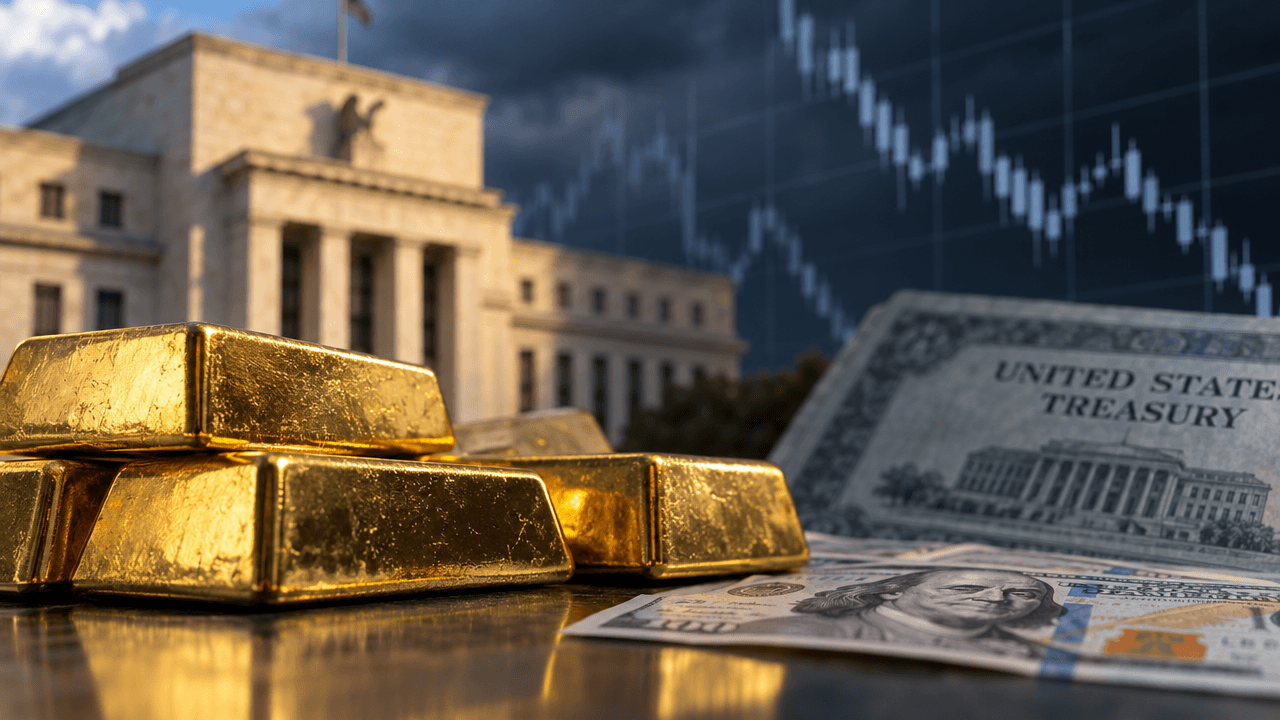
Gold remains near a three-month low as traders wait for a series of central-bank decisions that could determine whether the precious metal stabilizes or extends its decline. Spot gold was holding close to $4,008 per ounce after slipping below recent highs, while a stronger U.S. dollar and elevated Treasury yields continued to reduce demand for the non-yielding asset. [12]
The immediate focus is the Federal Reserve’s policy meeting on October 27–28. Markets broadly expect policymakers to leave interest rates unchanged, but traders are looking for guidance on whether another increase could arrive in December. That forward-looking message may matter more for gold than the decision itself. [1]
Why Gold Is Under Pressure
Gold does not pay interest or dividends. As a result, its opportunity cost tends to rise when investors can earn more from relatively low-risk assets such as U.S. Treasury securities. The 10-year Treasury yield was near 4.99%, while the two-year yield was around 4.71%, keeping pressure on assets that generate no regular income. [12]
Higher yields can influence gold in two ways. First, they make bonds more attractive to investors seeking income. Second, rising yields often reflect expectations that interest rates will remain elevated for longer. That outlook can reduce the appeal of holding gold as traders wait for a more favorable monetary-policy environment.
The U.S. dollar has added another headwind. Gold is priced internationally in dollars, so a stronger dollar makes each ounce more expensive for buyers using other currencies. On October 27, the dollar rose against a basket of major currencies and reached a near two-week high, contributing to the decline in spot gold. [1]
THE FEDERAL RESERVE’S MESSAGE MATTERS MOST
A decision to hold rates steady is already widely anticipated, meaning the market reaction will likely depend on the wording of the statement and comments from Federal Reserve officials.
A hawkish message could weigh on gold. If policymakers emphasize persistent inflation or signal that another rate increase remains possible, Treasury yields and the dollar could move higher. That combination would increase pressure on gold and could push prices below the important $4,000 psychological level.
A more dovish message could produce the opposite reaction. If the Fed acknowledges slowing economic activity, shows less concern about inflation, or reduces the likelihood of a December hike, yields and the dollar could retreat. Gold could then attract renewed demand from traders positioning for lower interest rates.
Markets were assigning a high probability to a December rate increase, with some estimates placing the odds near 80%. That means even a modest change in expectations could create a sharp move in gold. [1]
A Busy Week For Central Banks
The Fed is not the only institution in focus. The European Central Bank is scheduled to announce its decision on October 29, followed by the Bank of Japan on October 30. Both are broadly expected to keep policy unchanged, but their guidance could still affect currency markets, global yields, and investor sentiment. [9]
The ECB’s outlook will be important for the euro and the dollar. A relatively cautious ECB could support the dollar and create another obstacle for gold. Meanwhile, Bank of Japan commentary may affect the yen and broader expectations for global interest-rate normalization.
Central-bank decisions can also change demand for gold through their effect on risk appetite. If policymakers sound worried about growth or financial stability, investors may seek defensive assets. Gold can benefit from that behavior, although a stronger dollar during periods of stress can sometimes offset safe-haven demand.
Key Price Levels To Watch
The $4,000 level is the most visible near-term reference point. Gold recently moved below its previous range and tested a three-month low near $3,975 before recovering modestly. Holding above $4,000 could suggest that buyers are attempting to stabilize the market, while a sustained break below that level may reinforce the bearish trend. [6]
On the upside, the $4,031–$4,049 area represents nearby resistance. A move above that zone would indicate that buyers are regaining short-term control and could open the way toward higher resistance levels. However, rallies that fail below resistance may simply reflect temporary bargain-hunting rather than a confirmed trend reversal. [12]
Traders should avoid treating any single price level as a guaranteed turning point. Volatility can increase significantly after a central-bank statement, particularly when markets are positioned heavily for one outcome.
Practical Takeaways For Traders
First, distinguish between the interest-rate decision and the policy guidance. A rate hold may already be priced in, while a change in the expected path of future rates can move gold sharply.
Second, monitor the dollar and Treasury yields alongside XAU/USD. A gold rally supported by falling yields and a weaker dollar generally has stronger macroeconomic confirmation than a move driven only by short-term technical buying.
Third, define risk before the announcement. Traders using simulated finance accounts can practice setting entry levels, stop-loss points, and profit targets without exposing real capital to event-driven volatility.
Finally, avoid overleveraging. Central-bank announcements can produce rapid price swings, widened spreads, and false breakouts. Waiting for the first reaction to settle may offer a clearer setup than entering immediately before the decision.
Conclusion
Gold’s position near $4,008 reflects a market caught between long-term defensive demand and short-term monetary-policy pressure. Elevated Treasury yields and a firmer dollar are limiting buying interest, while expectations surrounding the Federal Reserve, ECB, and Bank of Japan could determine the next major direction.
For now, $4,000 remains the key psychological level. A dovish shift from central banks could help gold recover, but renewed concern about inflation and higher-for-longer interest rates may leave the metal vulnerable to another test of its recent lows. The most important lesson for traders is to follow the interaction between policy guidance, yields, currencies, and price action rather than relying on any single signal.