
Gold Prices Under Pressure: Navigating the Complex Market Dynamics
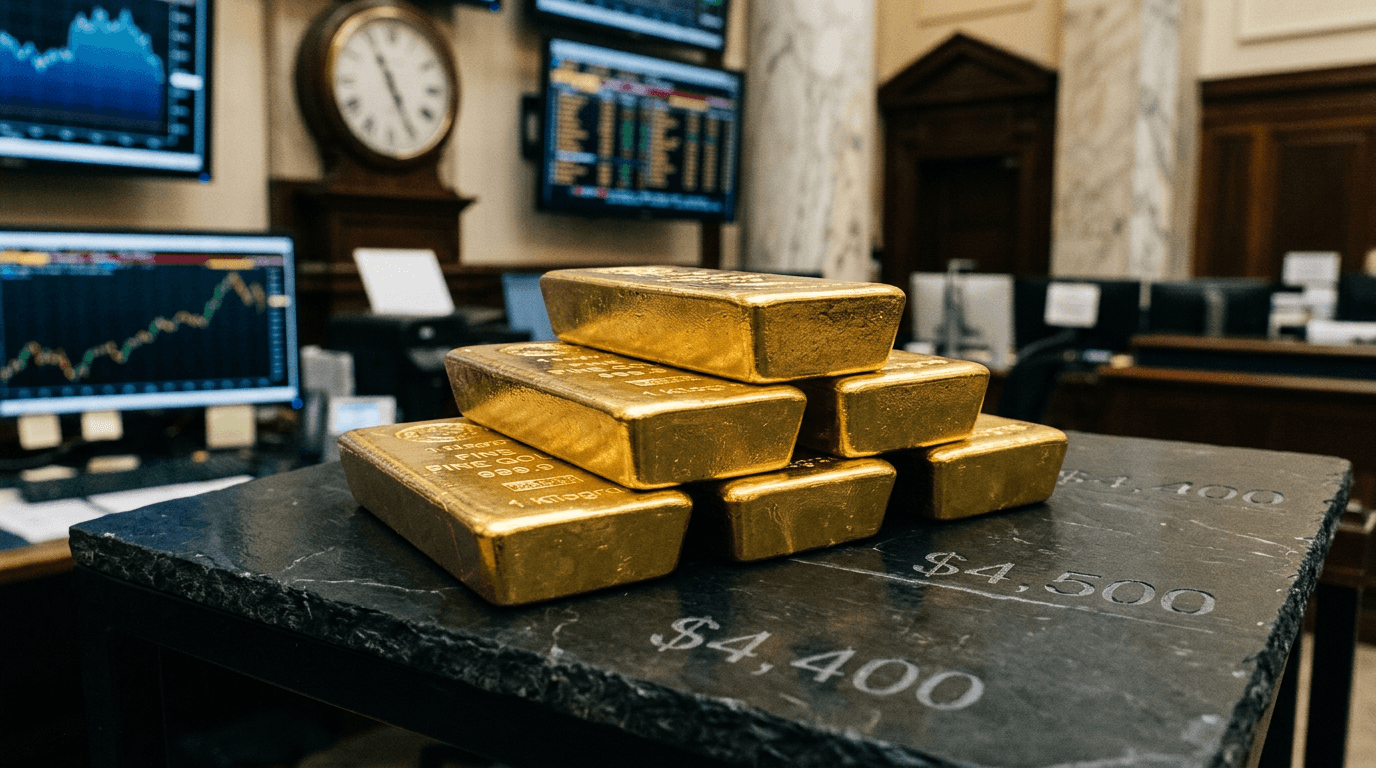
Gold prices are currently under significant pressure, testing critical support levels between $4,400 and $4,500. This pressure is largely due to the interplay of rising U.S. Treasury yields and a strengthening dollar, which have offset traditional safe-haven demand for the precious metal. The market's current weakness is a reflection of complex interactions between monetary policy expectations, geopolitical tensions, and technical repositioning. Traders and investors need to understand these dynamics to navigate the near-term volatility effectively.
A Compelling Story of Market Correction and Sentiment Shift
Recent price action in the gold market tells a compelling story of market correction and shifting sentiment. On March 26, 2026, gold traded at $4,439 per ounce, marking a $126 decline from the previous day and a pullback from earlier highs above $4,500. This decline is significant, with gold experiencing nearly a 10% drop in March 2026 alone, marking one of the worst weekly declines in over a decade. This dramatic sell-off indicates that despite gold's historical appeal as a hedge against uncertainty, current market dynamics are working against traditional safe-haven flows.
Technical Support Levels Under Scrutiny
The $4,400-4,500 zone has emerged as a critical battleground for gold prices. Technical analysts have identified multiple support levels that will determine gold's next direction. The $4,600 level is crucial, having been tested repeatedly, with traders closely monitoring whether prices hold above this threshold. A break below this level could see support around $4,400-4,500, aligning with the current trading range being discussed across financial markets. The importance of these levels cannot be overstated, as they serve as psychological and technical anchors guiding institutional and algorithmic trading decisions. When gold tested below the 50-day exponential moving average earlier in March, it signaled a bearish shift that has persisted through recent sessions.
Rising Yields and Dollar Strength: The Twin Headwinds
To understand why gold is struggling, we need to examine two interconnected forces: the U.S. dollar and Treasury yields. The 10-year Treasury yield has climbed to 4.384%, creating a significant opportunity cost for holding non-interest-bearing gold. When government bonds offer meaningful yields, investors can generate returns simply by holding them, making gold's zero-yield nature comparatively less attractive. This dynamic becomes especially pronounced when Fed policy expectations shift toward maintaining higher rates for longer periods.
The strength of the dollar represents the second major headwind. A stronger U.S. dollar increases the cost of dollar-denominated gold for foreign buyers, reducing demand from international investors who represent a substantial portion of the physical gold market. This effect has been amplified by the dollar's role as the primary beneficiary of global risk-off sentiment. During the current geopolitical crisis, the dollar has attracted capital flows that might historically have gone toward gold, creating an unusual dynamic where safe-haven demand is being channeled away from precious metals.
Federal Reserve Policy: The Elephant in the Room
The Federal Reserve's interest rate trajectory is perhaps the most important variable for gold's future direction. Markets are currently pricing in a cautious approach from the Fed, with expectations for only a 25-basis-point rate cut potentially coming in December 2026. This pricing reflects persistent inflation concerns and a Fed that has shown itself willing to maintain restrictive policy longer than many market participants anticipated. The prospect of sustained higher rates creates an unfavorable environment for gold, as investors can earn returns through fixed-income instruments without bearing the volatility of commodity prices.
Geopolitical Tensions and Momentum Unwinding
While the U.S.-Iran conflict has created geopolitical uncertainty that typically supports gold demand, the current environment presents a paradoxical situation. The conflict has driven up oil prices and inflation expectations, but rather than spurring traditional safe-haven demand, investors have reassessed the monetary policy outlook and moved toward yield-bearing assets. This divergence between geopolitical risk and gold's price action has raised important questions about gold's reliability as a hedge in the modern market structure.
Additionally, the sharp decline has been exacerbated by the unwinding of momentum trades and retail investor positioning. Many participants who entered gold positions during the 2025 bull market are now liquidating holdings, amplifying downward pressure through technical selling rather than fundamental weakness.
Long-Term Fundamentals Remain Intact
Despite the tactical correction, analysts maintain that gold's structural case remains compelling. Major institutions including J.P. Morgan and Deutsche Bank maintain elevated price targets of $6,300 and $6,000 respectively, viewing the current weakness as a temporary setback rather than a fundamental shift. Central banks worldwide continue accumulating gold reserves, supporting demand at the institutional level. De-dollarization trends and growing fiscal concerns surrounding U.S. government debt provide long-term support for gold prices.
For traders and investors, the key takeaway is recognizing the difference between tactical weakness and structural deterioration. The current support zone at $4,400-4,500 represents an important inflection point where either a bounce toward $4,600-4,800 or a breakdown lower would signal different medium-term directions. Monitoring Fed communications and dollar strength closely is crucial, as shifts in these variables could quickly reverse gold's current bearish momentum.
Gold Under Pressure: How Hawkish Fed Policy and Rising Yields Are Testing Key Support Levels
Gold faces critical support at $4,400-4,500 as rising Treasury yields and a stronger dollar offset geopolitical safe-haven demand. Here's what traders need to know about the near-term outlook and long-term fundamentals.