
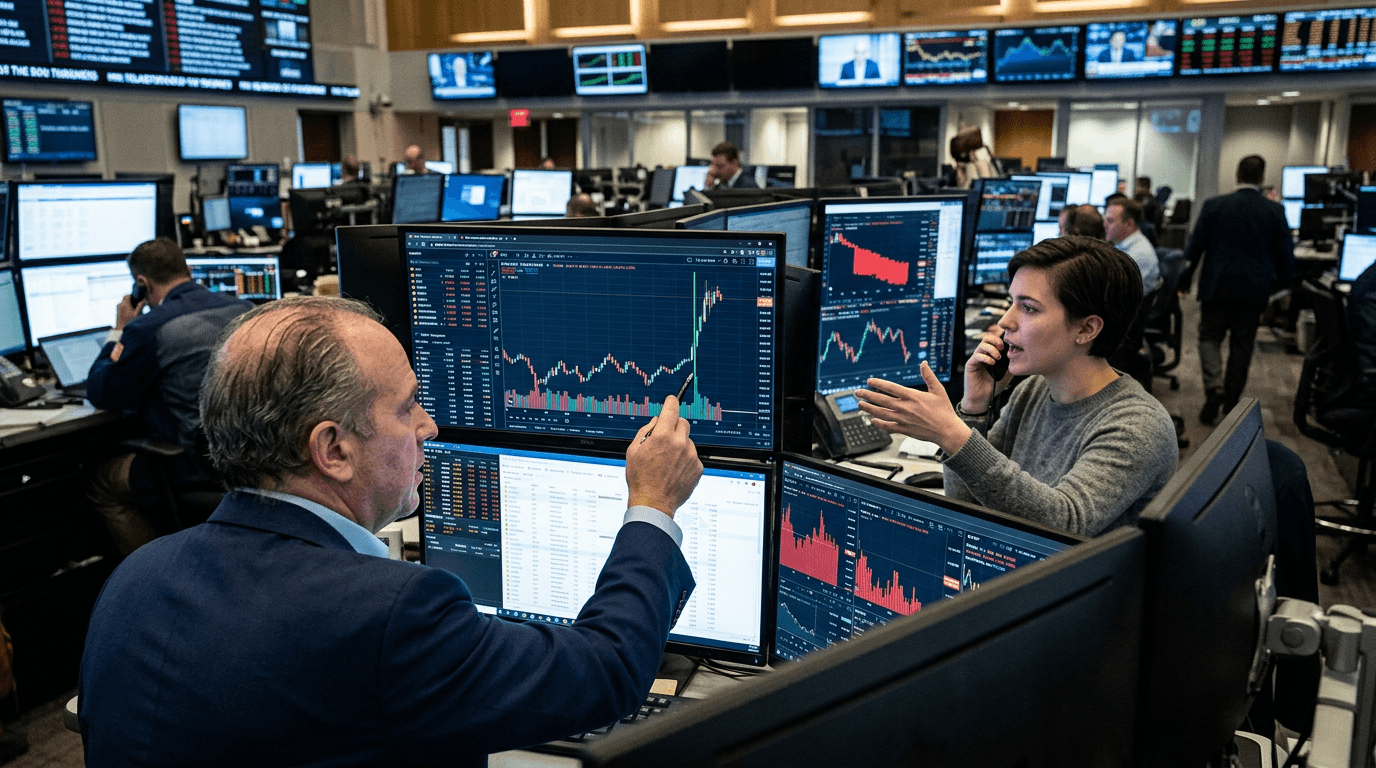
Gold futures have snapped back after an earlier pullback as investors rotate into traditional safe-haven assets on the back of choppy equity markets and mounting geopolitical tensions.[1][2] The move highlights a familiar pattern: when risk assets wobble and headlines turn hostile, gold often reclaims center stage as a portfolio hedge and volatility shock absorber.[2][4]
WHAT’S DRIVING GOLD’S LATEST REBOUND?
Gold is trading back above key levels after rebounding on a combination of renewed safe-haven demand, persistent expectations for rate cuts, and continued official sector buying.[1] Escalating geopolitical risk, including heightened tensions around Venezuela and broader regional flashpoints, has pushed investors back into bullion as a defensive asset.[1][2]
At the same time, markets are still pricing multiple Federal Reserve rate cuts over the year, which keeps real yields suppressed and reduces the opportunity cost of holding a non-yielding asset like gold.[1][2] That macro backdrop has been a core pillar behind the broader rally that previously saw gold break above $4,000 per ounce for the first time, in one of the strongest runs since the 1970s.[4]
Central banks are adding another layer of support. Strategic purchases by official institutions, with China extending its gold buying streak for a 14th consecutive month, have tightened available supply and reinforced structural demand.[1][4] This slow but steady bid helps underpin the market even when speculative futures positioning becomes more volatile.
SAFE-HAVEN FLOWS, EQUITY WEAKNESS AND THE “GEOPOLITICAL PREMIUM”
The immediate catalyst for the latest bounce is a rotation out of risk assets and into havens as equity markets struggle to find direction.[1][2] When stock indices stumble on geopolitical scares or policy uncertainty, portfolio managers frequently cut cyclical exposure and allocate to assets perceived as more resilient in a stress scenario—gold being a prime candidate.[2][4]
Recent episodes have underlined how sensitive gold is to geopolitical shocks. Tensions spanning regions from West Asia to Europe, along with episodes of sovereign debt anxiety in major economies like Japan, have repeatedly triggered waves of safe-haven demand into gold futures.[3][4] In periods where political risk overshadows economic data, gold’s role as a crisis hedge and store of value tends to dominate the price action.[2][4]
This pattern effectively adds a “geopolitical premium” to gold prices: as headlines worsen, implied downside protection becomes more valuable, and investors are willing to pay more for the hedge. The current rebound fits that playbook, coming at a time when risk sentiment is fragile and markets are keenly attuned to surprise escalations.
The Tug-of-war: Dollar, Rates And Gold Futures
Despite the rebound, gold’s path is not one-way. A firmer dollar and still-elevated real yields continue to act as headwinds, periodically overpowering safe-haven demand and triggering sharp pullbacks.[2][6] Earlier this year, gold’s decline from its highs was driven in part by higher real yields and a stronger dollar, which lifted the opportunity cost of holding bullion relative to interest-bearing assets.[2][6]
From a medium-term perspective, gold is trading within a wide 52-week range from roughly $3,245 to near $5,595, with a recent 2026 peak around $5,597 per ounce.[6] That kind of volatility underscores how quickly the dominant narrative can shift between “rates in control” and “safe-haven demand in control.” When bond yields rise faster than inflation expectations, gold tends to struggle; when yields are capped by dovish policy expectations or growth fears, haven flows can take over.[2][6]
Banks and research houses remain divided on how this tug-of-war will resolve. Some, like HSBC and Morgan Stanley, have raised or maintained bullish forecasts for gold on the basis of ongoing geopolitical risk, central bank buying, and the prospect of easier monetary policy.[1] Others point to episodes where aggressive rate repricing has overwhelmed risk-off flows, arguing that gold’s safe-haven status is now more conditional on the rate environment than in past cycles.[5][6]
Practical Framework: How Traders Can Read This Move
For both live and simulated traders, the current rebound is a useful case study in building a structured framework rather than reacting to every headline. A practical approach starts with three pillars: risk narrative, rates and real yields, and positioning.[2]
First, map the risk narrative. Identify which geopolitical flashpoints are driving sentiment—sanctions, territorial disputes, energy shocks, trade frictions—and ask whether they are likely to be brief flare-ups or persistent sources of uncertainty.[2][3] A short-lived headline spike might justify tactical trades, while a prolonged conflict or policy standoff can create a more durable safe-haven bid.
Second, anchor your gold view to real yields. Track how bond markets and inflation expectations are evolving around each event.[2][6] If risk-off headlines are pushing investors into bonds and suppressing real yields, they may be amplifying gold’s upside. Conversely, if central banks respond to inflation scares with more hawkish rhetoric, yields can rise even as geopolitical risk stays high, limiting gold’s ability to extend gains.
Third, consider positioning and prior price action. The recent rebound came after a sell-off that had already flushed out some speculative longs, making it easier for fresh safe-haven flows to have an outsized price impact.[2] In futures markets, crowded positioning can exaggerate both rallies and corrections as stops are triggered and margin constraints bite.
Key Takeaways For Simulated Traders
For SimFi traders, gold’s rebound offers several concrete lessons you can test and refine in a simulated environment before committing capital.
- Practice scenario mapping: Build playbooks for different combinations of geopolitical risk and rate dynamics—for example, “geopolitical shock plus falling yields” versus “geopolitical shock plus rising yields.” Use historical episodes where gold rallies on safe-haven demand, such as the surge above $4,000 per ounce during a period of global uncertainty and Fed cut expectations, as templates.[4]
- Link gold trades to clear triggers: Rather than trading every headline, define objective triggers such as breaks of key futures levels, changes in rate-cut probabilities, or sharp moves in equity indices. This helps you differentiate between noise and regime shifts.
- Stress-test your risk management: Simulate what happens to your gold futures positions if volatility spikes, margins increase, or the narrative suddenly flips—say, a de-escalation in tensions or a surprisingly hawkish central bank communication. Episodes where rates overpower safe-haven demand show how quickly a gold rally can unwind.[5][6]
- Integrate multi-asset cues: Monitor the interaction between gold, equity indices, bond yields, and the dollar. Rotations out of equities into havens, swings in sovereign debt markets, and central bank buying all contribute to the broader context in which gold trades.[1][3][4]
By treating the current rebound as more than a one-off headline move—and instead as a live example of how safe-haven flows, rates, and positioning interact—traders can use simulated environments to sharpen their strategy, test hypotheses, and be better prepared for the next bout of volatility in gold futures.