
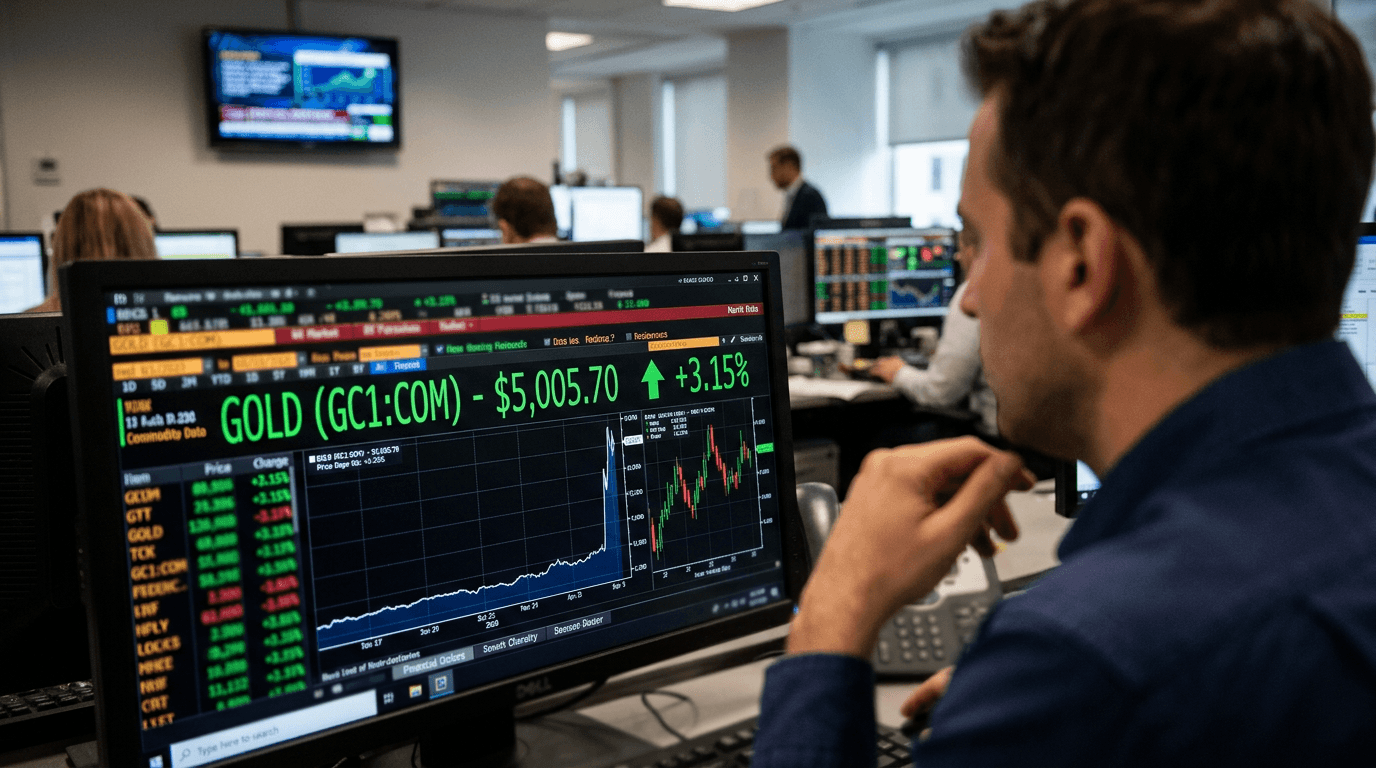
Gold has just breached the historic $5,000 per ounce milestone, reaching record highs near $5,400 in recent weeks, marking a dramatic shift in market dynamics that reflects far more than simple demand fluctuations. This surge represents a fundamental reassessment of risk in global financial markets, where investors are increasingly turning to the precious metal as protection against economic uncertainty, geopolitical tensions, and the prospect of persistent inflation. With the Federal Reserve scheduled to announce its decision tomorrow, March 17-18, gold traders are bracing for a critical juncture that could either accelerate the rally or trigger a significant pullback.[1][2][3]
The gold rally has been nothing short of historic. Over the past year, gold has surged dramatically, climbing from around $3,000 per ounce to nearly $5,400—a move that represents a more than 80% appreciation in just twelve months.[2][3] As of mid-March 2026, spot gold was trading near $5,050 to $5,200, having consolidated after touching record highs.[2][6] This isn't simply a technical breakout or algorithmic trading phenomenon. The drivers behind this move reveal deep structural shifts in how investors perceive risk and value.
The Perfect Storm Of Catalysts
The recent gold surge has been fueled by a rare convergence of macroeconomic and geopolitical pressures that overwhelm traditional Fed policy constraints. First, inflationary pressures have refused to fade despite the Federal Reserve's efforts to combat them. In late February, the Producer Price Index (PPI) data shocked markets with a 0.5% month-over-month increase, far exceeding the 0.3% consensus, while Core PPI jumped 0.8%—the largest monthly surge in recent memory.[3] This inflation persistence has created doubt about whether the Fed can truly control price pressures, a critical concern for investors seeking to preserve purchasing power.
Second, geopolitical risks have intensified dramatically. Military tensions in the Middle East, including strikes that effectively closed major shipping lanes, added an estimated $800 to the price per ounce as investors priced in supply disruptions and broader global uncertainty.[3] Central banks worldwide, particularly in the Global South, have accelerated de-dollarization efforts by purchasing gold at unprecedented rates.[3] This structural demand from institutional buyers provides a powerful floor beneath prices that goes beyond typical market cycles.
Third, the dollar has weakened substantially in recent months, making gold cheaper for international buyers and removing one traditional headwind to precious metals prices.[1][3][4] Simultaneously, real yields have fallen, reducing the opportunity cost of holding non-yielding assets like gold. These three forces—inflation concerns, geopolitical risk, and a softer dollar—have created what market analysts describe as a convergence of the "fear trade" and the "inflation trade," completely overwhelming the traditional "yield trade" that has historically pressured gold when interest rates rise.[3]
The Fed Meeting: Tomorrow's Critical Test
Tomorrow's Federal Reserve decision represents a critical juncture for gold prices. While the Fed is widely expected to hold interest rates steady in the 3.50% to 3.75% range, the real catalyst lies in the forward guidance and communication around future policy.[2][3] Specifically, investors are watching three key elements: the dot plot showing Fed members' rate expectations, any changes to the Summary of Economic Projections, and Chairman Jerome Powell's press conference comments regarding the Fed's willingness to cut rates if economic growth slows further.
Currently, markets are pricing in a 92% probability of rate cuts beginning in June 2026, driven by concerns that GDP growth has slowed to just 1.4%.[3] If the Fed signals readiness to abandon its "higher-for-longer" stance and acknowledge recession risks, gold could accelerate even higher. Conversely, if Fed officials sound hawkish or remove rate cuts from their 2026 projections, the historical pattern suggests gold could face a sharp pullback, as happened after seven of eight FOMC meetings in 2025.[2]
Technical Levels And What To Watch
Gold is currently trading above its 21-day and 50-day moving averages, which provides near-term technical support.[2] However, after a 100%+ rally over the past year, the market faces some technical headwinds from annual commodity index rebalancing that began in January.[2] This can amplify short-term volatility, creating opportunities for sharp corrections even within an intact longer-term uptrend.
Key support levels around Fibonacci levels near $5,050 have proven important, with gold bouncing from these areas in recent sessions.[2] Resistance now exists in the $5,300-$5,400 range where the metal has stalled multiple times. Investors should watch whether gold can definitively break through this zone or whether profit-taking accelerates a consolidation phase.
The Investor Takeaway
For traders and investors, tomorrow's Fed decision is not to be missed. The outcome will likely determine whether gold extends toward the $5,500-$6,000 range or consolidates in the $4,800-$5,200 zone. Central bank buying demand remains robust, real yields are falling, and geopolitical risks are elevated—all bullish for gold longer-term. However, near-term positioning after such a dramatic rally creates vulnerability to profit-taking if the Fed sends hawkish signals. Monitor the Fed decision closely, watch for dollar weakness, and remain alert to any new geopolitical headlines that could drive safe-haven flows toward precious metals.