
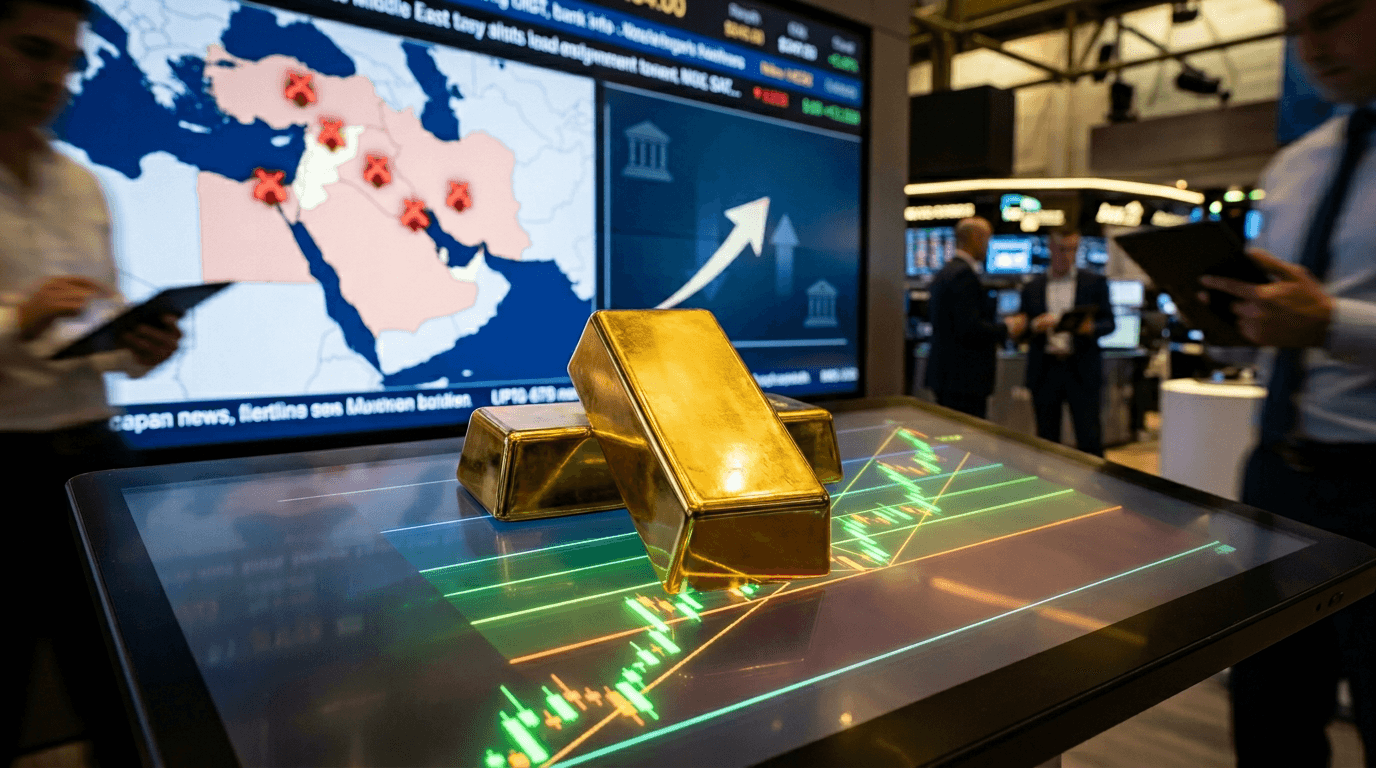
Gold's resilience at the $5,000 level marks a pivotal moment in the precious metals market. After a recent pullback, gold has found critical technical support exactly where analysts predicted, demonstrating the strength of underlying demand dynamics. The confluence of technical validation and intensifying geopolitical tensions is creating a compelling setup for traders seeking to understand not just where gold is headed, but why the momentum matters for portfolio positioning in 2026.
The Technical Setup: Fibonacci And Support Convergence
The $5,000 price level represents more than just a round number. It aligns with the 50% Fibonacci retracement from gold's recent rally, a level that technical analysts recognize as a magnet for both buyers and sellers. When price finds support at these mathematically significant levels, it signals that institutional money is actively accumulating rather than capitulating. The fact that gold bounced from this support zone rather than breaking through it tells traders that conviction remains strong among large market participants.
This technical confluence is critical for understanding gold's trajectory. The 50% Fibonacci retracement often represents a critical inflection point where a market either confirms a trend or reverses it entirely. By holding this level, gold is essentially saying that the bull market narrative remains intact. Traders monitoring technical levels understand this principle: support that holds attracts fresh buying, and fresh buying at support levels often launches the next leg higher.
Safe-haven Flows And Geopolitical Premium
The timing of gold's stability at $5,000 coincides with escalating tensions in the Middle East, a region that historically drives safe-haven demand. When geopolitical risks spike, capital flows into assets perceived as uncorrelated to equity markets and currency risk. Gold fits this profile perfectly. The recent conflict between the US and Iran represents exactly the type of uncertainty that historically unlocks capital flows into precious metals.
This geopolitical premium layered on top of structural demand creates a unique environment. Central banks, institutional investors, and individual traders are all adding to positions for similar reasons: portfolio insurance. When war escalates, people buy gold. The question for traders isn't whether safe-haven flows will persist, but how much additional capital remains on the sidelines waiting for a signal to deploy.
FUNDAMENTAL DRIVERS SUPPORTING THE $5,000 LEVEL
Beyond technical support and geopolitical tailwinds, gold is backed by powerful fundamental drivers that justify current price levels. Goldman Sachs, UBS, HSBC, and other major institutions have collectively raised their 2026 price targets to $5,000 and beyond, with Goldman now targeting $5,400. These aren't speculative calls but rather conclusions drawn from analyzing real economic conditions.
The fundamental case rests on several pillars. First, US real interest rates remain at historically low levels, reducing the opportunity cost of holding non-yielding gold. Second, central bank demand continues at record pace, with institutions like the People's Bank of China and Central Bank of Russia diversifying away from dollar reserves. Third, physical gold supply remains constrained while investment demand accelerates, creating supply-demand imbalances that naturally support prices. Fourth, global government debt is surging toward 110% of GDP, heightening concerns about currency devaluation and making gold's store-of-value function increasingly attractive.
These factors aren't temporary. They represent structural shifts in how institutions view monetary policy and reserve currency risk. As long as these conditions persist, they provide a persistent bid under gold prices.
WHAT $5,000 SUPPORT MEANS FOR YOUR PORTFOLIO
For traders and investors, gold finding support at $5,000 signals reduced downside risk. When an asset holds key support levels on multiple approaches, it establishes a risk floor. This means traders can establish positions with defined risk parameters knowing that major institutional players are supporting prices at these levels.
The current environment presents a specific setup: geopolitical tension driving safe-haven flows converging with technical support at a level where major financial institutions have positioned themselves as buyers. This combination historically precedes new breakouts higher rather than capitulation selling. If war tensions persist, expect gold to either consolidate around these levels or break decisively higher, potentially reaching the $5,400 targets discussed by major banks.
The practical takeaway: the risk-reward profile at current levels favors long positioning, particularly on any dips toward $4,900 where additional technical support layers in. New highs remain possible if geopolitical tensions intensify or if additional Fed policy shifts emerge to weaken the dollar further.
Conclusion: Momentum Meets Safety
Gold's hold at $5,000 represents a convergence of technical precision and fundamental strength. The precious metal isn't at these levels by accident but rather because powerful forces are actively supporting prices. As long as Middle East tensions persist and safe-haven demand remains elevated, gold has multiple reasons to remain well-supported, with breakouts higher increasingly likely as capital continues recognizing gold's role in portfolio construction.