
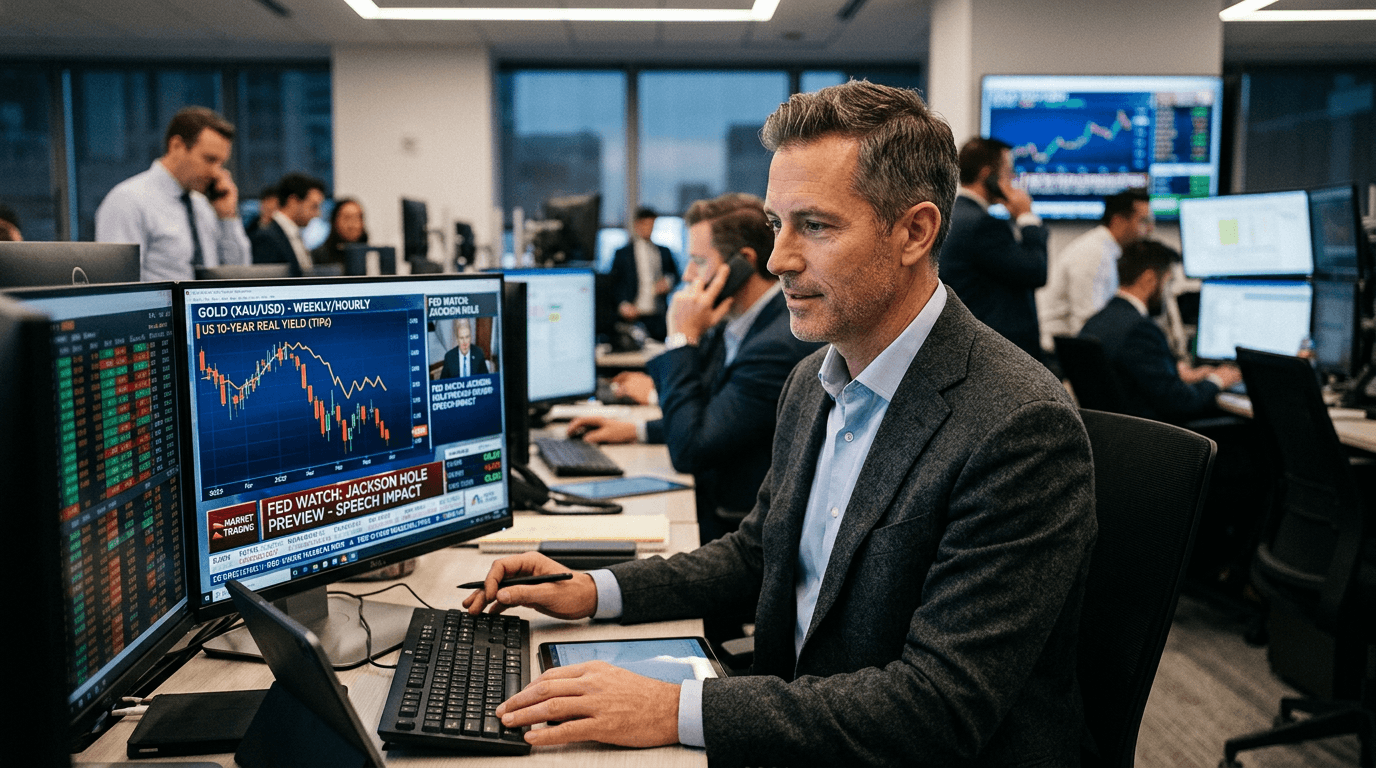
Gold prices slipped in early Friday trading as markets braced for potentially hawkish remarks from Federal Reserve Chair Kevin Warsh at the Jackson Hole symposium, reinforcing a higher‑for‑longer interest rate narrative and putting pressure on bullion. [2][3] The move marks a reversal from earlier in the week, when gold traded near a three‑month high on the back of a softer dollar and anticipation of key U.S. inflation data and Warsh’s speech. [9][11]
Macro Backdrop: Fed, Dollar And Real Yields
The key driver behind gold’s latest pullback is a shift in expectations that the Fed may keep policy rates elevated for longer to ensure inflation is firmly contained. [2][3] When traders anticipate higher real interest rates, the opportunity cost of holding non‑yielding assets like gold rises, typically weighing on bullion prices.
Earlier this week, gold briefly touched its highest level in more than three months as a subdued dollar and lingering inflation concerns supported demand for safe‑haven assets. [9][11] Spot prices climbed above 4,640 dollars per ounce, with U.S. gold futures also advancing as traders positioned ahead of incoming economic data and Warsh’s remarks. [9][11] That optimism has now faded as the market leans toward a more hawkish tone from Jackson Hole.
A stronger dollar and firmer real yields often move in tandem when the Fed is perceived as resolutely anti‑inflation, creating a double headwind for gold. When the dollar appreciates, gold becomes more expensive for non‑U.S. buyers, while higher real yields make fixed‑income instruments relatively more attractive than bullion. This combination frequently leads to short‑term pressure on gold prices during key policy moments.
Market Reaction: Price Action And Futures Flows
The latest downtick in gold is modest in absolute terms, but the narrative behind it is significant: traders are using Jackson Hole as a catalyst to re‑price the path of policy, risk premia, and inflation. [2][3][11] Spot prices have eased after Wednesday’s larger decline, while U.S. futures are trading slightly lower or flat as investors wait for clarity from Warsh. [2][3][11]
At the same time, futures markets are showing a pickup in activity as hedging demand rises into the event. Exchange data indicate that trading across the gold futures complex has grown, with recent quarters seeing higher average daily volumes, particularly in contracts tailored to active traders. [12] Micro‑sized gold contracts have been a standout, posting triple‑digit percentage growth in volume as they attract both smaller participants and systematic traders. [14]
Global gold market liquidity has remained robust this year, with average daily trading volumes staying above their 2025 levels despite periods of price consolidation. [7][13] While overall exchange volumes dipped slightly in July amid reduced volatility, policy‑driven episodes such as Jackson Hole tend to reignite activity as both hedgers and speculators seek to fine‑tune their exposure. [13][15] The current uptick in futures volumes fits this pattern of event‑driven liquidity spikes.
Why Gold Reacts So Strongly To Fed Expectations
Gold’s sensitivity to Fed expectations stems from its role as both a store of value and a hedge against monetary and financial instability. When markets anticipate lower future rates or a pivot toward easing, gold often rallies as real yields fall and the dollar softens. Conversely, a higher‑for‑longer stance raises the discount rate applied to future cash flows and increases the appeal of interest‑bearing assets, undermining gold.
Past Jackson Hole speeches have underscored how quickly the gold market can react to perceived shifts in policy bias. In previous years, dovish signals around the prospect of rate cuts helped propel gold higher within a single session as traders reassessed the trajectory of real rates. [1][8] The current setup is different: instead of hoping for an imminent pivot, markets are now testing how far the Fed is willing to go to maintain restrictive conditions.
Higher real yields and a firmer dollar are not the only risks for gold. If Warsh signals that the Fed is more concerned about entrenched inflation than slowing growth, investors may rotate toward assets perceived as benefiting from prolonged tight policy, such as certain fixed‑income and currency trades. That could temporarily dampen investment demand for gold, even if long‑term structural drivers like diversification and central bank buying remain intact.
HOW TRADERS CAN NAVIGATE HIGHER‑FOR‑LONGER RISK
For active traders, the current environment highlights the importance of monitoring not just spot gold prices, but also the drivers behind them: real yields, the dollar index, and Fed funds futures. These instruments encapsulate the market’s view of policy and inflation, and shifts in their pricing often lead moves in gold rather than simply reacting to them.
Ahead of major policy events like Jackson Hole, risk management is critical. Many traders scale position sizes, widen stop‑loss thresholds, or reduce leverage to account for the possibility of sharp intraday swings following a central bank speech. Others use options on gold futures to define risk while still participating in potential breakouts, structuring trades that benefit from volatility rather than a specific directional outcome.
Diversification within the gold complex can also help. Some traders combine positions in spot, futures, and related assets such as gold miners to express nuanced views on both the metal and broader risk sentiment. For example, a trader might hedge a long gold position with a short in a currency pair that tends to move inversely with bullion, creating a more balanced exposure to different macro scenarios.
Practicing Jackson Hole Scenarios In Simulated Markets
Simulated Finance platforms give traders a controlled environment to rehearse how they would respond to policy‑driven volatility without risking real capital. By replaying historical Jackson Hole events or constructing hypothetical scenarios around different Warsh outcomes, traders can test how their strategies perform when the market rapidly re‑prices Fed expectations.
In a simulated setting, a trader might design multiple playbooks: one for a clearly hawkish speech that pushes real yields higher, another for a balanced message that keeps uncertainty elevated, and a third for a surprisingly dovish tone. Each playbook can specify entry rules, position sizing, hedge ratios, and exit criteria, allowing the trader to compare performance across scenarios and refine their approach.
SimFi environments are particularly useful for practicing execution under stress. Policy speeches often trigger gaps, whipsaws, and short‑lived price dislocations as liquidity thins and algorithmic trading amplifies moves. Simulated order books and futures ladders allow traders to practice placing and managing orders in fast markets, including how to avoid over‑trading when volatility spikes.
Key Takeaways For Gold Traders
The immediate story in gold is not the size of the latest price move, but what it reveals about the market’s mindset heading into Jackson Hole. A modest slip, combined with a pickup in futures volumes, signals that traders are hedging and repositioning around the risk that Warsh leans hawkish and reinforces a higher‑for‑longer stance. [2][3][12]
For traders and investors alike, the takeaway is clear: gold’s trajectory in the near term will be heavily influenced by the interplay between Fed communication, real yields, and the dollar. Events like Jackson Hole can catalyze sharp moves, but they also offer valuable information about how the market prices policy risk. Using a structured, risk‑aware framework—and practicing it in simulated environments—can help traders navigate these turning points more confidently.
Over the longer horizon, gold’s role as a diversifier and potential hedge against monetary and market uncertainty remains intact, even if higher‑for‑longer policy injects bouts of volatility. Understanding how to bridge the gap between strategic allocation and tactical event‑driven trading is increasingly essential for anyone active in today’s gold market.