
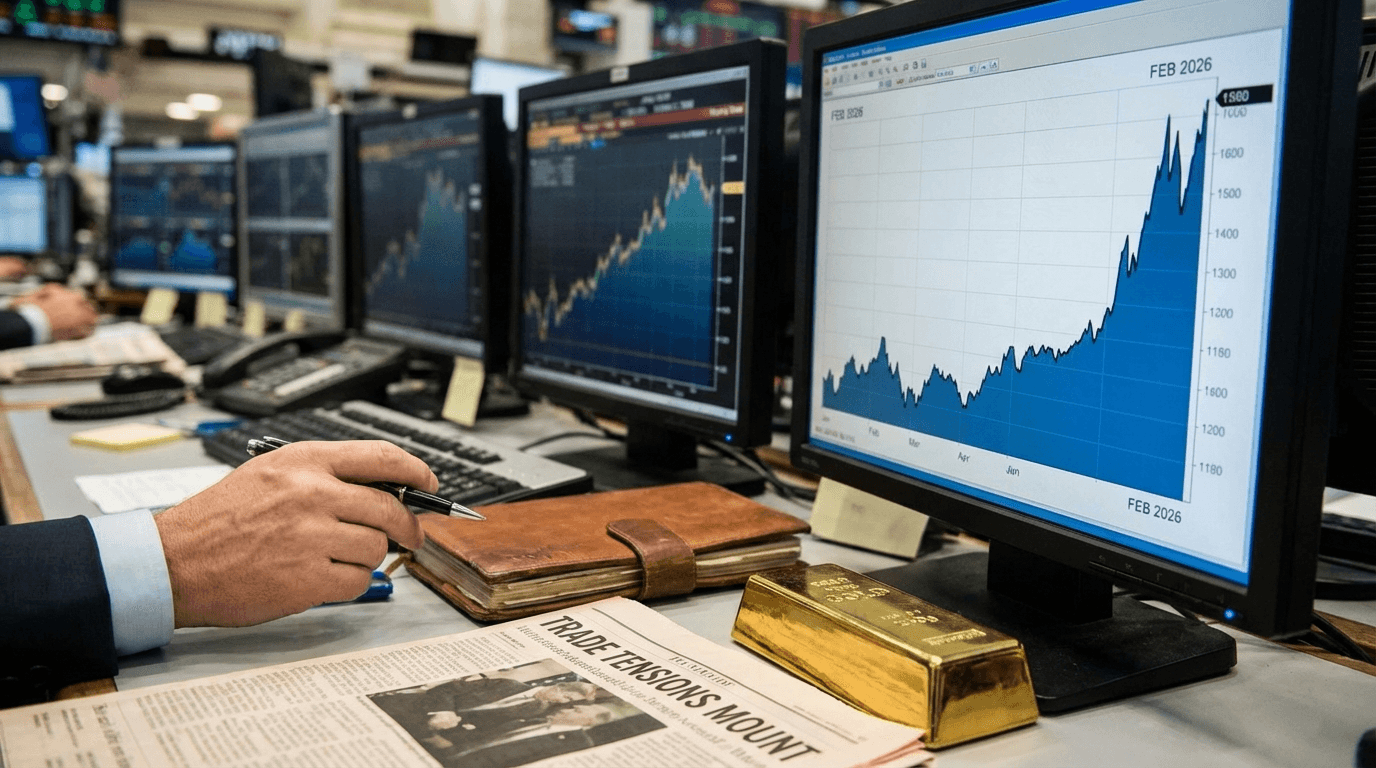
Gold just made a powerful statement about the state of the global economy. With a 2.35% surge to $5,227 per troy ounce, the precious metal has reached its highest level since late January, breaking decisively through the $5,100 resistance level that many traders had been watching closely.[4][5] This isn't a random price movement — it's a direct response to mounting concerns about tariffs, geopolitical risk, and the erosion of investor confidence in traditional assets.
For traders and investors watching the markets, this moment matters. Gold's climb tells a story about how markets are pricing in real economic risk, and understanding that story is essential for navigating what comes next.
The Tariff Shock That Reset Everything
The immediate catalyst for gold's surge traces back to a dramatic turn of events in U.S. trade policy. The Supreme Court struck down President Trump's emergency tariffs, triggering what should have been a moment of relief for markets. Instead, the administration responded immediately by announcing a 15% global tariff surcharge under Section 122 authority — a move that essentially reset the entire trade framework with a new legal pathway.[3]
This created a peculiar moment in markets: stock indices tumbled, the U.S. dollar weakened, and gold rocketed higher. The Dow dropped 635 points, the S&P 500 shed 0.6%, and Bitcoin fell below $65,000.[3] Gold, meanwhile, moved decisively upward. This divergence tells you exactly what's happening. Risk assets are selling off because investors see a more uncertain economic environment ahead. Safe-haven assets like gold are rising because that uncertainty is driving capital flows toward protection.
The tariff environment of February 2026 has become something few traders expected: a powerful structural tailwind for precious metals.[2] Every announcement about tariffs, every signal of trade war escalation, and every threat of retaliation sends investors back to the same conclusion: gold and silver are insurance policies in a volatile world.
How Tariffs Become Gold Rallies
The connection between tariffs and gold prices isn't always obvious at first glance, but the mechanics are straightforward and increasingly relevant. When tariffs rise, import costs increase, which flows through to consumer inflation. Inflation erodes the purchasing power of traditional currency and bonds, so investors move money into assets that hold real value — and historically, gold sits at the top of that list.[2]
But tariff fears do more than just drive inflation expectations. They also damage trade relationships, creating currency volatility and weakening the U.S. dollar. A weaker dollar makes gold — which is priced globally in dollars — more attractive to international buyers. When the dollar loses value, gold effectively becomes cheaper for foreign investors, increasing demand from across the globe.[2]
There's also a geopolitical dimension that's amplifying gold's current surge. The tariff disputes aren't occurring in a vacuum. They're happening alongside escalating tensions with Iran, with the Trump administration signaling potential military action within a 10-day window if nuclear negotiations don't progress.[3] Those talks are scheduled to resume in Geneva on February 27th, but the tone from Washington is decidedly escalatory. This combination of policy chaos, trade uncertainty, and geopolitical risk creates the perfect environment for gold to perform exactly as it has — as the world's oldest safe-haven asset.
The Structural Bid Underneath The Volatility
What's notable about gold's current rally is that it's not being driven by a single catalyst — it's the convergence of multiple forces. Central banks have been accumulating gold throughout 2025 and into 2026, providing a structural bid under prices.[3] This isn't speculative buying — it's reserve diversification by official institutions that expect economic volatility ahead.
Adding to this is the broader shift in how investors view risk. After years of favoring growth stocks and yield-bearing assets, the calculus has changed. Tariff-induced inflation fears, Fed uncertainty about how to respond to stagflation pressures, and geopolitical tensions have all combined to make non-yielding safe-haven assets like gold attractive again on a fundamental basis.[2]
Silver has been riding these same currents even more aggressively, with prices climbing to above $86 per ounce after surging nearly 150% in 2025.[2][4] The two precious metals are moving in tandem, signaling that the underlying demand is structural rather than speculative.
What Traders Should Watch Next
Three critical catalysts will shape gold's trajectory over the next two weeks. First, NVIDIA's earnings on February 25th serve as a bellwether for risk appetite — a disappointment could accelerate the rotation from equities into safe havens.[3] Second, the Iran-U.S. nuclear talks on February 27th carry outsized weight given Trump's public ultimatum. Any breakdown would likely send gold testing toward January's highs above $5,300.[3] Third, the February jobs report due March 6th will be a key data point for Federal Reserve policy, with Governor Waller having flagged it as crucial for shaping his rate outlook.[3]
The technical picture is also worth watching. Gold's break above $5,100 is significant — it's establishing a new floor for prices. Some analysts are already suggesting that gold could test $5,400 in the near term if geopolitical tensions escalate further or tariff negotiations break down.[3]
The Takeaway For Investors
Gold's surge to $5,227 isn't an isolated price move — it's a market-wide reassessment of economic risk in an environment of policy uncertainty and geopolitical tension. The precious metal is performing exactly as it should, serving as insurance against currency debasement, inflation, and systemic risk.
For traders, the key insight is that gold's current rally appears to have structural support beneath tactical volatility. Central bank buying, tariff-driven inflation concerns, and safe-haven demand from both retail and institutional investors are all providing floors under prices. Pullbacks in this environment are more likely to be buying opportunities than warnings of a trend reversal.
The markets are speaking clearly: when policy becomes chaotic, when trade relationships are uncertain, and when geopolitical tensions rise, gold's value as a store of wealth becomes undeniable. At $5,227, that message is being heard loudly.