
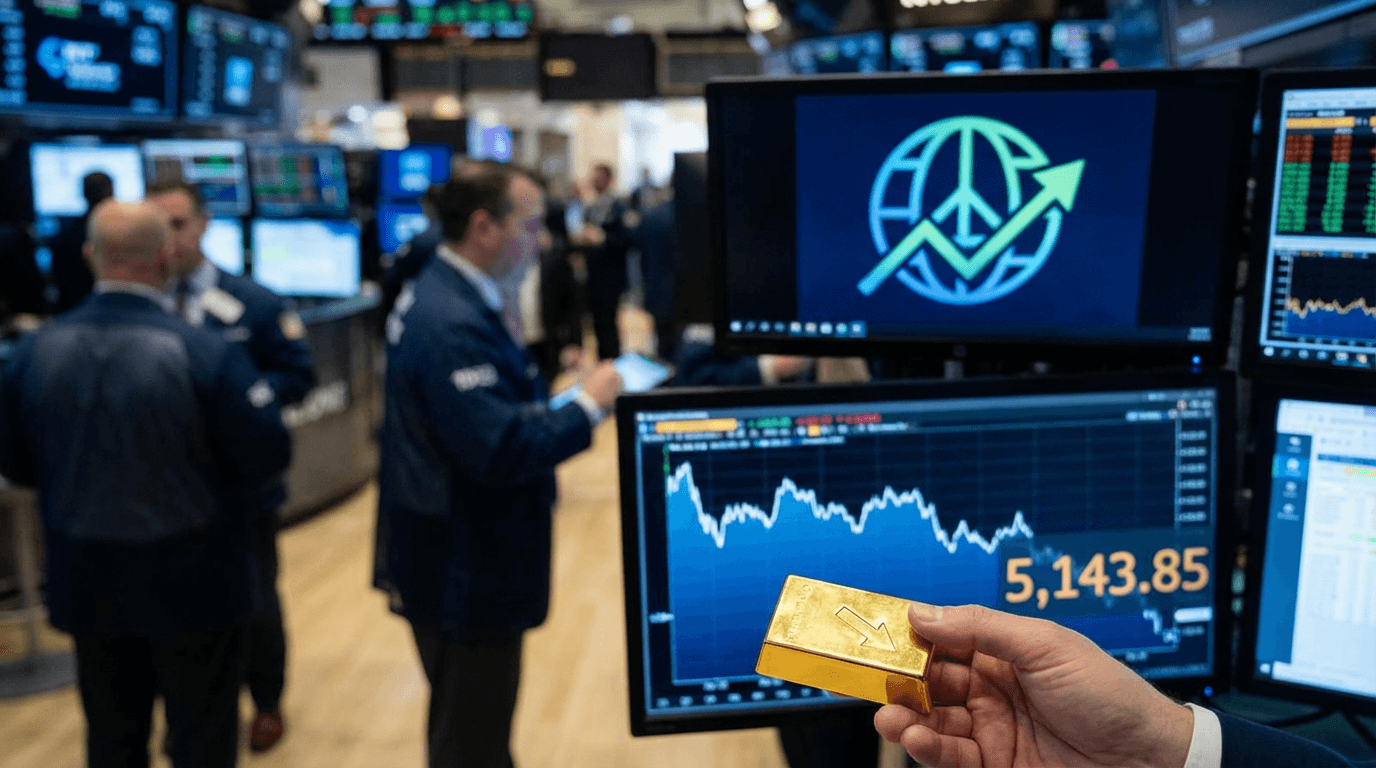
Gold prices retreated 1.57% this week, falling to $5,143.85 per ounce as improving market sentiment and easing geopolitical tensions reduced demand for traditional safe-haven assets. This pullback marks a notable shift in market dynamics, reversing some of the extraordinary gains gold has enjoyed over the past several months. While the decline might concern some investors, it reflects a fundamental principle in financial markets: when risk appetite strengthens, investors rotate out of defensive positions and into riskier, higher-yielding opportunities.
Understanding The Market Reversal
Gold has been on one of the most powerful runs in its modern history, with spot prices touching an all-time high near $5,589 in late January 2026 before pulling back and stabilizing.[6] The recent 1.57% retreat brings prices down from recent highs, but the metal remains trading well above $5,000 per ounce—still near historic levels.[6] This pullback is not unusual in commodity markets and often signals a healthy rebalancing rather than a fundamental deterioration in gold's appeal.
The primary catalyst for this week's decline centers on improved geopolitical conditions. Specifically, easing tensions between Iran and the United States have reduced one of the key drivers of safe-haven demand that has supported gold prices throughout 2025 and early 2026. When geopolitical risks diminish, investors perceive lower tail risks in their portfolios, making them more comfortable holding equities and other risk assets that typically offer higher returns than gold's passive income.
The Safe-haven Demand Equation
Throughout 2025 and into 2026, gold benefited from what Goldman Sachs describes as the "debasement trade"—a growing concern over long-term fiscal sustainability and government debt levels.[6] This concern, combined with broader macro uncertainties and trade policy volatility, drove institutional buyers, high-net-worth individuals, and family offices to accumulate physical gold bars as a hedge.[6] Additionally, Western exchange-traded funds added approximately 500 tonnes since the start of 2025, well above what interest rate cuts alone would explain, indicating structural reallocation rather than tactical positioning.[6]
However, when external risks ease—such as the recent de-escalation in Iran-US tensions—investors reassess their hedging needs. The cost of maintaining defensive gold positions becomes harder to justify when risk premiums compress and equity markets rally. This dynamic played out this week, as improved sentiment sparked a rotation from defensive positioning into higher-returning risk assets. This is a natural part of market cycles and does not negate the longer-term structural factors supporting gold.
What The Numbers Reveal
Current pricing shows gold trading in the $5,143-$5,176 range, down from February 25 levels near $5,200 but still substantially elevated compared to historical averages.[1][2] The retreat remains relatively modest in percentage terms, representing normal volatility rather than a sustained trend reversal. For context, gold is still approximately 80% higher than it traded one year ago, demonstrating the metal's powerful uptrend despite this recent pullback.[3]
Wall Street remains constructive on gold's medium-to-long-term outlook. Goldman Sachs maintains a year-end 2026 target of $5,400 per ounce, up from a prior forecast of $4,900.[6] More bullishly, JP Morgan recently raised its year-end target to $6,300, projecting central bank and investor demand to average 585 tonnes per quarter through the year.[6][7] These forecasts suggest current prices offer reasonable entry points for investors with longer investment horizons.
Key Factors Supporting Gold Going Forward
Central bank buying continues to provide structural support for gold prices. Goldman Sachs forecasts 60 tonnes per month of central bank purchases in 2026, with China alone extending purchases for 15 consecutive months through January.[6] This steady institutional demand provides a floor beneath prices and distinguishes current gold demand from speculative bubbles in other commodities.
The "debasement trade" remains intact despite improved short-term sentiment. Fiscal deficits and policy uncertainties continue to concern sophisticated investors, making gold valuable as a long-term store of value. This motivation—rooted in deep structural concerns rather than near-term geopolitical events—is unlikely to disappear quickly. Trade policy uncertainty, particularly surrounding potential tariff escalations, also continues to support gold as investors hedge macro risks.[3]
Actionable Takeaways For Traders
For active traders, this pullback offers a valuable lesson in distinguishing between tactical corrections and fundamental trend changes. The 1.57% retreat reflects normal profit-taking and rotation into risk assets, not a breakdown in gold's structural demand drivers. Investors seeking exposure should consider this weakness a potential accumulation opportunity rather than a warning sign.
For portfolio managers, the recent price action reinforces gold's role in diversified portfolios. The metal's ability to retain 80% year-over-year gains while experiencing short-term retreats reflects its dual nature: a safe-haven asset during stress and a diversifier during normal market conditions. As geopolitical tensions inevitably reemerge—whether from Iran-US relations or other global flashpoints—gold's insurance value becomes apparent again.
The bottom line: Gold's retreat amid improving risk appetite is perfectly normal market behavior. The metal's longer-term structural supports remain intact, and Wall Street's optimistic forecasts suggest further upside potential before year-end. Smart investors view this pullback as a healthy consolidation rather than a reason to abandon their strategic gold positions.