
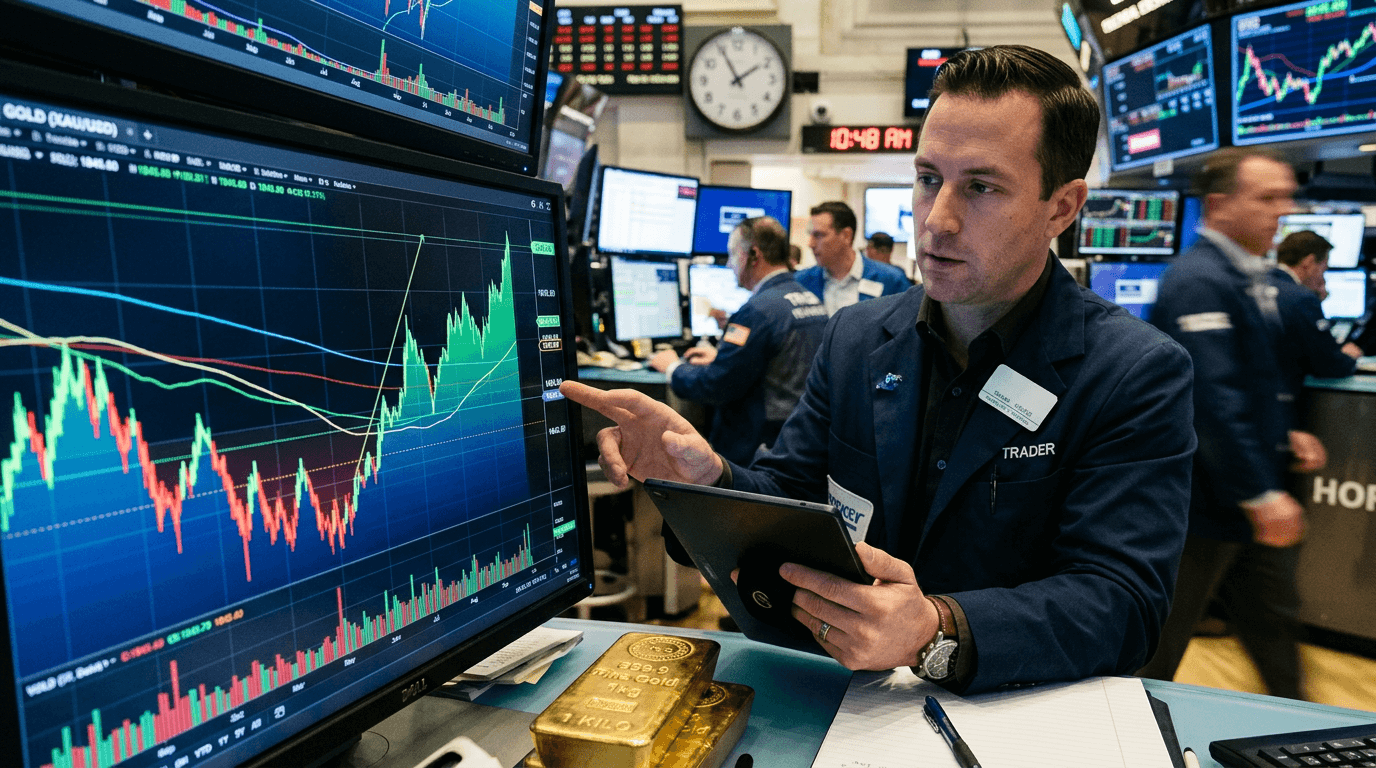
Gold is back on the front foot, with futures recovering the prior session’s losses as renewed safe‑haven demand draws buyers back into the market.[4] The move is not happening in isolation: the broader precious metals complex is also pushing higher, signaling a shift in sentiment after a period of profit‑taking and rate‑driven pressure.[6] For traders, the rebound is a fresh reminder that when geopolitical risk and real‑yield expectations collide, gold’s role as a hedge can reassert itself quickly.[3][5]
WHAT IS DRIVING GOLD’S SAFE-HAVEN BID?
Gold’s latest bounce is rooted in a familiar driver: uncertainty. Periods of geopolitical tension, policy ambiguity, or market stress often send investors searching for perceived stores of value, and gold still sits near the top of that list.[5][7] When risk assets wobble, even modestly, capital tends to rotate toward assets that are less tied to earnings cycles or default risk, boosting demand for bullion, futures, and gold‑backed ETFs.[5]
At the same time, expectations for real interest rates remain central to the story. Research shows that gold’s performance has increasingly tracked real yields and monetary policy rather than simply reacting to headlines.[3] When traders start to price a slower pace of tightening, a longer pause, or eventual cuts, the opportunity cost of holding non‑yielding gold falls, making safe‑haven exposure more attractive even if nominal rates are still elevated.[3][6]
This interplay explains why gold can sell off on some risk events yet rally on others. The market is not just reacting to the shock itself, but to what it implies for central bank policy, inflation expectations, and growth.[3] The latest rebound suggests that, for now, the market leans toward a scenario where policy support is more likely than a sustained tightening push, giving gold room to recover.
PRECIOUS METALS MOVE IN TANDEM – BUT FOR DIFFERENT REASONS
The current move is not limited to gold. Silver, platinum, and palladium have also attracted fresh buying interest as part of a broader precious‑metals rebound. While gold is primarily a monetary and safe‑haven asset, the others straddle both investment and industrial demand, which changes how they react to the same macro drivers.
In risk‑off episodes, silver tends to lag gold on the way up but can outperform once sentiment stabilizes because its industrial applications link it to growth expectations. Platinum and palladium, tied closely to automotive and industrial activity, may benefit from a combination of improved risk appetite, short covering, and hopes for more supportive policy over the medium term.
For traders, this backdrop opens up relative‑value ideas. A strong safe‑haven bid can widen the performance gap between gold and more industrial metals; when volatility cools, those gaps sometimes partially mean‑revert. Understanding whether the current move is primarily fear‑driven, rate‑driven, or growth‑driven can help shape strategies across the complex, not just in gold.
Real Yields, Dollar Dynamics, And Positioning
The key macro driver to watch remains real yields—the yield on inflation‑adjusted bonds. Historically, when real yields fall, gold tends to benefit because the cost of holding a non‑yielding asset declines.[3] Recent analysis highlights that gold has become more sensitive to these rate dynamics than to geopolitical risk alone, with price action sometimes tracking U.S. Treasuries more closely than equities.[3][6]
The U.S. dollar is the other major piece of the puzzle. A softer dollar tends to support gold by making it cheaper for non‑USD buyers and by reinforcing the idea that monetary policy is pivoting toward a more accommodative stance.[3] Conversely, a firm dollar can blunt safe‑haven flows, especially when rate expectations move toward “higher for longer.”
Positioning data in futures and ETFs adds another layer. When speculative positioning is light and ETF holdings have been reduced, the market has more “room” for fresh safe‑haven inflows during risk‑off episodes.[3] Recent signs of renewed ETF buying and central bank interest have supported the idea that the earlier selloff was more of a positioning reset than a structural shift away from gold.[3]
What Traders Should Watch Next
For short‑term traders and portfolio builders alike, the questions now are: how durable is this rebound, and what will drive the next leg? Several catalysts stand out:
First, incoming inflation data and growth indicators will shape expectations for real yields. Any downside surprise on inflation or signs of slowing growth can reinforce the case for easier policy, typically a constructive backdrop for gold.[3][6]
Second, central bank communication remains crucial. Even subtle changes in tone around the path of rates, balance sheet policy, or inflation tolerance can trigger repricing in bond markets, which gold tends to react to quickly.[3]
Third, geopolitical headlines can still create sharp intraday moves, even if the medium‑term trend is dominated by policy. Markets will watch not just the events themselves but also any impact on energy prices and expectations for fiscal or monetary responses.
Finally, technical levels and volatility matter for execution. After a strong rally followed by a pullback, traders often focus on prior swing highs, recent lows, and major moving averages to gauge whether the current bounce is a simple correction or the start of a new leg higher.[6] Changes in volatility can also influence position sizing, margin requirements, and risk‑adjusted return expectations.
Trading Opportunities In A Simulated Environment
For traders operating in a Simulated Finance (SimFi) environment, this kind of gold rebound is a valuable live case study. It allows you to test how your strategies behave when safe‑haven flows return, volatility picks up, and macro narratives shift in real time—without the capital risk attached to live accounts.
You can, for example, build and test scenarios around different macro assumptions: one where geopolitical tensions escalate and real yields fall, another where inflation resurfaces and rate expectations move higher, and a third where risk sentiment improves and safe‑haven demand fades. By running these scenarios in a simulated setting, you can observe how gold and the broader precious metals complex respond, and how your risk management rules hold up.
SimFi also allows for experimentation with cross‑asset relationships. You might test strategies that link gold to bond yields, the dollar, equity volatility, or even energy prices, reflecting the more complex drivers highlighted in recent research.[3][6] Watching how these relationships evolve through a rebound phase can help refine entry criteria, stop‑loss placement, and profit‑taking logic.
Practical Takeaways For Traders
A few practical lessons emerge from the latest move in gold:
Safe‑haven flows rarely act alone. They are filtered through the lens of real yields, the dollar, and policy expectations, so macro context is critical.[3][6]
The precious metals complex is interconnected, but each metal has its own demand profile. Gold may lead on fear and policy, while silver, platinum, and palladium respond more to growth and industrial dynamics.
Positioning and sentiment can amplify moves. When markets are under‑positioned in gold, even modest safe‑haven demand can trigger outsized rebounds as traders rush to rebuild exposure.[3]
Simulated trading is an ideal environment to practice navigating such conditions—testing strategies across different volatility regimes, timeframes, and macro scenarios before committing capital.
As gold recovers on safe‑haven demand and the broader precious metals complex follows, traders are reminded that this market lives at the intersection of macro, sentiment, and technicals. Those who take the time to understand the drivers, stress‑test their ideas, and manage risk systematically will be better positioned the next time uncertainty sends investors back into the arms of gold.