
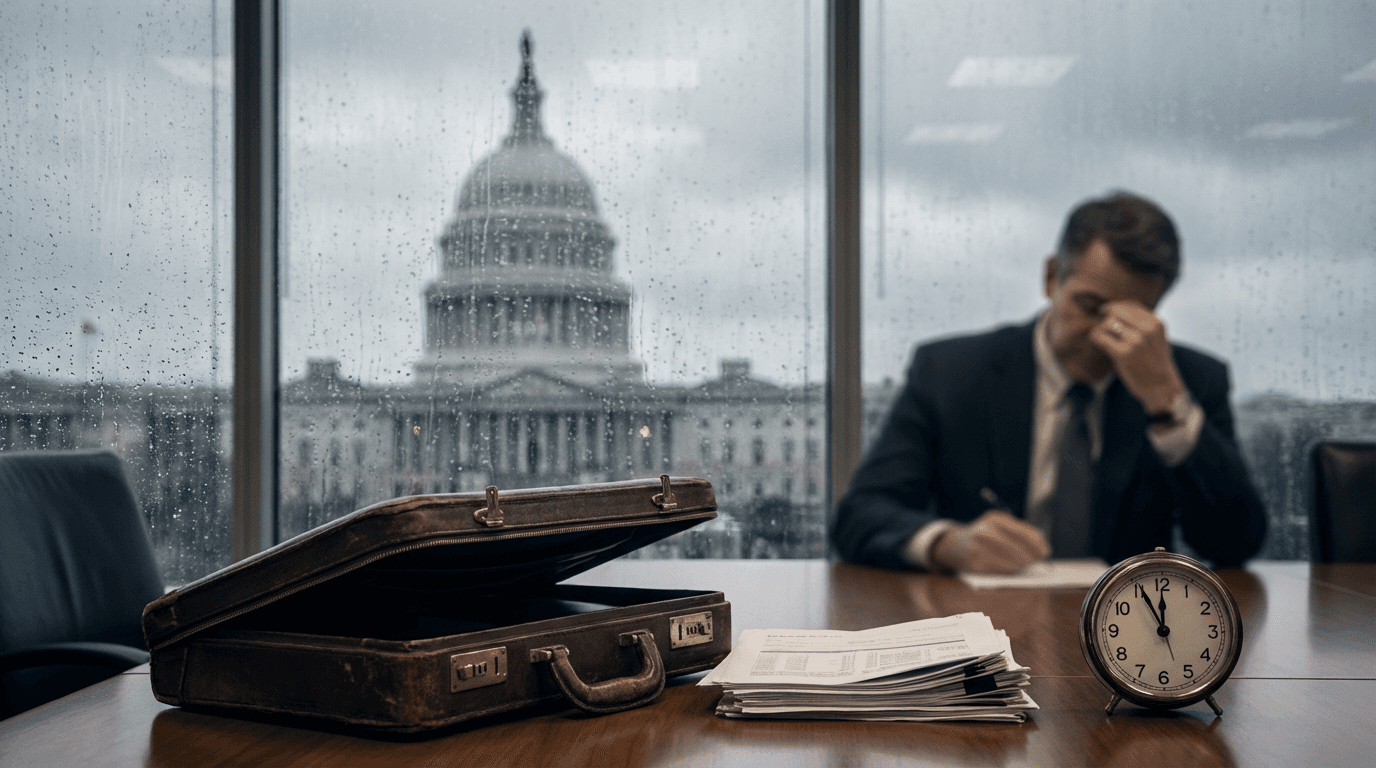
As government funding expired on January 30, 2026, the United States found itself on the brink of yet another federal shutdown, with markets pricing in a 26% probability of a significant disruption to government operations. This looming deadline marked the second critical moment this fiscal year when Congress faced the prospect of failing to appropriate funding for essential federal agencies, raising serious questions about the sustainability of the current budget process and its impact on the broader economy.
The situation unfolded with familiar urgency as lawmakers scrambled to secure appropriations before the clock struck midnight. The Senate managed to approve a spending package on Friday evening that would fund the vast majority of federal agencies through the remainder of fiscal 2026, yet the timing proved too late to prevent the technical triggering of shutdown procedures. With the House still in recess and unable to return until Monday, the government was forced to initiate formal shutdown protocols despite a resolution appearing imminent, creating uncertainty that echoed through financial markets and business planning rooms across the nation.
What Happened To The January 30 Deadline
Nine of the twelve federal appropriations bills expired as scheduled on January 30, 2026, triggering shutdown procedures that required the Office of Management and Budget to issue directives for an orderly government closure. The Senate-approved spending package would fund the departments of Defense, Labor, Health and Human Services, Education, Transportation, Housing and Urban Development, State, and Treasury, along with numerous other related agencies. However, a two-week continuing resolution for the Department of Homeland Security remained contentious, as Senate Democrats had demanded additional restrictions on immigration enforcement following a fatal shooting incident involving Border Patrol agents.
The timing of this impasse proved particularly costly. Federal employees who would normally report to work on February 2 faced uncertainty about whether they would be furloughed or expected to initiate shutdown procedures, creating confusion across government agencies just as normal business operations were resuming for the week. OMB made clear in its guidance to agencies that it lacked authority to stave off shutdown impacts simply because a vote was expected to occur, forcing the government to follow standard protocols even as resolution appeared within reach.
The Economic Toll Of Government Shutdowns
The previous shutdown, which lasted 43 days from October 1 through November 12, 2025, stands as the longest government shutdown in U.S. history, leaving a trail of economic disruption in its wake. The Congressional Budget Office estimated that this extended closure cost the economy $11 billion in real GDP losses. More broadly, economic analysis suggests that each week of government shutdown costs the economy roughly $7 billion in lost output, representing approximately 0.13 percentage points of annualized GDP growth.
These figures underscore why markets reacted with concern to the January 30 deadline. Beyond the immediate output losses, government shutdowns create cascading disruptions throughout the economy. Federal contractors face delays in contract awards, modifications, and payments that can severely impact cash flow and project timelines. Government facilities close, non-essential employees are furloughed, invoices remain unpaid, and acquisition processes grind to a halt. Historical data from 2013, 2018, and 2019 shutdowns indicates that taxpayers bore nearly $4 billion in costs across those three events alone.
Impact On Federal Contractors And Agencies
For federal contractors working with unfunded departments and agencies, the consequences of shutdown are immediate and severe. Government facilities close their doors, halting ongoing operations and access to necessary resources. No new contracts are issued, and existing acquisitions face indefinite delays. The furlough of non-essential government employees means that critical decision-makers, contract officers, and project managers become unavailable, creating bottlenecks that persist even after funding is restored.
Perhaps most damaging to contractor operations is the halt in invoice payment processing. Bills submitted during a shutdown may not be paid during the closure itself, and payments are frequently delayed for weeks or months afterward as agencies struggle to clear accumulated backlogs. Additionally, statutory deadlines for filing claims and bid protests are not automatically extended, forcing contractors to navigate legal complications even as government operations remain suspended.
A Path Toward Permanent Solutions
Congress has had the opportunity to address this recurring crisis through the Prevent Government Shutdowns Act, a bipartisan proposal that would establish an automatic continuing resolution at current spending levels if lawmakers cannot reach agreement on appropriations. Such an auto-CR would allow government operations to continue while Congress negotiates, preventing the artificial urgency that has plagued the budget process for decades. The proposal has received support from a diverse group of lawmakers and narrowly came close to passage when voted as an amendment to a recent funding bill.
By implementing automatic safeguards and creating meaningful incentives for timely appropriations work, Congress could eliminate the shutdown drama that has become routine. Until such reforms are enacted, traders and investors should continue monitoring appropriations deadlines as significant risk events with measurable economic consequences.
The resolution of the January 30 deadline, whenever it ultimately occurs, will provide temporary relief but will not address the underlying dysfunction in the federal budget process. Until Congress acts to implement structural reforms, shutdown risk will remain a persistent feature of financial markets and economic planning.