
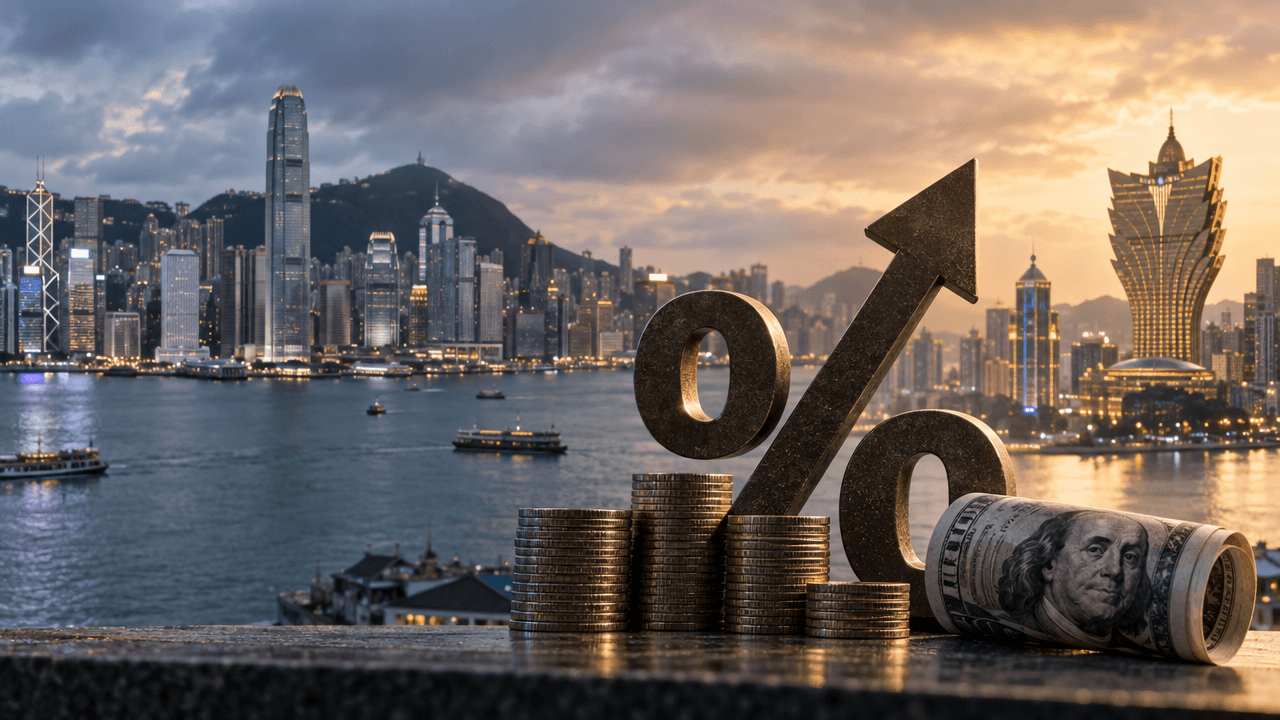
Hong Kong and Macau have joined the latest leg of global monetary tightening, lifting their base rates by 25 basis points to 4.25% in lockstep with the U.S. Federal Reserve’s latest hike.[1][4][6] For traders in FX and rates markets, this move is more than a local adjustment—it reinforces the transmission of U.S. policy through dollar-linked systems and shapes funding, carry, and volatility dynamics across the region.[1][4]
Global Context: Fed Hikes And Global Tightening
The Federal Reserve’s 25 basis point increase in its target range marks its first rate hike in about three years, signaling a decisive shift away from the ultra-accommodative stance that characterized the post-pandemic period.[1][6] When the Fed moves off the sidelines, dollar funding costs rise globally, and economies tied to the U.S. currency tend to follow to preserve financial stability and currency credibility.[1][6]
By raising their base rates to 4.25%, Hong Kong and Macau are effectively importing tighter financial conditions from the U.S. into their own markets.[1][4][6] This aligns local funding costs with the global dollar environment and helps anchor expectations around inflation, asset prices, and capital flows. For traders, the key takeaway is that the tightening cycle is now clearly synchronised across these dollar-linked jurisdictions, reducing the odds of policy divergence and increasing the importance of U.S. data and Fed communication in regional asset pricing.[1][4][6]
Why Hong Kong And Macau Move With The Fed
Hong Kong operates a linked exchange rate system that pegs the Hong Kong dollar to the U.S. dollar, making interest rate policy heavily dependent on movements in U.S. rates.[13] The Hong Kong Monetary Authority (HKMA) sets its base rate using a pre-set formula, typically at 50 basis points above the lower end of the Fed’s target range or based on local interbank rates (HIBOR), whichever is higher.[13] When the Fed raises rates, maintaining the peg and discouraging destabilising capital flows usually requires Hong Kong to follow.
Macau’s Monetary Authority uses a framework that aligns its base rate with Hong Kong’s, effectively mirroring HKMA’s decisions and the Fed’s policy stance.[4][14] Its recent move to lift the base rate to 4.25%—also by 25 basis points—was its first hike since 2023 and underscores how closely Macau’s short-term funding costs are tied to both Hong Kong and the U.S.[4][14]
For traders, the structural message is clear: in Hong Kong and Macau, domestic macro considerations play a secondary role to the mechanics of the dollar link. Policy moves are less about independent inflation targeting and more about defending currency arrangements and maintaining orderly money markets. Understanding this linkage helps explain why policy changes can sometimes appear sudden or closely timed with Fed decisions.
Market Impact: Fx And Rates Opportunities
In FX markets, the rate hikes support the Hong Kong dollar and Macanese pataca’s dollar-linked regimes by making local funding more aligned with U.S. rates.[1][4] While the HKD typically trades within a narrow band due to the currency board, changes in rate expectations can still influence forward points, swap spreads, and carry strategies.
For rates traders, the shift to a 4.25% base rate resets the benchmark for overnight funding and discount window operations, with knock-on effects on HIBOR curves and local bond yields.[1][5][10] Short tenors may move first, reflecting tighter funding conditions, while longer maturities adjust to evolving expectations about the path of future Fed and HKMA policy. This can create relative value opportunities between:
– U.S. Treasuries and Hong Kong or Macau government and quasi-government paper – Local interbank benchmarks (HIBOR) and global benchmarks like SOFR or Euribor – Corporate credit spreads as borrowers reprice debt in a higher-rate environment
Volatility may increase around key U.S. releases—nonfarm payrolls, CPI, and Fed meetings—as traders reassess the pace of tightening and its transmission into Hong Kong and Macau. For FX and rates strategies, this environment favors disciplined risk management and scenario analysis around different Fed paths.
Local Economy And Asset Markets
Higher base rates translate gradually into tighter financial conditions for households and businesses. Banks typically use the base rate as a reference point for setting prime lending rates, which in turn influence mortgage costs, corporate loans, and revolving credit facilities.[5][10] Although commercial banks may adjust lending rates with some lag or discretion, the overall direction is toward more expensive borrowing.
Property markets in Hong Kong and Macau, already sensitive to changes in funding costs, could see moderation in leveraged demand as mortgage rates edge higher relative to the prior low-rate environment.[5][10] Highly geared segments—such as speculative real estate, margin-funded equity positions, or small firms reliant on short-term credit—may face pressure, raising the importance of credit selection for investors.
Equities and REITs that benefited from cheap funding may see valuations tested as discount rates rise and earnings expectations adjust. At the same time, financials can sometimes benefit from wider net interest margins if loan growth remains resilient, creating sector rotation opportunities for portfolio traders.
Trader Playbook And Simulated Strategies
For traders on simulated finance platforms like E8 Markets, this environment provides a rich, real-world backdrop to practice macro-driven strategies without capital at risk. The synchronized hikes in Hong Kong and Macau offer several practical angles:
– Tracking the spillover: Build scenarios that link U.S. data surprises to Fed rate expectations, then map these into HKMA and Macau policy responses and local market reactions. – Relative value in rates: Simulate trades that exploit differences between HIBOR curves and U.S. yield curves, testing how spreads behave as the tightening cycle progresses. – Carry and funding: Experiment with FX carry strategies involving HKD and MOP, focusing on forward points and funding spreads rather than spot appreciation. – Stress testing: Model how portfolios concentrated in property, high-yield credit, or rate-sensitive sectors perform under additional 25–50 basis point hikes.
The key takeaway for learners is that in dollar-linked systems, understanding the Fed is non-negotiable. Policy moves in Hong Kong and Macau are powerful reminders that local markets can change quickly when global funding regimes shift, and simulated environments are ideal for practicing rapid adaptation, risk control, and multi-asset thinking.
Ultimately, the decision by Hong Kong and Macau to lift base rates to 4.25% is a textbook example of how global monetary policy cascades through interconnected systems.[1][4][6] For traders who can read this chain—from Fed signals to local rate moves to market pricing—these shifts are not just headlines, but actionable information. The current tightening phase is an opportunity to refine macro frameworks, test strategies in realistic conditions, and prepare for the next round of global policy changes with greater confidence and discipline.