
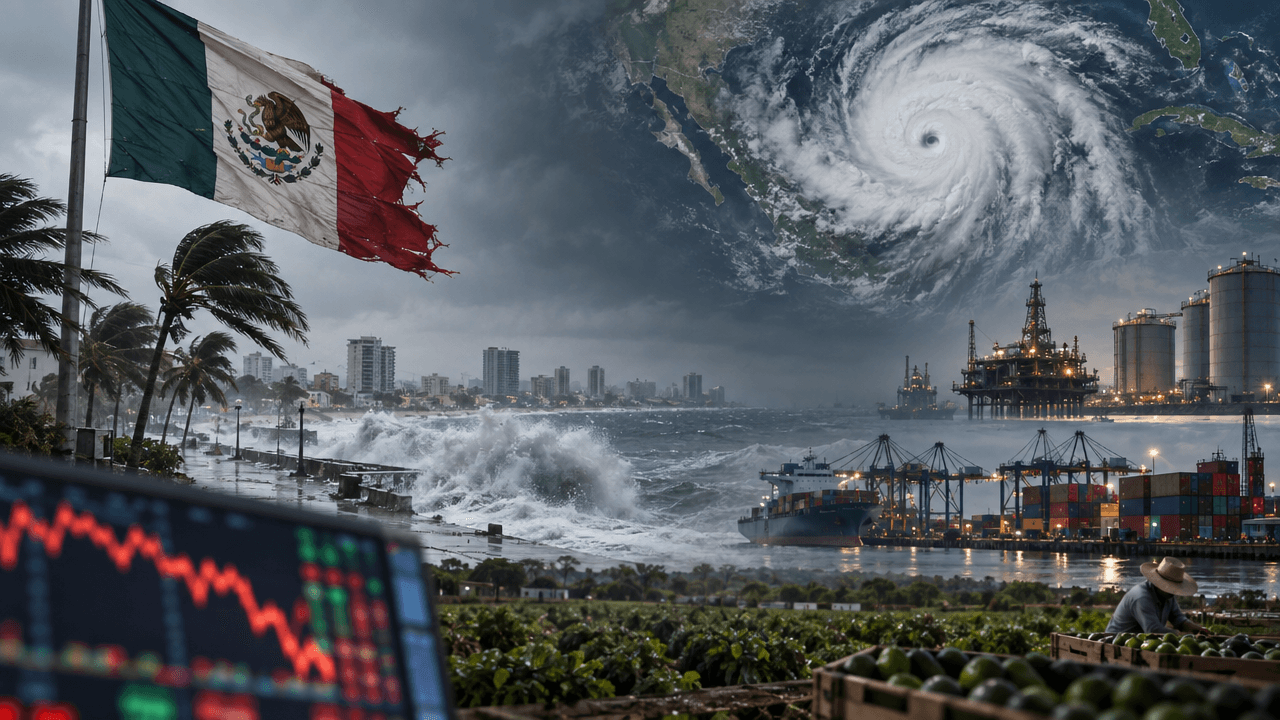
Hurricane Polo is a powerful reminder that weather is a market driver, not just a headline. With hurricane warnings now in place for key stretches of Baja California Sur and watches and tropical storm alerts along both Pacific and Gulf-facing states, Mexico is bracing for damaging winds, flooding rains and coastal storm surge.[1][7][13] For traders, the immediate question is not only where Polo goes next, but how quickly risk will be repriced across energy, agriculture, transportation and insurance-linked markets.[3][10]
Storm Overview And Current Warnings
Authorities in Mexico have issued hurricane warnings for portions of the west coast of Baja California Sur from Punta Abreojos to Santa Fe, alongside hurricane watches and tropical storm warnings that extend north toward Punta Eugenia and along the east coast near Loreto and Santa Rosalia.[1][4][7][13] Forecast guidance indicates Polo remains a major hurricane, with recent bulletins describing an intense system tracking northwest offshore before weakening closer to landfall.[9][11][14]
U.S. embassy alerts and national meteorological bulletins highlight the risks of dangerous surf, rip currents, rogue waves and severe coastal flooding from Cabo San Lucas up the Pacific side of the peninsula.[6][3] Inland, heavy rainfall is expected to trigger mudslides, road closures and localized damage from Sonora down through Guerrero and other Pacific states, areas where earlier warnings emphasized threats of landslides and flash floods.[5][12] This combination of coastal and inland hazards sets the stage for short-term disruption in regional infrastructure and economic activity.
For market participants, the key meteorological variables to monitor are Polo’s intensity at landfall, the precise track across Baja and into mainland Mexico, and the duration of heavy rainfall bands over key energy and agricultural regions. Specific path changes within 24–48 hours can materially alter the risk profile for refineries, pipelines, ports and cropland.
Energy And Commodity Market Ripple Effects
Mexico’s Pacific coast hosts important export terminals, storage facilities and logistics hubs connected to both domestic fuel distribution and international trade. Even if Polo’s center remains just offshore for part of its trajectory, dangerous surf and port closures can delay shipments of crude, refined products and LNG cargoes, tightening regional supply and amplifying short-term price volatility.[3][10] Traders in fuel, gas and power markets should expect localized spikes in basis prices and increased dispersion between unaffected hubs and those in Polo’s path.
Onshore, prolonged power outages and damage to transmission assets in Baja California Sur and neighboring states can affect industrial production and local demand patterns. In previous major storms, emergency fuel allocations and priority shipments have redirected flows away from normal commercial routes, creating temporary dislocations between spot and futures markets for regional energy benchmarks.[12] Market participants using simulated finance platforms can model scenarios where refinery throughput falls, import schedules slip or domestic demand fluctuates, allowing them to stress-test positions before real-world data catch up.
Soft commodities may also respond. While Pacific-side cropland is less dominant than Mexico’s interior agricultural belts, heavy rains and flooding can still disrupt harvest logistics for fruits, vegetables and specialty crops destined for export, particularly if roads and rail links are compromised.[5][6] Short-lived supply constraints can strengthen prices for certain regional products, especially where inventories are lean or where substitutes are limited.
Agriculture, Logistics And Trade Flows
Hurricane Polo’s rainfall footprint is a critical determinant of agricultural risk. Forecasts point to widespread heavy rain over Baja California Sur and parts of mainland Mexico, with totals sufficient to drive flooding and mudslides.[6][9] For farmers, the timing relative to planting and harvest windows matters as much as the absolute volume of rain. Excess rainfall can damage crops, erode topsoil and delay harvesting, while in some water‑stressed areas it can replenish reservoirs and improve medium‑term prospects.
Logistics risk is more immediate. Major Pacific highways, local roads and mountainous passes are vulnerable to landslides and washouts, which can disrupt truck transport for days or weeks.[5][12] Port operations along the southwestern coast, already facing high waves and strong winds, may suspend loading activities, slowing exports of agricultural products and manufactured goods.[3][10] This can ripple into currency markets and cross‑border trade flows if delays become extended and insurance claims surge.
For traders focusing on agricultural futures, FX and transportation-linked equities, SimFi environments offer a structured way to explore these dynamics. By building scenario trees around “mild disruption,” “severe port closure,” or “widespread inland flooding,” participants can observe how price relationships might evolve across grain, perishable produce, trucking, rail and shipping exposures. This kind of practice can sharpen intuition about which markets tend to overreact and which lag in pricing weather risk.
Insurance, Risk Pricing And Simulated Finance
Insurance and reinsurance markets are highly sensitive to events like Polo, particularly where exposure accumulates in coastal tourism zones, urban centers and vulnerable housing stock. As Polo is described as one of the most powerful Pacific cyclones in decades, underwriters will be scrutinizing potential losses ranging from wind damage and storm surge to business interruption and crop failures.[15][2] Catastrophe bonds and other insurance‑linked securities may see spreads widen as investors reassess modeled loss probabilities.
Pricing models in the insurance sector increasingly incorporate high‑resolution meteorological data and historical analogues, yet real‑time events routinely diverge from modeled scenarios.[2][12] Simulated finance platforms can bridge this gap for traders and risk managers by enabling them to test how different landfall intensities, damage footprints and governmental responses (such as deployment of military and civil protection units) might translate into claim volumes and capital needs.[12] This helps users learn how insurance equities, regional banks and diversified financials tend to react to escalating loss estimates.
For E8 Markets users, Polo is an opportunity to practice constructing multi‑asset risk narratives: starting from a weather shock, mapping through physical damage to infrastructure, scaling up into insurance losses and finally connecting to credit spreads and equity performance. The aim is not to forecast perfectly, but to build robust frameworks that can be reused when the next large system forms.
What Traders Should Watch Next
Short term, the most important variables to monitor are updated hurricane advisories, changes to warning and watch areas, and any reported damage to ports, refineries, pipelines, roads and key tourist zones.[1][4][7][13] Traders should track:
1. Port closures and cargo delays along the Baja and southwestern Mexican coast. 2. Power outages and infrastructure damage affecting industrial and residential demand. 3. Insurance company commentary on exposure, claims estimates and capital buffers. 4. Government emergency measures that may alter fuel allocation or logistics priorities. 5. Shifts in local currency and equity markets signaling changing risk perception.
In a SimFi environment, these factors can be turned into data points for scenario dashboards. Users can create positions that respond to hypothetical shocks—such as a week‑long closure of a major port or an upward revision in insured losses—and then observe how correlated assets behave. This builds muscle memory for trading around real‑world disasters while keeping capital safe.
Conclusion: Turning Weather Risk Into Market Insight
Hurricane Polo is first and foremost a human and humanitarian event, bringing real danger to communities in Baja California Sur and across mainland Mexico.[5][6][9] At the same time, it illustrates how quickly weather can propagate through energy, agriculture, transportation and insurance markets, reshaping risk and opportunity. Traders who learn to read these signals carefully—tracking advisories, infrastructure reports and insurer disclosures—are better positioned to navigate volatility with discipline rather than emotion.
For E8 Markets users, Polo underscores the value of simulated finance: the ability to rehearse complex, multi‑asset responses to a major storm, refine playbooks for future events and deepen understanding of how physical climate risk translates into financial market behavior. By treating Hurricane Polo as a case study in weather‑driven market dynamics, traders can convert a challenging news event into lasting risk‑management insight.