
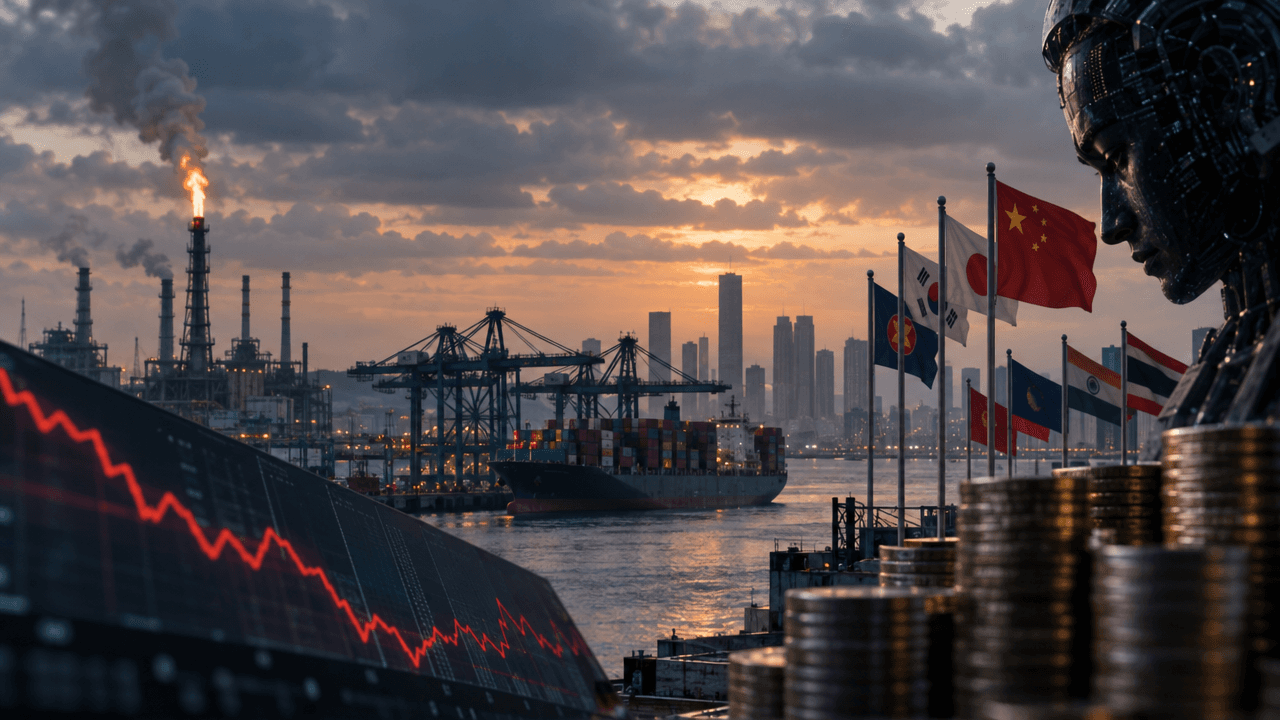
Asia’s economic outlook is losing momentum. The International Monetary Fund now projects regional growth will slow from 5.0% in 2025 to 4.8% in 2026 and 4.4% in 2027. Although Asia is still expected to remain one of the world’s fastest-growing regions, the downgrade in momentum highlights how exposed markets are to energy shocks, geopolitical conflict, elevated borrowing costs, and uncertainty surrounding the artificial-intelligence investment boom. [1]
For traders, the message is not simply that growth is slowing. It is that several risks could reinforce one another. Higher energy prices can lift inflation, rising bond yields can tighten financial conditions, and an AI-related correction could weaken both market sentiment and export demand. The result could be greater volatility across equities, emerging-market currencies, bonds, and rate-sensitive futures.
The Growth Outlook Is Cooling
The IMF’s latest Regional Economic Outlook describes a region being shaped by three major forces: an energy shock linked to conflict in the Middle East, an AI-driven technology boom, and continuing changes in global trade patterns. [2]
The 4.4% growth projection for 2027 is not a recession forecast. Instead, it represents a moderation from an exceptionally strong recent pace. Asia’s performance has benefited from technology exports, resilient domestic demand, and supply-chain investment. However, those same strengths create vulnerabilities when global demand changes.
Economies deeply connected to electronics, semiconductors, artificial intelligence infrastructure, and advanced manufacturing may experience sharper swings than less technology-dependent markets. Strong demand can produce rapid gains in exports, corporate earnings, and equity valuations. But if businesses reduce capital expenditure or consumers delay purchases, the reversal can be equally powerful.
For traders, the headline growth rate matters less than the distribution of growth across countries and industries. A resilient regional average can conceal significant weakness in individual economies, sectors, or currencies.
Energy Prices Create An Inflation Dilemma
The first major risk is the energy shock. Higher oil and gas prices raise transportation, manufacturing, and household costs. Energy-importing economies are particularly vulnerable because they must spend more on foreign commodities, potentially widening trade deficits and weakening their currencies.
The pressure also creates a difficult policy trade-off. Central banks may want to support economic activity with lower interest rates, but persistent energy inflation can limit their ability to ease. If policymakers remain cautious, borrowing costs may stay restrictive for longer. If they cut rates too quickly, markets may worry that inflation expectations are becoming unanchored.
The IMF has warned that a prolonged conflict could keep commodity prices elevated, while extreme weather and food-price pressures could add to the strain. [7] This makes inflation data, central-bank communications, and energy futures especially important market indicators.
In practical terms, traders should monitor whether higher energy prices are being absorbed by companies, passed on to consumers, or reflected in wage demands. Each outcome carries different implications for margins, inflation, interest rates, and currencies.
Rising Yields Can Amplify Market Stress
A second risk comes from global bond markets. The IMF cautioned that stress in major sovereign markets, including the United States, United Kingdom, euro area, and Japan, could spill over into Asian bond markets. Higher global yields can push up local borrowing costs even when domestic economic conditions have not changed significantly. [7]
This matters because many governments and companies must refinance existing debt. When yields rise, debt-service costs increase, fiscal flexibility narrows, and investors may demand a larger risk premium from emerging markets.
The effects can spread across asset classes. Higher yields tend to make risk-free assets more attractive relative to equities. They can also pressure growth stocks, reduce the present value of future corporate earnings, and weigh on currencies when capital flows toward higher-yielding developed-market assets.
Rate-sensitive futures may respond before economic data confirms a slowdown. Traders should therefore pay attention to yield-curve movements, government bond auctions, credit spreads, and interest-rate expectations. A sharp increase in yields combined with a weakening currency can signal that financial conditions are tightening rapidly.
The Ai Boom Is Both An Opportunity And A Risk
Artificial intelligence has supported investment, technology demand, and optimism about future productivity. Asia is especially connected to this theme through semiconductor manufacturing, hardware production, data-center equipment, and related supply chains.
However, the IMF warned that a correction in AI demand or valuations could have an outsized effect on the region. In a scenario where expected AI productivity gains fail to materialize, the IMF has estimated that US equities could fall 20%, while global growth could be 1.1 percentage points below baseline projections by 2028 and Asian growth could be 1.7 percentage points lower. [10]
A correction would not necessarily begin with weak economic data. It could start with disappointing earnings, reduced corporate spending, stricter financing conditions, or a reassessment of how quickly AI investment will produce profits.
Traders should distinguish between broad market weakness and concentrated technology-sector repricing. A decline in major technology indexes may affect semiconductor shares, supplier currencies, and equity benchmarks with high technology exposure. At the same time, defensive sectors and lower-beta assets may attract capital.
Practical Takeaways For Simfi Traders
The IMF outlook reinforces the importance of scenario planning rather than relying on one directional market view.
First, define the catalyst before entering a trade. An oil-price spike, a weak Asian manufacturing report, or a sharp rise in Treasury yields can affect markets through different channels.
Second, watch correlations. During calm periods, equities, currencies, and commodities may move independently. During stress, correlations can rise quickly, increasing portfolio risk.
Third, manage leverage carefully around central-bank meetings, inflation releases, energy headlines, and major technology earnings. A fundamentally correct view can still produce losses if volatility expands faster than expected.
Fourth, consider both first-order and second-order effects. Higher oil prices may support energy assets initially, but prolonged inflation can pressure equities and delay monetary easing. Similarly, strong AI demand may benefit semiconductor stocks while increasing the risk of excessive valuations.
Finally, use simulated trading to test execution under multiple conditions. Compare how the same strategy performs during falling yields, rising yields, stable energy prices, and an AI-sector selloff. The objective is not to predict every headline but to build a process that remains disciplined when the market narrative changes.
Conclusion
Asia’s projected slowdown to 4.4% growth in 2027 is a warning about vulnerability, not a prediction of collapse. The region still has powerful structural advantages, but its markets face an unusually complicated mix of energy inflation, geopolitical uncertainty, rising borrowing costs, and dependence on the AI investment cycle.
For traders, the most important lesson is to follow transmission channels. Track how a headline affects inflation, yields, currencies, earnings, and risk appetite in sequence. In a market shaped by overlapping macro risks, disciplined risk management and scenario analysis may be more valuable than a confident forecast.