
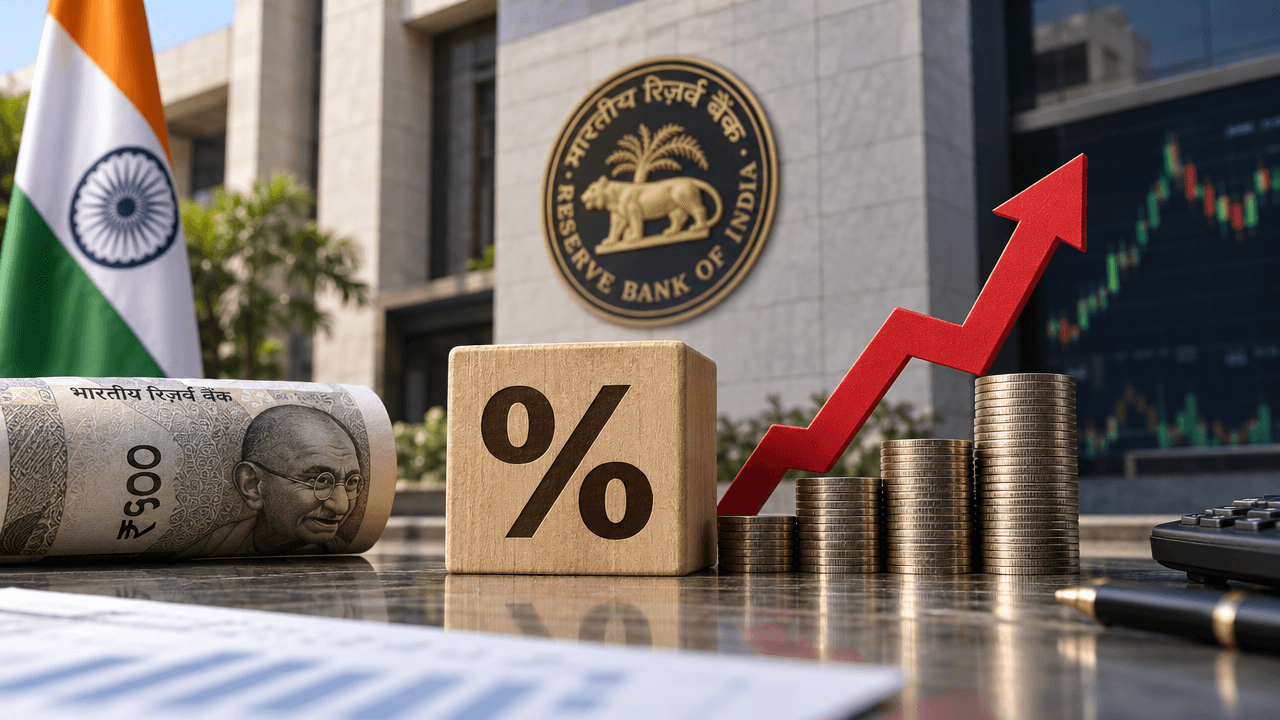
The Reserve Bank of India (RBI) has raised its benchmark repo rate by 25 basis points to 5.5%, marking its first rate hike since February 2023 and signaling a decisive turn toward tighter policy amid rising inflation and global risks.[1][6][14] For traders and investors, this move is a macro catalyst that will reshape the risk-reward landscape across the rupee, Indian government bonds, and domestic equities over the coming months.[6][9]
Policy Decision At A Glance
The repo rate is the interest rate at which the RBI lends short-term funds to commercial banks, serving as the anchor for borrowing costs across the financial system.[8][15] By increasing this rate from 5.25% to 5.5%, the RBI is making liquidity more expensive, a change that will gradually ripple into loan rates, corporate funding costs, and broader financial conditions.[7][15]
This hike ends a three-and-a-half-year era in which the RBI prioritized rate cuts and accommodative policy to support growth, and it stands out as the first increase since February 2023.[6][10][12] The central bank has also shifted its stance from “neutral” to “calibrated tightening,” signaling that while future moves are data-dependent, the bias is now toward containing inflation rather than easing credit conditions.[1][4][9]
Alongside the rate move, the RBI has reportedly nudged its macro forecasts, with estimates pointing to stronger GDP growth around 7.1% and inflation closer to 5.2%, reinforcing the narrative of an economy that is expanding robustly but facing persistent price pressures.[1][9] For market participants, this combination of solid growth and elevated inflation explains why the central bank is comfortable withdrawing some monetary accommodation.
Macro Backdrop: Why The Rbi Moved
The decision comes against a backdrop of rising inflation, higher global energy prices, and renewed geopolitical risks, particularly the ongoing West Asia crisis that has supported crude oil above the USD 100 per barrel mark.[5][11][12] These factors have raised the risk that imported inflation could feed into domestic prices, from fuel and transportation to food and manufactured goods.[11][12]
At the same time, the Indian economy has maintained strong growth momentum, with resilient domestic demand and steady investment flows, reducing the need for ultra-loose monetary settings.[1][9][10] A robust growth profile gives the RBI room to act pre-emptively against inflation rather than waiting for price pressures to become entrenched.
The rupee has also faced periodic weakness amid a strong US dollar and higher global yields, increasing the risk of capital outflows and imported inflation via a more expensive import bill.[11][14] A measured rate hike helps shore up currency credibility and signals to global investors that the RBI is willing to act to protect both price and financial stability.[3][14]
In short, the policy calculus is clear: inflation risks have risen, growth is solid, and global conditions are volatile, making a modest hiking cycle—and a shift to calibrated tightening—a rational response to a more challenging macro environment.[9][12][14]
Immediate Impact: Loans, Currency, Bonds, And Equities
One of the most direct consequences of the repo rate hike is that loans will become more expensive over time as banks pass on higher funding costs to borrowers.[5][15] Home loans, vehicle loans, personal credit, and corporate borrowing are all likely to see incremental rate increases, and existing borrowers may face higher EMIs if their loans are on floating-rate terms.[5][15]
In the currency market, a higher policy rate tends to be supportive for the rupee, as it improves the carry for foreign investors holding rupee-denominated assets and signals the RBI’s intent to contain inflation.[6][9][14] While short-term volatility is always possible around major policy events, the medium-term impact of a credible anti-inflation stance is typically positive for currency stability.
Indian government bonds will reprice to reflect tighter policy expectations, particularly at the short end of the yield curve, where rates are most sensitive to the repo rate.[3][6] Yields are likely to move higher, which can weigh on bond prices in the near term but may also make fixed-income instruments more attractive for yield-focused investors.[3][15]
Equity markets often react more ambiguously to rate hikes: higher borrowing costs are a headwind for leveraged sectors, yet policy credibility and macro stability can be supportive for long-term valuations.[3][6][14] Rate-sensitive sectors such as banks, NBFCs, real estate, and autos could see near-term volatility as investors reassess earnings trajectories under a higher-rate environment.
What This Means For Traders And Investors
For traders, the RBI’s move is a textbook example of how monetary policy can act as a cross-asset catalyst, and it underscores the importance of integrating macro data into trading strategies. Currency traders should monitor the rupee’s reaction not just on day one, but over the coming weeks as global yield differentials and risk sentiment evolve.
Fixed-income traders can look for opportunities in the reshaping of the yield curve, particularly around expectations for subsequent MPC meetings and the path of inflation prints. Options on government bonds or interest-rate futures can be useful tools to express views on volatility and the pace of tightening.
Equity traders may focus on sector rotation. Financials and rate-sensitive cyclicals might face pressure if the market prices in a more extended hiking cycle, whereas exporters and companies with strong balance sheets could benefit from currency stability and disciplined inflation management. Position sizing, diversification, and clear risk limits become critical when macro narratives shift.
Long-term investors can use this moment to reassess asset allocation. A higher repo rate is a reminder to stress-test portfolios against scenarios of tighter liquidity, higher funding costs, and potential multiple compression in equities. Strategic exposure to quality companies with strong cash flows and manageable leverage may become even more valuable in this environment.
Using Simulated Finance To Navigate Policy Shocks
For participants in SimFi platforms like E8 Markets, this RBI decision is an ideal case study to practice trading around macro events without real-world capital at risk. Simulated environments allow traders to build and test scenarios that incorporate rate hikes, currency responses, and sector rotations, using historical patterns and real-time data.
One practical approach is to design simulated strategies that respond to different paths of future RBI meetings: a single hike followed by a pause, a gradual hiking cycle, or a surprise reversal if inflation eases faster than expected. Each scenario can be translated into specific positions across currencies, bonds, and equities, with clear entry and exit rules.
Another valuable exercise is to test portfolio resilience. Traders can simulate higher funding costs, tighter credit conditions, and changes in valuation multiples to see how hypothetical portfolios perform under stress. This type of experimentation helps build intuition about how central bank decisions propagate through markets.
By systematically practicing these scenarios in a SimFi setting, traders can refine their reaction frameworks, improve discipline around risk management, and gain confidence in handling real-world policy shocks when they occur.
Conclusion
India’s 25 basis point hike in the repo rate to 5.5% marks a turning point in its monetary cycle, reflecting a clear commitment to fighting inflation amid strong growth and complex global risks.[1][6][12][14] The shift to a calibrated tightening stance sends a powerful message to markets that price and financial stability are back at the center of the RBI’s agenda.[3][9][14]
For traders and investors, this decision is more than a headline—it is a signal to reassess assumptions about liquidity, funding costs, and risk premia across asset classes. Those who take the time to understand the macro drivers, map the cross-asset implications, and rigorously test their strategies—whether in live markets or simulated finance environments—will be better positioned to navigate the new regime.