
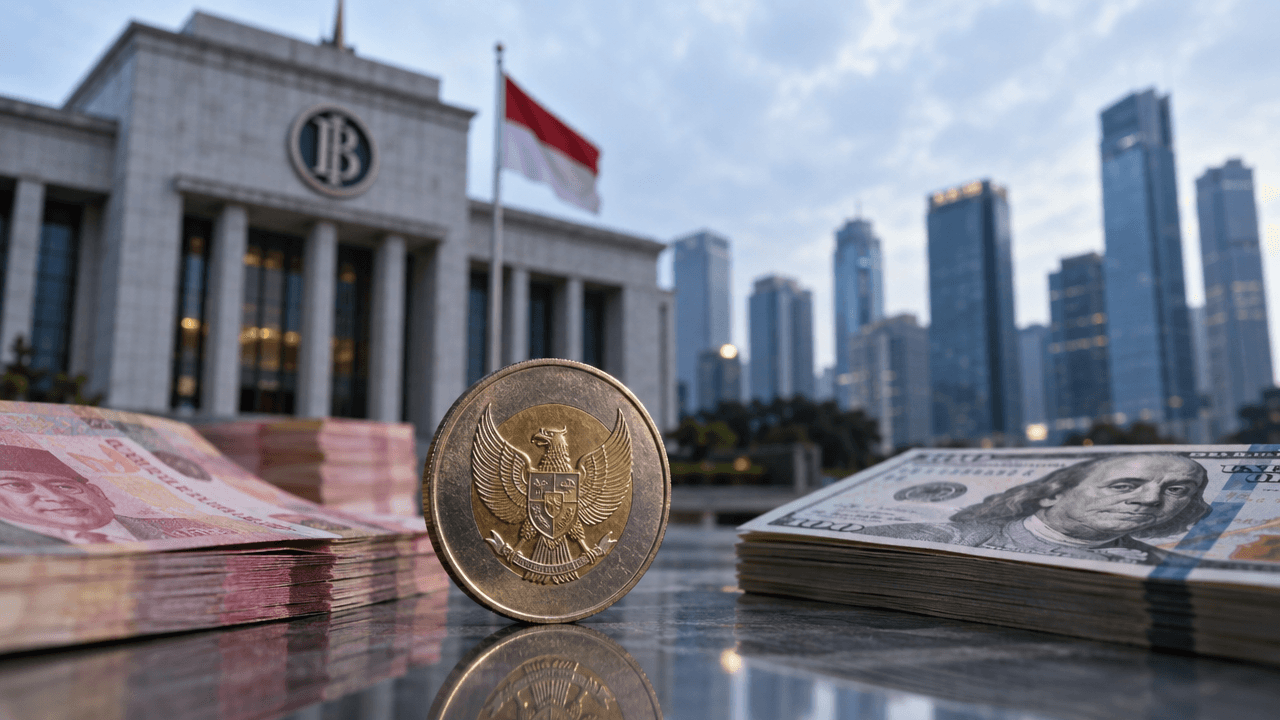
Bank Indonesia has raised its benchmark interest rate by 25 basis points to 6%, delivering a clear message to financial markets: protecting the rupiah and preserving price stability now take priority over additional monetary easing. The decision, announced after the central bank’s November 17–18 meeting, comes as emerging-market currencies face renewed pressure from global uncertainty, a strong US dollar, and elevated international interest rates. [1]
Why Bank Indonesia Raised Rates
The higher BI-Rate is designed to strengthen the rupiah by making Indonesian financial assets more attractive to domestic and international investors. When interest rates rise, investors may be more willing to hold assets denominated in rupiah because they can receive higher returns. This can help reduce selling pressure on the currency and limit capital outflows.
The move also serves as a pre-emptive measure against inflation. Bank Indonesia is targeting inflation within a range of 2.5% plus or minus 1 percentage point during 2026 and 2027. Recent inflation data has remained inside that corridor, but a weaker currency can increase the domestic cost of imported goods, energy, raw materials, and equipment. [1]
The timing is particularly important. Reports indicate that the rupiah has been trading near record lows against the US dollar, while markets are monitoring the possibility of further US Federal Reserve tightening. A higher rate in the United States can pull capital away from emerging markets, especially when investors become more cautious about currency risk. [2]
The Global Pressure Behind The Decision
Indonesia is not facing this challenge in isolation. Emerging-market central banks often have to balance domestic economic growth against international capital flows. Even when local inflation is manageable, a sharp move in the dollar can weaken a national currency and create financial instability.
The US dollar benefits when global investors seek safety or expect US interest rates to remain high. As dollar-denominated assets become more attractive, investors may reduce exposure to emerging-market bonds, equities, and currencies. That creates pressure on countries such as Indonesia to maintain a competitive interest-rate differential.
Bank Indonesia’s decision therefore reflects more than a response to domestic price data. It is also an attempt to preserve confidence in the rupiah and reduce the risk that currency weakness becomes self-reinforcing. If businesses and consumers expect further depreciation, they may accelerate purchases of imported goods or increase demand for foreign currency, adding more pressure to the exchange rate.
The central bank also raised its Deposit Facility rate to 5.25% and its Lending Facility rate to 6.75%. These adjustments help ensure that the broader interest-rate corridor moves consistently with the benchmark decision. [1]
WHAT THE RATE HIKE MEANS FOR INDONESIA’S ECONOMY
Higher interest rates can support the currency and contain inflation, but they also carry economic costs. Borrowing becomes more expensive for households, companies, and financial institutions. Consumers may delay purchases of homes, vehicles, and other large-ticket items. Businesses may postpone expansion plans if financing costs rise and expected returns become less attractive.
The impact will depend on how long the rate remains at 6% and how effectively the policy stabilizes the rupiah. A temporary increase may have a limited effect on growth if it quickly restores market confidence. However, prolonged restrictive policy could weaken credit growth, private consumption, and business investment.
For Indonesian exporters, a weaker rupiah can provide some support because export revenues may translate into more local currency. Companies with substantial dollar revenues could also benefit. Importers and businesses with foreign-currency debt face the opposite problem: depreciation increases their costs and can make debt repayment more difficult.
Investors should therefore look beyond the headline rate. The key questions are whether the rupiah stabilizes, whether inflation expectations remain anchored, and whether banks continue extending credit to productive sectors of the economy.
Market Implications For Traders
The decision creates several important themes for traders. First, the rupiah may experience short-term support if investors view the rate hike as credible and sufficient. Currency markets, however, will continue to track US interest-rate expectations, global risk appetite, and future communication from Bank Indonesia.
Second, Indonesian government bonds may face mixed conditions. Higher rates can initially pressure bond prices because newly issued securities offer more attractive yields. At the same time, a stronger currency and improved inflation outlook could attract foreign investors back to local debt markets.
Third, rate-sensitive equities may come under pressure. Banks can benefit from higher lending rates in some circumstances, but they may also face slower loan growth and rising funding costs. Property, consumer, and highly leveraged companies are often more vulnerable because their valuations depend heavily on affordable financing.
For SimFi traders, this event offers a useful case study in macroeconomic positioning. A professional approach would involve monitoring the USD/IDR exchange rate, Indonesian bond yields, equity-sector performance, and central-bank guidance rather than trading the interest-rate headline alone. Risk management remains essential because emerging-market currencies can react sharply to global news.
Key Takeaways For Market Participants
The 6% BI-Rate is both a currency-defense measure and an inflation-management tool. It signals that Bank Indonesia is willing to accept some pressure on domestic borrowing and economic activity to reduce the risks associated with rupiah weakness.
Traders should watch four indicators: the rupiah’s response, foreign investment flows, inflation expectations, and signals from the US Federal Reserve. A stable currency combined with contained inflation could allow Bank Indonesia to pause. Continued depreciation or renewed inflation pressure could increase expectations for additional tightening.
The broader lesson is that central-bank decisions are rarely driven by one data point. In emerging markets, currency stability, inflation, global interest rates, and investor confidence are closely connected. Indonesia’s latest move demonstrates how policymakers may act pre-emptively when external pressure threatens to become a domestic problem.
Conclusion
Bank Indonesia’s decision to raise its benchmark interest rate to 6% marks a significant shift toward defending financial stability in a challenging global environment. The hike may weigh on borrowing and growth, but policymakers are betting that a more stable rupiah and firmly anchored inflation expectations will create a stronger foundation for the economy.
For traders and investors, the decision is a reminder to analyze both local fundamentals and global forces. Indonesia’s next market direction will depend not only on the new rate, but also on whether it succeeds in stabilizing the currency while keeping economic activity resilient.