
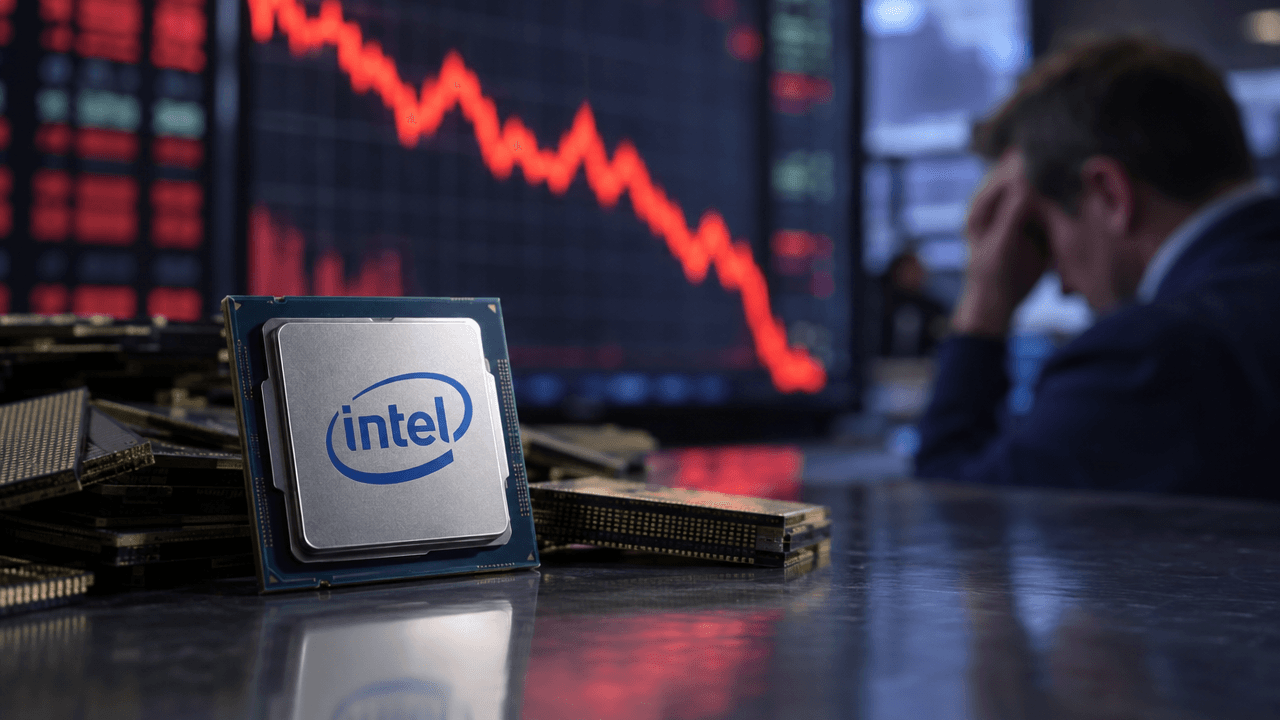
Intel’s sharp selloff has turned a company-specific earnings disappointment into a broader warning for the semiconductor industry. Shares plunged nearly 30% after the chipmaker issued a weak forward outlook, while investors focused on declining personal-computer demand, elevated component costs, and the pressure those trends could place on Intel’s turnaround strategy. The Philadelphia Semiconductor Index dropped more than 7%, AMD fell about 11%, and Nvidia lost more than 4%, showing how quickly a negative signal from one major company can spread across a highly interconnected sector. [2][8]
WHY INTEL’S OUTLOOK MATTERS
Intel’s latest warning was especially damaging because it challenged expectations that the PC market was beginning to stabilize. The company projected fourth-quarter revenue of approximately $15 billion to $16 billion, below Wall Street expectations near $17 billion. Intel also indicated that PC weakness could persist into 2027, with industry unit shipments expected to decline significantly during the second half of 2026 and fall again the following year. [9][13]
The problem extends beyond the number of computers being sold. Higher memory prices and shortages of other components are increasing manufacturing costs and pushing up prices for consumers. When devices become more expensive, businesses and households are more likely to delay upgrades. That creates a difficult cycle for chipmakers: lower shipments reduce revenue, while higher input costs pressure margins.
Intel remains particularly exposed because personal-computer processors are central to its business. Although its data-center operations have shown stronger growth, that expansion has not yet fully offset weakness in its traditional client-computing segment. The company’s third-quarter PC chip revenue declined 5% year over year, while data-center revenue rose sharply, highlighting the uneven nature of its recovery. [10]
Why The Entire Chip Sector Fell
Investors did not treat Intel’s forecast as an isolated corporate issue. Semiconductor companies operate within the same supply chains and depend on many of the same end markets. A weaker PC outlook can affect processor designers, memory manufacturers, equipment suppliers, and companies that provide packaging and manufacturing services.
That explains the reaction in shares of AMD, Nvidia, Arm, Qualcomm, Broadcom, and other chip companies. Their businesses are not identical to Intel’s, but falling demand expectations can cause investors to reassess industry-wide valuations. The Philadelphia Semiconductor Index, which tracks major publicly traded chip companies, fell more than 7% during the session. [2]
The selloff also reflects the market’s sensitivity to high-growth technology stocks. Semiconductor valuations had benefited from optimism surrounding artificial intelligence, cloud infrastructure, and data-center investment. When a major company warns about demand and costs, investors may reduce risk across the entire group rather than waiting to determine which businesses are most insulated.
This process can create exaggerated short-term moves. A company with strong long-term prospects may decline simply because investors are selling the sector as a whole. For traders, distinguishing between broad risk reduction and a genuine change in business fundamentals is essential.
The Ai Boom Versus The Pc Slump
One of the most important themes in the selloff is the uneven distribution of demand across the semiconductor market. Artificial-intelligence infrastructure has created extraordinary demand for advanced processors, networking equipment, and high-bandwidth memory. At the same time, the conventional PC market is facing weaker shipments and rising component costs.
These trends can coexist. Strong AI spending does not automatically guarantee growth for every chip company. A manufacturer may benefit from data-center demand while struggling in consumer electronics. Meanwhile, intense competition for memory and manufacturing capacity can raise costs for companies serving less profitable markets.
Intel’s results therefore raise a broader question: how durable is the current technology investment cycle if consumer demand remains weak? Investors may be willing to support large capital expenditures when revenue growth is accelerating, but they become more cautious when major companies report that demand is slowing and cash flow remains under pressure.
For Nvidia and other AI-focused businesses, the immediate impact may be less direct. However, their valuations can still be affected if investors begin questioning whether the pace of AI spending is sustainable or whether companies will eventually reduce capital budgets.
What Traders Should Watch Next
The first priority is forward guidance rather than backward-looking earnings. Past results show what happened, but management forecasts reveal how companies view demand, pricing, inventories, and costs over the next several quarters. Intel’s weak projection mattered more than the fact that some prior-quarter results were in line with expectations.
Traders should also monitor PC shipment forecasts, memory pricing, inventory levels, and capital spending plans from major technology companies. These indicators can help determine whether the selloff reflects a temporary adjustment or a deeper downturn.
Price action is another important signal. If semiconductor shares stabilize after the initial shock, the market may be treating Intel’s problems as company-specific or already reflected in valuations. If weakness continues across chip designers, equipment makers, and memory companies, it could indicate that investors are reducing exposure to the broader technology cycle.
Risk management is especially important in this environment. Large one-day declines can create the appearance of a bargain, but falling prices alone do not confirm that a stock has reached fair value. Traders should define position sizes, use clear invalidation levels, and avoid assuming that a diversified group of chip stocks is automatically diversified by risk.
The Broader Market Lesson
Intel’s collapse demonstrates how quickly earnings guidance can reshape market expectations. The semiconductor sector is both cyclical and strategically important, making it highly sensitive to changes in demand, supply chains, interest rates, and investor sentiment.
The immediate message is not that every chip company faces the same future. It is that sector-wide optimism must be supported by company-level fundamentals. AI demand may remain powerful, but weakness in PCs, higher memory costs, and uncertain consumer spending can still generate substantial volatility.
For SimFi traders, the event offers a useful case study in correlation risk. A position that appears diversified across several semiconductor names may still move sharply in the same direction when the market receives a common industry signal. The practical takeaway is to track both individual company data and the wider economic forces affecting the sector.
Intel’s warning has made the semiconductor outlook more selective. The companies best positioned to withstand weaker consumer demand, manage costs, and convert growth into sustainable cash flow may attract greater investor confidence. Until that distinction becomes clearer, volatility is likely to remain a defining feature of chip-stock trading.