
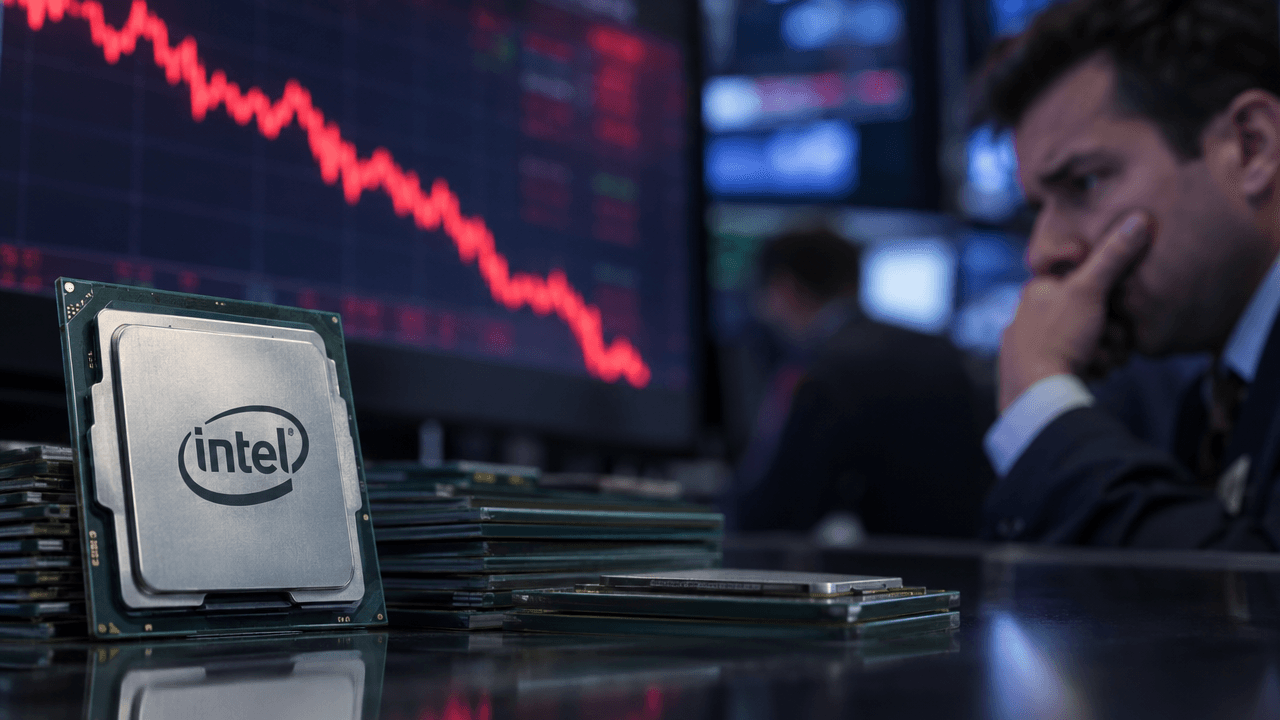
Intel’s collapse has become a warning signal for the entire semiconductor industry. Shares of the chipmaker plunged nearly 30% on October 30, marking one of the steepest declines in the company’s history and intensifying a broader technology selloff. The Philadelphia Semiconductor Index fell sharply, while AMD dropped roughly 11% and Nvidia declined more than 4% during the market rout. [7]
The immediate trigger was Intel’s weak outlook, particularly its warning that declining PC demand and higher component costs could pressure sales well into 2027. But the market reaction reflects more than one disappointing forecast. Investors are reassessing the durability of semiconductor demand, the cost of the artificial intelligence buildout, and the high expectations embedded in chip-stock valuations.
WHY INTEL’S WARNING MATTERS
Intel remains closely tied to the personal-computer market. PC chips accounted for approximately half of the company’s third-quarter revenue, but revenue from its client computing division fell 5% year over year to $8.1 billion. Management expects sales from that segment to decline by more than 20% sequentially in the current quarter. [7]
The company also indicated that the PC market could remain weak through at least the first half of 2027. Its forecast points to a broader industry contraction, with PC shipments expected to fall meaningfully as elevated memory prices and component shortages increase the cost of computers. Higher prices can encourage consumers and businesses to delay upgrades, creating a negative cycle for manufacturers and chip suppliers.
For Intel, the problem is especially serious because the company is already working to rebuild its competitive position. A weaker client market limits revenue just as Intel faces substantial costs associated with manufacturing expansion, product development, and its effort to participate in the artificial intelligence infrastructure boom.
FROM COMPANY-SPECIFIC PROBLEM TO INDUSTRY SELLoff
Investors rarely treat a major semiconductor warning as an isolated event. Chip manufacturers operate within a highly interconnected supply chain, and a slowdown in one important end market can affect equipment makers, memory companies, designers, and contract manufacturers.
That explains why the selloff spread quickly beyond Intel. AMD fell approximately 11%, while Nvidia lost more than 4%. Other semiconductor names also came under pressure as traders reduced exposure to companies whose earnings depend on continued growth in computing demand. The Philadelphia Semiconductor Index, which tracks major U.S.-listed chip companies, fell more than 7% in early reports of the selloff. [2]
The market’s response also shows how sentiment can overpower individual fundamentals. AMD and Nvidia have different businesses from Intel and are more directly associated with data centers and AI accelerators. Nevertheless, when one major company warns that customers are delaying purchases and costs are rising, investors begin asking whether other parts of the industry could face similar pressure.
Ai Boom Meets Economic Reality
The semiconductor sector has benefited enormously from demand for artificial intelligence hardware. Data-center investment has supported strong growth for leading accelerator and networking-chip companies. However, that growth has also created new risks.
Building AI infrastructure requires enormous capital spending by cloud providers, technology companies, and data-center operators. Investors are now examining whether the revenue generated by AI services will justify the cost of purchasing and operating increasingly expensive computing systems.
Intel’s warning added to those concerns. The company’s results suggested that AI-related demand does not automatically offset weakness in traditional computing markets. In addition, rising demand for AI hardware has contributed to tighter supplies and higher prices for certain memory components. Those costs can eventually reach PC manufacturers and consumers, weakening demand for everyday devices. [3]
This creates a two-speed semiconductor market. Some areas, especially advanced data-center hardware, may continue expanding rapidly, while consumer-facing segments such as PCs remain under pressure. The challenge for investors is determining whether growth in the strongest categories can compensate for weakness elsewhere.
What Traders Should Watch Next
The most important question is whether Intel’s forecast represents an industry-wide downturn or a company-specific execution problem. Traders should monitor upcoming earnings reports from AMD, Nvidia, memory manufacturers, semiconductor equipment companies, and major PC makers.
Management commentary will be particularly important. Investors should listen for changes in order trends, inventory levels, capital-spending plans, and customer purchasing behavior. If multiple companies report delayed orders or rising inventories, the selloff could persist. If other businesses maintain strong guidance, the market may eventually separate Intel’s difficulties from the broader AI opportunity.
Price action also deserves attention. A sharp decline can create oversold conditions, but oversold does not mean undervalued. Traders should avoid assuming that a falling stock has automatically become a bargain. Instead, they can evaluate whether the company’s earnings estimates, cash flow outlook, and competitive position justify its current valuation.
For SimFi traders, this event provides a useful exercise in risk management. A disciplined approach could include reducing oversized positions, defining stop levels before entering a trade, and avoiding excessive concentration in highly correlated semiconductor stocks. Diversification matters because several different chip companies can decline together when market sentiment changes.
The Bigger Market Lesson
Intel’s collapse demonstrates how quickly a single earnings outlook can alter expectations across an entire sector. The semiconductor industry remains central to economic growth, cloud computing, consumer electronics, and artificial intelligence, but its companies are not insulated from cyclical demand, rising costs, or valuation risk.
The key takeaway is not that the semiconductor story is over. Rather, the market is demanding clearer evidence that future growth can support today’s expectations. Strong demand in one segment may not protect companies from weakness in another, and ambitious investment plans can become a liability when end-market growth slows.
For traders and investors, the next phase will require selectivity. Instead of treating all chip stocks as one trade, analyze each company’s customers, revenue mix, balance sheet, competitive advantages, and exposure to PC, data-center, automotive, and AI demand. Intel’s warning has made one fact clear: in a high-expectation market, guidance can matter more than history.