
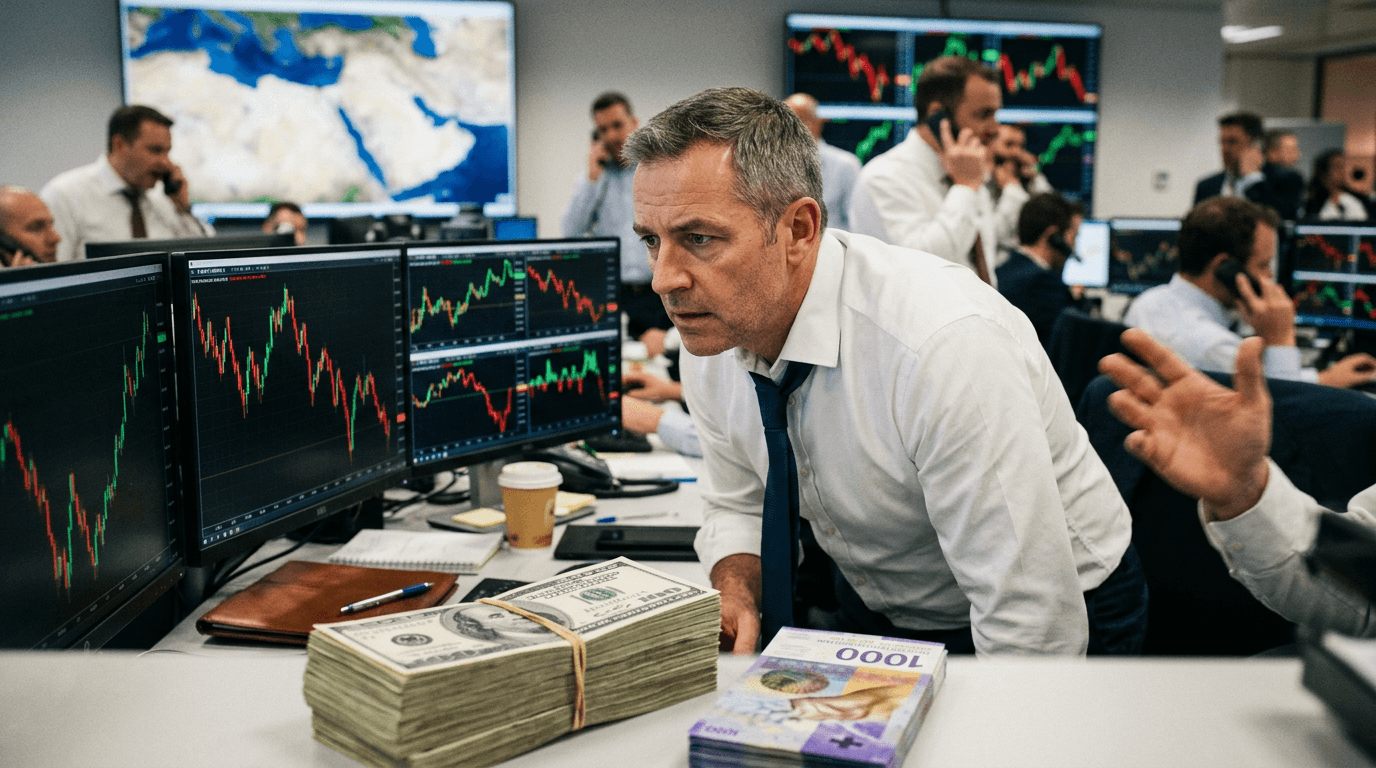
The Iran conflict that erupted on February 28, 2026, has fundamentally reshaped global financial markets, with currency traders and institutional investors increasingly rotating toward safe-haven assets amid unprecedented geopolitical uncertainty. As military operations between the US, Israel, and Iran escalate and show no signs of immediate de-escalation, foreign exchange markets have become a crucial barometer of shifting risk sentiment, with safe-haven currencies like the US dollar and Swiss franc experiencing sustained inflows while riskier currencies face mounting pressure. Understanding these forex dynamics is essential for traders navigating an environment where traditional correlations are breaking down and volatility is likely to persist for months to come.
Safe-haven Flows Accelerate Amid Geopolitical Shock
The conflict's immediate impact on currency markets reveals a classic risk-off scenario playing out in real time. The US dollar surged in the war's opening days as investors sought shelter in the world's most liquid and stable currency.[1] This flight to safety reflects deep concerns about prolonged energy supply disruptions, with the effective blockade of the Strait of Hormuz representing the most significant chokepoint disruption since the 1970s.[2] Beyond the dollar, traditional safe-haven flows have benefited the Swiss franc and Japanese yen, as investors retreat from emerging market currencies and commodity-linked assets facing heightened uncertainty.
The mechanics driving these flows are straightforward: escalating geopolitical risk creates fear of stagflation—simultaneously rising inflation from energy shocks and slowing economic growth. In such environments, investors abandon yield-seeking strategies and emerging market carry trades, instead concentrating capital in developed-market currencies backed by strong central banks and deep, liquid markets. Gold prices rose sharply as a safe-haven asset in tandem with these currency flows, underscoring how traditional risk-off plays are synchronized across asset classes.[1]
Forex Volatility Breaks New Highs
Volatility across major currency pairs has increased materially since the conflict began, though not yet to crisis-level extremes. Credit spreads and volatility indicators have moved higher but remain below levels observed during previous geopolitical shocks, suggesting that markets are pricing in the disruption as potentially temporary rather than catastrophic.[3] However, this relative calm masks significant daily whipsaws in currency pairs as headlines drive rapid repricing of risk scenarios.
The USD/EUR pair exemplifies this volatility pattern, with the euro weakening as Europe faces the most severe energy import dependency and recession risks among developed economies.[1][2] Meanwhile, the USD/JPY has climbed as both safe-haven flows and diverging monetary policy expectations favor dollar strength against the yen. Emerging market currencies have experienced far more dramatic swings, with currencies from energy-importing nations like India and South Korea facing additional pressure from both risk-off flows and the prospect of deteriorating economic growth if energy disruptions persist.
Shifting Risk Sentiment Reshape Positioning
The conflict has triggered a complete recalibration of investor positioning in forex markets. Prior to the war, many traders were positioned for continued dollar weakness, expecting a longer-term shift away from dollar-denominated assets amid geopolitical fragmentation.[2] The Iran crisis has temporarily arrested this trend, but with important caveats: analysts expect that once military operations wind down, dollar weakness could resume as structural positioning adjusts. This creates a critical timing question for forex traders—attempting to pick the exact inflection point when safe-haven flows reverse could prove as dangerous as being caught on the wrong side of the initial shock.
The conflict's impact varies dramatically by region, with Asian currencies experiencing the most pressure due to energy import dependency and export-driven growth models vulnerable to disrupted supply chains.[2][3] European currencies face similar headwinds, while the dollar's relative stability reflects America's expanded domestic energy production and more diversified economic base. This regional divergence has created opportunities for sophisticated traders positioning for divergent economic outcomes across developed markets.
Market Implications And Trading Considerations
The persistence of elevated uncertainty for the next six to twelve months creates a complex trading environment. Even if military operations cease quickly, lingering supply constraints and precautionary stockpiling could keep energy prices and currency volatility elevated for far longer than initial cease-fire optimism might suggest.[3] Central banks face mounting pressure to balance inflation concerns against growth risks, with many lacking conventional policy flexibility. This has created a high-conviction environment favoring safe-haven currencies and volatility strategies.
For traders, the key takeaway is that traditional forex relationships are fracturing under stress. Correlations between currency pairs and equity markets have weakened, while geopolitical risk premiums have widened. Long positions in the USD and CHF against emerging market currencies remain the consensus trade, but positioning is already crowded—suggesting the next major move may come from an unexpected de-escalation or, conversely, from a significant intensification of the conflict that forces central banks into more dramatic policy responses.
The Iran conflict has transformed forex markets from a relatively quiet corner of finance into a critical proving ground for risk assessment and macroeconomic forecasting. For traders and investors, success requires staying nimble, monitoring both conflict developments and economic data with equal intensity, and remembering that safe-haven flows can reverse with stunning speed once uncertainty begins to clear.