
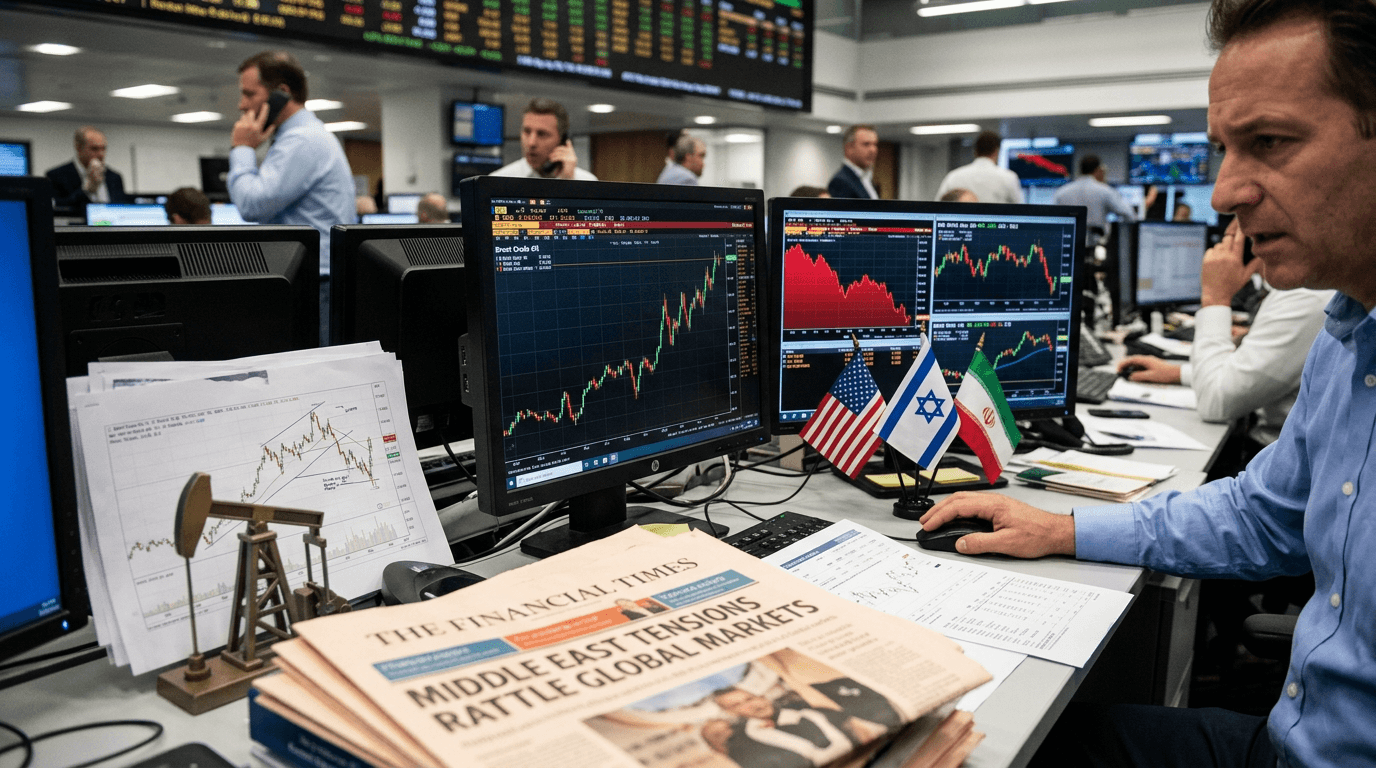
The recent military escalation between the United States, Israel, and Iran is sending shockwaves through global financial markets in ways both immediate and unpredictable. As investors navigate unprecedented geopolitical uncertainty, understanding how this conflict is reshaping asset prices, currency flows, and investment strategies has become essential for trading success. The Iran war represents a critical moment where traditional market mechanics meet real-world geopolitical risk, creating opportunities and challenges for traders at all experience levels.
The Immediate Market Shock
When the U.S. and Israel launched strikes on Iranian military targets on February 28, 2026, financial markets reacted with the kind of swift repricing that characterizes major geopolitical events. Oil prices spiked materially from February 27 through March 1, with traders immediately reassessing the risk of energy supply disruptions. This initial shock extended far beyond energy markets. Equities experienced sharp selling pressure consistent with historical patterns following targeted military strikes, while safe-haven assets like U.S. Treasuries, the U.S. dollar, and gold moved higher as investors rushed to de-risk their portfolios.
The beauty and danger of these market movements is that they happen in real time, often before full clarity emerges on the conflict's duration or ultimate scope. Early analysis suggests the immediate sell-off in equities may prove short-lived if the conflict remains contained, but the uncertainty itself has become an asset class worth trading.
Oil Prices And The Strait Of Hormuz
The critical factor determining how far this conflict's financial impact will ripple is the fate of the Strait of Hormuz. This narrow waterway, through which roughly one-third of the world's seaborne oil passes, is the transmission channel connecting Middle East geopolitics directly to global energy prices and inflation expectations. Currently, analysts believe a sustained closure of the Strait remains unlikely, but the risk premium is undeniably priced in.
A 5 to 10 percent rise in oil prices typically adds 0.1 to 0.3 percentage points to headline inflation in the U.S. and Europe almost immediately. This relationship matters enormously for central banks trying to manage their policy responses. Energy-driven inflation impulses create a dilemma: central banks may attempt to "look through" temporary price spikes, but if the conflict becomes prolonged and oil prices remain elevated, inflation expectations could drift higher. For regions where headline inflation has already exceeded targets for years, like the U.S. and UK, this creates serious complications for monetary policy decisions ahead.
Two Scenarios For Traders
Market analysts have identified two distinct scenarios that will ultimately determine whether this remains a trading opportunity or a fundamental market reset. The first scenario involves a four to seven day conflict followed by internal Iranian uncertainty. In this case, expect an initial oil spike that fades as Hormuz disruption fears ease, combined with a temporary war premium that leaves no lasting macro implications. This mirrors the June 2025 playbook that traders can reference for historical patterns.
The second, more severe scenario involves prolonged conflict where Iranian retaliation forces sustained military responses. In this timeline, strikes continue past fixed military targets into infrastructure and mobile assets, potentially lasting four to five weeks or longer. This scenario introduces asymmetric economic warfare, including sustained harassment of tanker traffic, Houthi attacks on Red Sea shipping, and disruption attempts at the Strait of Hormuz. This outcome would create a secondary supply-side inflation shock while global tariffs are still unfolding, complicating growth outlooks and making rate cuts harder to justify.
Sectoral Implications And Trading Opportunities
Different market sectors are responding predictably to this crisis. Energy stocks, aerospace and defense equities, and gold are spiking as investors position for extended uncertainty and potential supply disruptions. Conversely, cyclical sectors most sensitive to growth concerns, particularly consumer-facing areas like airlines and industrial oil users, are under pressure.
Some experienced traders are viewing extreme moves in regional assets as buying opportunities. If Gulf Cooperation Council assets, East Asian equities, or European markets fall sharply on war fears alone, without fundamental deterioration, these dips may represent tactical entry points before the conflict's scope becomes clearer. This contrarian approach works best when you distinguish between genuine risk and panic-driven overshooting.
Central Bank Complications
The Federal Reserve faces a genuine policy dilemma. While core inflation sits around 3 percent and many committee members question the disinflationary trajectory, an energy-driven inflation shock could force difficult choices between supporting financial conditions and maintaining price stability. European central banks must remain even more cautious, given energy dependencies and potential gas price spikes following oil rallies. This creates potential divergence in monetary policy globally, adding currency volatility to an already uncertain environment.
Navigating The Uncertainty
The key takeaway for traders is that this conflict has injected significant uncertainty into a global trading system already stressed by trade tensions and geopolitical fragmentation. Markets will continue demanding a higher risk premium until clarity emerges on Iran's internal stability and whether the conflict remains contained. As more information surfaces daily, opportunities exist for those who can distinguish between durable structural shifts and temporary volatility. The conflict may conclude quickly or persist for months, but either way, understanding these market transmission channels separates successful traders from those caught off guard by the next headline.